



Use Wozber and land your dream job
Create Resume
No registration required
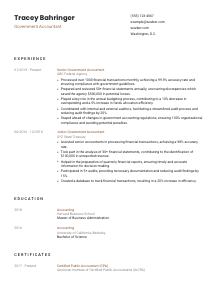
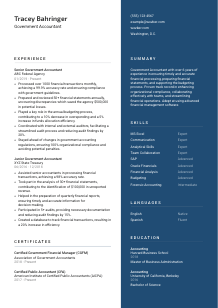
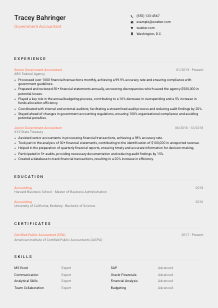
Balancing the nation's books, but your resume doesn't add up? Check out this Government Accountant resume example, built with Wozber free resume builder. It shows how to adapt your number-crunching skills to match public service priorities, helping your career and the country's finances both stay in the black!
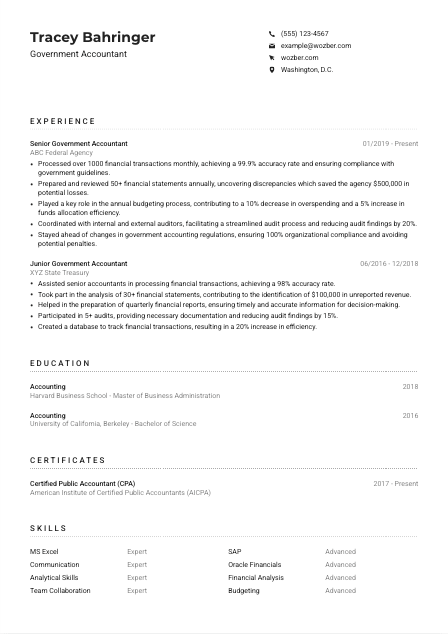
Government accounting resumes are reviewed through the lens of control, accuracy, and public accountability. Hiring teams want to see that you can keep transaction processing clean, produce reliable financial statements, support audits without scrambling for documentation, and work inside the rules that govern public funds. Your resume should make that operating discipline visible from the first section.
A tailored version changes how quickly your background reads against the job's actual accounting workload. When your resume uses the same language the employer uses for budgeting, financial reporting, audit support, and regulatory compliance, an ATS-compliant resume is far easier to match to the role. Wozber's free resume builder helps you align that wording cleanly and present it in an ATS-friendly resume format, so the hiring team can quickly see where your government finance experience maps to their reporting and control needs.
Government finance roles call for professionalism from the top of the page. Your personal details should be clean, formal, and easy to review, with no distractions that take attention away from your accounting background and compliance work.
Lead with your full name, then use the exact job title you are pursuing when it reflects your experience, such as "Government Accountant." This creates immediate alignment with the posting and helps frame the rest of the resume around public-sector accounting rather than general corporate finance.
Use a reliable phone number and a professional email based on your name. If you include a LinkedIn profile or professional website, make sure the content matches your resume, especially around accounting roles, certifications, reporting responsibilities, and software proficiency.
Some government roles include a location requirement, as this one does for Washington, D.C. If the employer specifies that you must be based in a certain city or region, list that clearly in your personal details so there is no question about your eligibility.
A LinkedIn profile can help if it reinforces your government accounting path, credential history, or agency experience. Keep titles, dates, and certifications consistent. If the profile is sparse or outdated, leave it off until it reflects the same level of accuracy as the resume.
Skip details such as age, marital status, photo, or other personal identifiers unless a specific jurisdiction explicitly requires them. Government accounting hiring should stay focused on qualifications like financial reporting, compliance knowledge, audit support, and budgeting experience.
Your header should answer the basic screening questions fast: who you are, how to reach you, whether your title aligns with the position, and, when relevant, whether you meet the location requirement. Keep it straightforward and professional, the same way your accounting work needs to be.




This section carries the most weight for a Government Accountant. Hiring teams look past job titles and focus on the work itself: transaction volume, statement preparation, audit coordination, budget participation, compliance results, and the systems you used to keep records accurate.
Before writing bullets, isolate the duties that define the role. Here, that means processing financial transactions accurately, maintaining accounting records under government guidelines, preparing and reviewing statements, supporting audits, contributing to budgeting, and staying current on regulations. Use those priorities to decide which experience bullets stay, which get rewritten, and which can be cut.
Use reverse chronological order and give each entry the essentials: job title, organization, and dates. For this field, titles such as "Senior Government Accountant" or agency-based finance roles immediately give context about level, reporting scope, and familiarity with public-sector standards.
Generic bullets like "responsible for accounting tasks" do not help much here. Write bullets that show the work and the result: transaction volumes processed, reports prepared, discrepancies identified, overspending reduced, audit findings lowered, or compliance maintained. The sample resume does this well by tying monthly transaction processing to a 99.9% accuracy rate and financial statement review to avoided losses.
Government accounting performance is often visible through accuracy rates, reporting volume, audit outcomes, budget variance, timeliness, recovered funds, and process efficiency. Numbers make your contribution concrete. If you improved close cycles, reduced reconciliation issues, or supported a cleaner audit, say by how much.
If you have both government and private-sector accounting experience, lead with the work that is closest to the role's environment and regulations. Federal, state, municipal, grant, fund, or agency accounting experience usually deserves more space because it speaks directly to compliance standards, public reporting expectations, and audit documentation workflows.
Your experience section should show that you can handle public funds with discipline, produce accurate reporting, and support accountability under scrutiny. When the bullets connect duties to measurable results, hiring teams can picture you stepping into the reporting cycle, budget process, and audit trail with very little guesswork.
For a Government Accountant, education is a qualification screen as much as a background detail. The degree field, institution, and any advanced study help confirm that you have the accounting base needed for regulated reporting, financial analysis, and government compliance work.
If the posting asks for a bachelor's degree in Accounting, Finance, or a related field, make that easy to see. Put the exact degree and field on the page. In this case, a Bachelor of Science in Accounting clearly meets the requirement, while a master's degree adds depth where the employer lists it as preferred.
List school, degree, field of study, and graduation year in a consistent format. This section does not need decoration. Clear structure helps both human reviewers and ATS systems confirm that you meet the education threshold without hunting for missing details.
If you have an MBA, MAcc, MPA, or another relevant graduate degree, include it prominently. For government accounting roles, advanced study can support your case for stronger analytical depth, budget planning exposure, or broader financial management capability, especially when the posting notes a master's degree as preferred.
Earlier-career candidates can include coursework, honors, or projects tied to governmental accounting, auditing, public budgeting, or financial reporting. If you already have several years of direct experience, keep this section lean and let your work history carry the heavier proof.
Honors, scholarships, or strong academic awards can help when they are relevant and recent. They are most useful when your resume needs one more credible marker of discipline and technical strength, not when they crowd out more important evidence from accounting roles or certifications.
This section should confirm that you meet the formal accounting requirement and, where relevant, that you bring additional academic depth. Keep it easy to scan, accurate, and proportional to your experience level.
Certifications carry real weight in government accounting because they point to technical standards, ethics, and continued professional development. When a posting mentions CPA or CGFM, those credentials deserve immediate visibility.
Place CPA, CGFM, or other directly relevant certifications first. For this role, those two designations align closely with the employer's preferences and speak to accounting rigor, financial management standards, and public-sector credibility.
Do not crowd this section with certificates that have little connection to accounting, auditing, reporting, or finance systems. A short list of highly relevant credentials is stronger than a long list that dilutes your specialization.
If the certification is current, show that clearly with an active date range or issue date. In regulated accounting environments, currency matters. It shows you are maintaining standards rather than relying on outdated knowledge.
If you have continuing education tied to GASB updates, governmental auditing, grant compliance, or public budgeting, include it when space allows. That kind of ongoing learning tells the employer you stay current as regulations and reporting expectations change.
Well-chosen certifications reinforce your technical standing quickly. In government accounting, they can strengthen your case for roles that involve complex reporting, audit coordination, and compliance-heavy financial oversight.
A Government Accountant skills section should read like a practical toolkit for reporting, controls, and analysis. It needs to show both the systems you can work in and the judgment you bring to regulated financial operations.
Start with the skills the employer named directly, then add closely related capabilities you genuinely use. For this role, that includes financial management software such as SAP or Oracle Financials, analytical ability, communication, collaboration, and English fluency. From there, add supporting strengths like budgeting, financial analysis, reconciliations, or audit support if they are backed by your experience.
Use the same software and skill language the employer uses when it is true to your work history. If you have used SAP, Oracle Financials, or similar ERP platforms in transaction processing and reporting, name them plainly. This improves ATS optimization and makes your fit easier to recognize without forcing awkward keyword stuffing.
Include both technical and working skills, but keep them tied to the job. For government accounting, technical tools and finance skills should lead, with communication and collaboration supporting them. The sample resume handles this well by pairing systems knowledge with financial analysis, budgeting, and team collaboration rather than listing broad traits with no accounting context.
By the time someone finishes this section, they should understand which systems you know, which accounting tasks you can handle, and whether you can work effectively in a finance team that deals with audits, reporting deadlines, and regulated procedures.
Language ability matters in accounting when reports, audit support, and stakeholder communication depend on precision. For government roles, clear English communication is often an explicit requirement because financial records, explanations, and compliance discussions leave little room for ambiguity.
When the posting specifically requires clear English communication, list English at the top with an honest proficiency level such as Native or Fluent. This addresses a stated requirement directly and supports your ability to prepare reports, explain discrepancies, and coordinate with auditors or budget teams.
Additional languages can be useful, especially in agencies or public-facing environments that serve diverse communities. Include them if they are real working skills, not resume decoration. They can strengthen your profile when stakeholder communication is part of the role.
Stick to standard labels such as Native, Fluent, Intermediate, or Basic. Those terms are easy to understand and set accurate expectations. Inflated claims can become a problem quickly when a role involves documentation review or live communication.
Not every Government Accountant job needs more than English, but some do benefit from broader communication ability across departments, agencies, or community contacts. If another language has helped you support reporting, collaboration, or service delivery, it is worth listing.
Languages are usually a supporting section in accounting resumes, not a headline feature. Include them cleanly and let them complement, rather than overshadow, your financial reporting, compliance, and systems experience.
Use this section to confirm you meet any stated English requirement and to show additional communication range where it is relevant. Keep the claims accurate and easy to scan, just like the rest of the resume.
The summary needs to do one job well: link your background to the accounting work the employer needs done. For Government Accountant roles, that usually means accuracy in financial processing, reliable reporting, budget support, audit coordination, and compliance with public-sector rules.
Identify the few responsibilities that define the role and build around those. In this posting, the strongest themes are transaction accuracy, financial statement review, budgeting, audit support, and staying current with government accounting regulations. Those themes should shape the opening lines of your summary.
Start with a direct line such as "Government Accountant with 6+ years of experience" if that reflects your background. This immediately places you in the right lane and helps the reviewer understand whether your level matches the scope of the role.
Choose strengths that connect to deliverables, not generic traits. Good examples include preparing financial statements, improving transaction accuracy, supporting annual budgets, coordinating audit documentation, or maintaining compliance with government regulations. The sample summary works because it stays close to those real responsibilities instead of leaning on vague claims.
Aim for three to five lines with specific language and no filler. This section should read like a compressed version of your most relevant qualifications, not a general career objective. If every sentence points back to public-sector accounting work, the summary is doing its job.
A good summary should make your government accounting focus obvious before the reader reaches the first job entry. When it names your experience level, reporting strengths, compliance background, and core systems or finance capabilities, the rest of the resume lands with more context.
A Government Accountant resume works when it shows disciplined financial processing, accurate reporting, audit support, budget involvement, and familiarity with the systems and regulations that shape public-sector accounting. Each section should reinforce those themes instead of drifting into generic accounting language.
Use Wozber's free resume builder and ATS resume scanner to align your wording with the posting, strengthen ATS optimization, and present everything in an ATS-friendly resume format that is easy to review. The final result should make one thing clear right away: you can step into a government accounting function and handle the numbers, controls, and compliance expectations responsibly.