



Use Wozber and land your dream job
Create Resume
No registration required
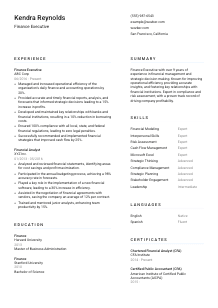
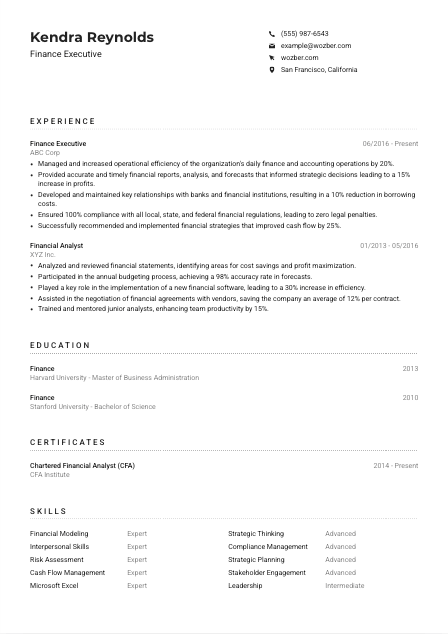
Navigating financial labyrinths, but your resume seems off-balance? Check out this Finance Executive resume example, created with Wozber free resume builder. It shows how to turn your fiscal acumen into an investment-worthy resume, guiding your career to its most lucrative destinations!
Finance Executive hiring usually turns on one question fast: can this person run the numbers and advise the business at the same time? Senior finance leaders are expected to keep reporting accurate, guide forecasting, protect compliance, manage banking relationships, and translate financial analysis into decisions a CEO or CFO can act on. Your resume needs to make that level of responsibility visible from the first few lines.
Screening gets easier when your resume clearly separates strategic finance leadership from narrower accounting or analyst work. Wozber's free resume builder helps you shape an ATS-compliant resume around the language employers use, so financial reporting, modeling, compliance oversight, and executive-facing recommendations are easy to identify. That clarity matters when a team is deciding whether you can own the finance function, not just support it.
For a Finance Executive, the header should read like a clean business introduction. Keep it direct, polished, and accurate so the hiring team can immediately place you at the right level of finance leadership without searching for basics.
Use your full name in the most prominent spot on the page. Choose a clean, readable style that fits an executive resume. Senior finance hiring often starts with quick scans, and a clear header helps the reader move straight into your reporting scope, leadership history, and financial results.
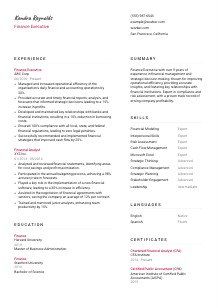
Place the role title directly under your name when it matches the position you are pursuing. Using "Finance Executive" here is helpful because it aligns your profile with the target opening right away and frames the rest of your resume around executive finance ownership rather than analyst-level support.
List a phone number you answer, an email address with a professional format, and any relevant professional link. Finance leadership roles involve communication with executives, auditors, banks, and board-level stakeholders, so even your contact details should reflect sound judgment and professionalism.
If a role specifies location or relocation, include that information in a straightforward way. In the example, San Francisco appears in the header, which immediately answers a stated requirement. Use this approach when geography affects hiring decisions, but keep it limited to the details section unless the job makes location central to the role.
Include LinkedIn or a personal professional site if it strengthens your candidacy. For a Finance Executive, that profile should reinforce the same career timeline, titles, certifications, and accomplishments shown on the resume. Consistency matters, especially when employers are reviewing senior leadership backgrounds carefully.
This section should confirm that you are organized, reachable, and aligned with the basic logistics of the role. Once that is clear, the reader can focus on the finance leadership, reporting ownership, and strategic judgment you bring.




This is the section most likely to decide whether you move forward. Finance Executive experience needs to show command of operations, forecasting, compliance, and decision support, with enough business context to prove you can influence profitability, liquidity, and financial discipline.
Read the job description as a list of what your experience must prove. If the role calls for overseeing finance and accounting operations, presenting reports to senior management, advising the CEO or CFO, and managing external financial relationships, your bullets should map to those functions directly. Use the employer's language where it reflects your real work, especially around forecasting, financial analysis, compliance, and executive recommendations.
List roles in reverse chronological order with title, company, and dates. For senior finance positions, that structure should also show increasing responsibility, such as moving from analysis and budgeting into ownership of reporting cycles, controls, cash flow, or leadership of the wider finance function. The example does this well by showing a progression from Financial Analyst to Finance Executive.
Your bullets should show what changed because of your work. Instead of repeating standard responsibilities like preparing reports or managing operations, describe the result: improved efficiency, better forecast accuracy, lower borrowing costs, stronger cash flow, or zero compliance penalties. A line such as improving finance and accounting operational efficiency by 20% works because it connects leadership to a measurable business gain.
Quantify achievements with metrics that matter in finance: profit growth, cost reduction, cash flow improvement, forecasting accuracy, audit outcomes, working capital improvements, or compliance performance. The sample resume uses figures like 15% profit growth, 25% stronger cash flow, and 10% lower borrowing costs. Those are strong because they reflect outcomes a Finance Executive would plausibly influence.
Prioritize accomplishments that show financial stewardship, strategic judgment, and stakeholder management. Team leadership, board-ready reporting, banking relationships, regulatory compliance, and major systems or process improvements usually deserve more space than routine transactional work. If you include earlier experience, frame it around the foundations that support executive finance leadership today.
A hiring team should be able to see that you have done more than close books or build spreadsheets. Your experience should show that you can run finance operations, produce reliable insight, and influence senior decisions with numbers that hold up under scrutiny.
Education matters in finance because it establishes technical grounding in accounting, corporate finance, and analytical decision-making. For a Finance Executive, it usually works as supporting proof behind a much larger story of leadership, reporting ownership, and strategic financial management.
If the posting asks for a bachelor's degree in Finance, Accounting, or a related field, make sure that qualification is easy to find. List the degree, field, school, and graduation year clearly. In the example, the Bachelor of Science in Finance directly satisfies the baseline requirement.
A master's degree is often preferred for finance leadership roles because it signals broader business training and stronger strategic exposure. If you hold an MBA, master's in finance, or similar credential, place it prominently. The example's MBA in Finance supports the executive scope of the target role without needing extra explanation.
Use a clean structure for each entry so the section is easy to scan. Degree, field, institution, and year are usually enough. At this career stage, the value is in relevance and credibility, not long academic descriptions.
If you completed coursework or academic projects in financial modeling, valuation, strategic finance, risk management, or accounting controls, include them only when they add something useful to your overall profile. This is most helpful when the role emphasizes modeling depth or when your experience needs extra support in a specific area.
For candidates with 8+ years in finance leadership, education should support the narrative rather than dominate it. You can include honors or notable academic leadership if they are impressive and relevant, but your reporting impact, strategic recommendations, and operational oversight should still carry more weight overall.
Your education section should confirm that you have the financial foundation expected for senior leadership. Once that is established, the rest of the resume should carry the heavier proof through operating results, executive partnership, and financial judgment.
Well-chosen certifications can sharpen your positioning fast in finance hiring. They signal technical depth, current standards knowledge, and professional commitment in areas that matter for reporting quality, analysis, and financial oversight.
When a posting specifically mentions certifications such as CFA or CPA, move those credentials into clear view. They are especially valuable in senior finance roles because they reinforce technical authority in analysis, accounting standards, valuation, controls, and financial decision-making.
Prioritize credentials that support the work you want to do. For a Finance Executive, CFA and CPA are both highly relevant because they connect to strategic analysis, reporting integrity, and executive credibility. The example benefits from listing both, but most candidates only need to feature the certifications that genuinely strengthen their profile.
Use certification dates when they show active status, recent completion, or continued relevance. In regulated and standards-driven finance environments, current credentials reassure employers that your knowledge is up to date and professionally maintained.
If you have continuing education tied to financial regulation, advanced modeling, treasury, or risk, include it only when it adds real value. The certifications section works best when it stays focused on credentials that matter to the finance leadership scope of the role.
Certifications should deepen the hiring team's confidence in your technical finance background. They work best when they clearly support the strategic and operational responsibilities described in your experience.
A Finance Executive skills section should feel selective, not crowded. The best version highlights the tools and capabilities that support forecasting, executive reporting, financial control, compliance, and sound commercial judgment.
Start with the skills the employer names or strongly implies. In this case, financial modeling, analytical thinking, strategic thinking, communication, leadership, and interpersonal effectiveness all belong near the top because they connect directly to forecasting, recommendations, and cross-functional finance leadership.
Lead with capabilities tied to business outcomes, such as financial modeling, cash flow management, compliance management, risk assessment, strategic planning, and stakeholder engagement. The sample skill list does this well because it centers finance-relevant competencies before more general traits.
Senior finance work depends on both technical precision and influence. A hiring team wants to see that you can model scenarios, review reports, and manage compliance, while also communicating with executives, auditors, lenders, and internal teams. Include both sides, but keep each skill grounded in the actual work of the role.
Your skills section should quickly confirm that you can handle the analytical, operational, and interpersonal demands of senior finance leadership. If a skill does not support that picture, it probably does not need space.
Language requirements matter when the role involves executive communication, lender discussions, audit coordination, or work across international teams. In finance, clarity matters more than flair, so present language ability in a simple and credible way.
If fluent English is required, list it clearly and use an honest proficiency label such as "Native" or "Fluent." That gives the employer a direct answer on a stated requirement and supports the communication demands of reporting, forecasting discussions, and senior management presentations.
Additional languages can strengthen your profile when the company works with international stakeholders, regional operations, or multilingual teams. They are not always essential for a Finance Executive, but they can add value in banking relationships, cross-border reporting environments, or investor-facing contexts.
Stick to clear terms such as "Native," "Fluent," "Intermediate," or "Basic." Hiring teams do not need vague claims here. They need a realistic sense of how confidently you can communicate in business settings.
Only include languages you can genuinely use in professional situations. In finance, that may mean discussing performance, reviewing documents, or handling stakeholder conversations with precision. Keep the section concise and believable.
If another language strengthens your candidacy, let it support a relevant business narrative. The example includes Spanish alongside native English, which can be useful in diverse markets or stakeholder environments. Use that kind of addition when it complements your finance leadership profile rather than distracts from it.
For most Finance Executive resumes, the language section is brief but purposeful. It should confirm required fluency and, where relevant, add one more practical detail about how you operate across stakeholders and markets.
The summary should position you as a finance leader before the reader reaches the first job entry. It needs to capture your seniority, your operating scope, and the kind of financial outcomes you have delivered, using language that fits the target role closely.
Start by identifying the few themes that define the target position. For this kind of Finance Executive role, those themes include financial management, reporting and forecasting, strategic recommendations, compliance oversight, and relationship management with banks or auditors. Your summary should reflect that level of responsibility in a compact form.
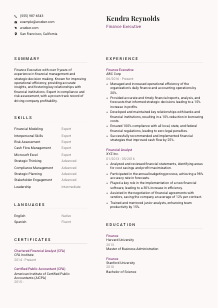
Lead with a direct statement of who you are and how long you have worked in relevant finance roles. "Finance Executive with over 9 years of experience in financial management and strategic decision making" works because it establishes seniority and function in one line.
Choose the strengths most relevant to the role rather than trying to cover everything. In this case, financial analysis, forecasting, compliance management, operational efficiency, and executive-level recommendations are stronger summary material than generic statements about being hardworking or detail-oriented. The example summary succeeds because it stays close to business outcomes and finance leadership work.
Aim for three to five lines that can be understood in seconds. For senior finance hiring, a dense, well-targeted summary is more effective than a long paragraph. Every phrase should either establish scope, highlight a finance specialty, or point to measurable business contribution.
A well-written summary should leave no doubt that you belong in senior finance conversations. When it is aligned with the role, the rest of the resume reads as proof of a leadership profile that can manage the numbers and shape the decision behind them.
A Finance Executive resume should show clear control over reporting, forecasting, compliance, and strategic financial decision-making. When those threads are consistent across your summary, experience, skills, and credentials, the hiring team can quickly see the level at which you operate.
Use Wozber's free resume builder to organize that story in an ATS-friendly resume format, refine role-specific language, and strengthen ATS optimization where needed. The final result should make one thing easy to judge: you can lead finance operations and provide the analysis senior leadership relies on.