



Use Wozber and land your dream job
Create Resume
No registration required
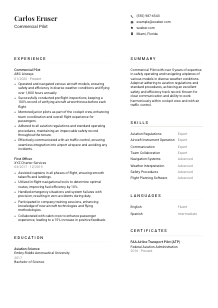
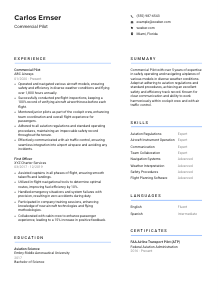
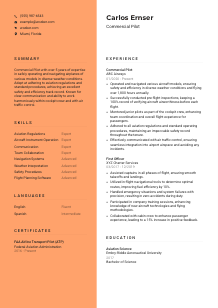
Navigating the skies, but your resume feels grounded? Take off with this Commercial Pilot resume example, created with Wozber free resume builder. It shows how to match your aviation expertise with job guidelines, keeping your career trajectory as smooth as a well-timed ascent!
Commercial pilot hiring starts with trust. Before anyone looks at career ambition or personality, they want to see whether you have handled real flight operations safely, followed standard operating procedures without drift, and communicated clearly when conditions change. Your resume needs to show disciplined execution in the air, not just a list of aircraft, hours, and employers.
A tailored resume changes how quickly that judgment can happen. When your flight time, ATP status, aircraft experience, safety record, and crew communication are easy to find, hiring teams can separate line-ready pilots from applicants with adjacent aviation backgrounds. Wozber's free resume builder helps you shape that information into an ATS-compliant resume with the right aviation wording, so your document reads clearly to both screening systems and chief pilots reviewing operational readiness.
This section does quiet but important work in aviation hiring. It confirms who you are, how to reach you, and whether you meet immediate practical requirements before anyone reviews your flight history in detail. Keep it clean, professional, and aligned with the posting.
Use your full name in the most prominent text on the page. Avoid nicknames or decorative formatting. In a field where licenses, medicals, and flight records need to match exactly, consistency matters.
Place "Commercial Pilot" beneath your name so the role is obvious at first glance. If your current position is First Officer or Captain, you can still use the target title here when you are applying for a commercial pilot opening, as long as the rest of the resume supports it with relevant flight experience.
List one phone number you answer reliably and a professional email address. Aviation hiring often moves through calls for interviews, simulator evaluations, or document follow-ups, so remove anything casual or hard to read.
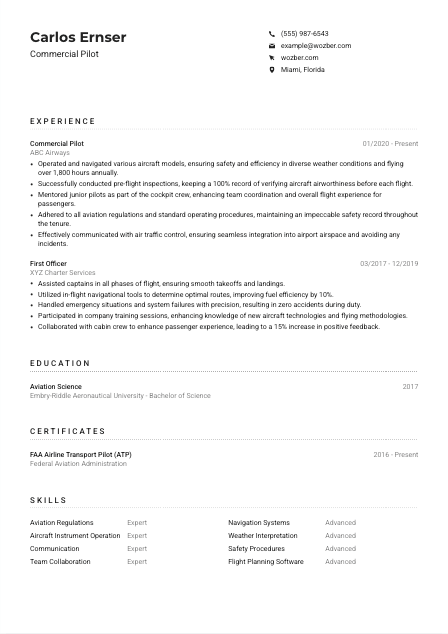
If a role requires local presence or relocation, state your city and state clearly. For the example posting, showing Miami, Florida directly in the header answers a stated requirement early and avoids unnecessary doubt about availability.
A LinkedIn profile or personal aviation website can help if it supports the application with current experience, aircraft types, training history, or certifications. Only include it when the information is polished and matches the resume exactly.
Your personal details should confirm identity, contact access, and any location requirement without distracting from the flight qualifications that follow. In aviation, clarity here helps the review move quickly to the parts that matter most.




This is the section most hiring teams study first. They are looking past job titles to understand aircraft exposure, total time, safety discipline, crew coordination, and how you performed across normal operations and irregular situations. Write your experience like a professional flight record translated into business language.
Read the job description for the specific work patterns the employer cares about. In this case, that includes safe operation in all weather conditions, pre-flight airworthiness checks, SOP compliance, instrument proficiency, and communication with air traffic control and cabin crew. Those themes should appear in your bullets through concrete examples, not general claims.
For each position, include employer, title, and dates in reverse chronological order. Start with your most recent flying role and prioritize positions that show line operations, multi-engine exposure, cockpit crew work, or direct responsibility during takeoff, en route navigation, approach, and landing.
Bullet points should show what you handled and what result followed. The sample resume does this well with lines such as operating various aircraft models in diverse weather conditions and maintaining a 100% record on pre-flight airworthiness verification. That kind of wording shows safety discipline and operational consistency, which matter far more than vague statements like "responsible for flights."
Use numbers that are native to aviation work. Total flight hours, annual hours, fuel efficiency gains, incident-free records, training participation, or passenger feedback can all strengthen your case when they are accurate. The example's 1,800 hours annually and 10% fuel-efficiency improvement give the reader real operating scale and performance impact.
Trim achievements that do not help explain your cockpit judgment, aircraft handling, procedural discipline, or crew coordination. If you include an earlier role such as First Officer, focus the bullets on phases of flight, navigation support, emergency response, and coordination with captains and cabin crew rather than unrelated duties.
By the end of this section, a hiring team should understand your flight environment, your decision-making discipline, and the scale of operations you have handled. Make it easy for them to see that your experience translates directly into safe, reliable line performance.
Education usually does not outweigh flight time and certification for a commercial pilot, but it still adds useful context. It shows formal training, technical grounding, and in some cases a long-term commitment to aviation that complements your operational record.
Some pilot postings focus almost entirely on hours, aircraft qualifications, and certifications. Even when a degree is not required, aviation-related study can still strengthen your profile by showing structured training in aerodynamics, navigation, meteorology, and flight operations.
List the degree, field of study, school, and graduation year or date. Use a format that can be scanned quickly, especially if the reader is moving through many applicants and mainly wants to confirm your academic background before returning to flight credentials.
If your degree is directly relevant, make that connection easy to see. A Bachelor of Science in Aviation Science, like the one in the example, immediately reinforces technical preparation for flight operations without needing extra explanation.
You do not need to turn this into a second certifications section, but relevant coursework or training can help early-career pilots. Subjects such as instrument procedures, aviation safety, weather systems, or navigation can add context when your flying experience is still growing.
Academic distinctions, flight team participation, or aviation clubs can help if they reflect discipline and industry engagement. For experienced pilots, keep these details brief unless they clearly add something not already shown through hours, ratings, or line experience.
Present your academic background as supporting context for your operational work. Once it is clear and relevant, let the resume return focus to the areas aviation employers weigh most heavily: hours, certifications, aircraft experience, and safety performance.
For commercial pilot hiring, certifications are not a nice extra. They are a gate. If a required license or rating is missing, buried, or unclear, the application often stops there no matter how impressive the rest of the resume looks.
When a job specifically asks for an FAA Airline Transport Pilot certificate, make sure it appears clearly in the certifications section and, if helpful, is also reflected in your summary. The example does this by naming the FAA Airline Transport Pilot "ATP" certificate directly, which removes ambiguity fast.
List certifications and ratings that matter to the aircraft, operation, or regulatory environment of the role. Keep the focus on credentials tied to commercial flight duties rather than padding the section with unrelated training records.
Show issue dates and, when relevant, validity or renewal information. Aviation employers need to know whether credentials are current, especially for regulated roles where an expired certificate or unclear status creates immediate concern.
Professional development matters in aviation because procedures, systems, and safety expectations evolve. If you regularly complete recurrent training, check rides, or updated procedural courses, reflect that ongoing commitment through current certifications and recent dates.
This section should leave no doubt that you meet the licensing standard for the job. Clear, current credentials tell the employer they are reviewing a pilot who can step into a regulated operating environment without avoidable paperwork concerns.
A commercial pilot skills section should look grounded in actual flight operations. That means balancing technical capability with crew communication, procedural discipline, and situational judgment. Keep the list tight and specific enough to reflect how the work is really done.
Start with the capabilities named in the posting, then match them only if they reflect your real experience. Here, the role calls out aviation regulations, navigation and weather systems, aircraft instruments, English proficiency, and collaboration with air traffic control and crew. Those are stronger resume skills than generic terms such as "hardworking" or "problem solver."
Commercial pilots are evaluated on both aircraft handling and communication under procedure. A good mix might include aircraft instrument operation, weather interpretation, navigation systems, safety procedures, communication, and team collaboration. The sample skills list follows that pattern well and stays close to the actual job language.
Group the most relevant skills near the top and avoid long catalogs of loosely related tools. If you mention software, use categories that fit aviation work, such as flight planning software, only when they support the operational profile you are presenting.
When this list is done well, the reader can quickly picture the kind of cockpit contributor you are: technically reliable, procedure-driven, and clear in communication when coordination matters most.
Language matters differently in aviation than it does in many other jobs. Clear communication affects coordination, safety, and compliance, especially when speaking with air traffic control, crew, and passengers in time-sensitive conditions. Treat this section as operational information, not filler.
If the posting requires high proficiency in English, list English first and state your level clearly. For this role, that is a direct requirement, so it should never be hidden below secondary languages.
Additional languages can strengthen your profile when they are relevant to passenger service, international routes, or multilingual crew environments. Spanish, for example, can be useful in some markets, but it should remain secondary to the required English proficiency unless the posting says otherwise.
Choose standard descriptors such as Fluent, Native, Professional, or Intermediate. Avoid vague wording that leaves the reader guessing how well you can actually communicate in operational or customer-facing situations.
Extra languages are most helpful when they support real communication needs, not just resume decoration. In pilot hiring, that can mean smoother interaction in international operations, better passenger communication, or added flexibility across route networks.
A concise language section helps the employer confirm that you can communicate to the standard the operation requires. For aviation roles, that is a practical qualification, not a side note.
Your summary sits at the top of the resume, where it can quickly frame how the rest of your experience should be read. For a commercial pilot, that means leading with flight credentials, operating scope, safety mindset, and the kinds of conditions or responsibilities you are already trusted to handle.
Before writing, identify the few qualifications the employer is most likely to screen for first. In this case, that includes commercial flight experience, ATP certification, safety in varied weather conditions, instrument and navigation proficiency, and strong communication with crew and ATC. Use those themes to shape the opening, rather than writing a generic career statement.
Start with who you are and the level at which you operate. The example summary begins with "Commercial Pilot with over 5 years of expertise," which works because it immediately establishes role identity and experience depth. You can also reference total hours or aircraft environment if those details strengthen the match.
Use the next lines to highlight the strengths most relevant to the job. Good options include safety record, SOP adherence, weather and navigation competence, crew coordination, or communication with air traffic control. The sample summary succeeds because it stays close to those operational realities instead of drifting into broad personality language.
Aim for three to five lines. That is enough space to establish your flight profile, one or two high-value strengths, and the type of operation you are prepared for. If a detail can be shown more precisely in experience or certifications, save it for there and keep the summary moving.
A well-written summary helps the reader understand your flight background before they reach the detailed sections. By the time they move on, they should already know your operating level, your safety orientation, and the kind of commercial pilot role you are prepared to step into.
A commercial pilot resume should make a hiring team confident in three things quickly: you meet the licensing threshold, you have relevant flight experience, and you operate with the discipline the role demands. When those points are clear, the rest of your background has room to strengthen the case instead of fixing confusion.
Use Wozber's free resume builder to organize your experience in an ATS-friendly resume format, then refine the wording with Wozber's ATS resume scanner and AI resume builder features so flight hours, certifications, crew communication, and operational strengths align with the posting. The final resume should make your readiness for safe, professional commercial flying easy to judge.




