



Use Wozber and land your dream job
Create Resume
No registration required
Taking off into the skies, but your resume feels grounded? Explore this Cabin Crew resume example, created with Wozber free resume builder. Learn how to match your customer service prowess and safety focus to job expectations, so your career trajectory always stays at cruising altitude!
Cabin crew work is judged in real time. You are expected to stay calm during boarding pressure, handle passenger concerns with tact, and switch instantly into safety mode when procedures demand it. A resume for this field needs to make that mix visible early, showing that you can protect passengers, support the operation, and deliver polished service in a confined, fast-moving environment.
That becomes much easier when your resume mirrors the language of the target airline and keeps those qualifications easy to parse in an ATS. Wozber's free resume builder helps organize your background into an ATS-friendly resume format while keeping role-specific details such as safety training, customer-facing experience, and language ability clear enough for a recruiter to quickly see how you would perform on board.
Airlines usually review personal details for practical reasons first. Can they contact you quickly, does your headline match the role, and do you meet any stated work authorization or location requirements? Keep this section clean and job-aligned so the recruiter can move straight to your service and safety background.
Place your name prominently at the top of the resume in a clear, readable font. Cabin crew hiring often moves through high application volume, so your header should be simple and professional, not decorative or crowded.
Add "Cabin Crew" directly beneath your name when that is the target title. Matching the posting language helps with ATS sorting and immediately tells the reader that your background is relevant to inflight service rather than general hospitality or travel support.
Recruiters need fast, error-free ways to reach you for interviews, assessment days, or document follow-ups. Use contact information you check regularly and keep the format professional.
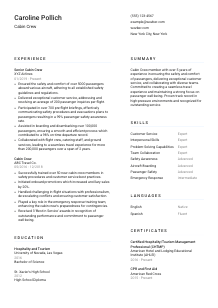
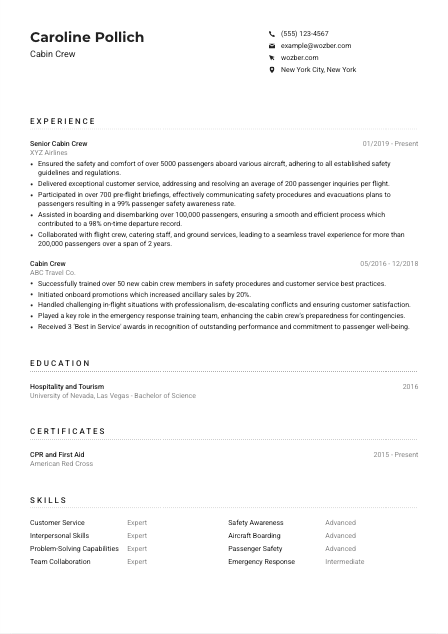
If an airline asks for candidates in a specific city or region, list that location clearly. In the provided example, "New York City, New York" directly supports a stated requirement and removes avoidable questions about availability or relocation.
Include LinkedIn or a professional website only if it supports your application with consistent role history, hospitality credentials, language background, or service awards. Any link you include should strengthen your cabin crew profile, not send the recruiter to unfinished or unrelated content.
Do not add age, marital status, or other personal details that are unrelated to onboard performance. Airlines need to see your qualifications, communication readiness, and eligibility, not background information that does nothing for your application.
This section should answer the operational basics in seconds. When your title, contact details, and any location requirement are easy to confirm, the recruiter can focus on what matters most for cabin crew hiring: safety judgment, passenger care, and teamwork under pressure.




Cabin crew experience should read like proof of performance in a live service environment. Hiring teams look for signs that you can manage safety procedures, maintain passenger comfort, coordinate with crew, and stay composed when flights get busy or unpredictable. Your bullets should connect past work to those realities.
Start by pulling forward the parts of your work history that align most closely with cabin crew priorities. Passenger safety, inflight service, boarding support, conflict handling, and coordination with pilots or ground teams should appear before less relevant hospitality tasks.
List positions in reverse chronological order so your most recent operational experience appears first. For each role, make the basics easy to scan before the achievements begin.
Numbers matter in aviation because they give scale to your work. If you supported thousands of passengers, improved on-time boarding, handled high inquiry volume, or trained new crew members, say so. The sample resume does this well by tying duties to outcomes like passenger counts, briefing frequency, and a 98% on-time departure record.
Read the posting closely and tune your bullets to its core responsibilities. If the airline emphasizes pre-flight briefings, evacuation procedures, passenger inquiries, or collaboration with catering and ground services, use those exact work areas where they reflect your real experience. For example, a bullet about participating in 700+ pre-flight briefings says far more than a generic line about "supporting operations."
Cabin crew are hired as part of an operation, not as standalone service staff. Mention how you coordinated with flight deck crew, fellow attendants, gate teams, or catering to keep service smooth and maintain safety compliance. Leadership also counts here. Training new crew, de-escalating incidents, or supporting emergency response drills all show trust and maturity on board.
A strong experience section shows more than time in a customer-facing role. It should tell the airline that you can handle passengers, procedures, and crew coordination at working-flight pace, with results that hold up under pressure.
Education is rarely the most important section for experienced cabin crew, but it still helps establish baseline qualifications and industry relevance. Use it to confirm required schooling and to highlight any hospitality, tourism, or service-focused study that supports passenger care and travel operations.
Make sure the minimum academic requirement from the posting is easy to find. For this role, that means showing a high school diploma or equivalent, then adding post-secondary education if you have it.
List your education in a simple, consistent format. Cabin crew recruiters do not need long academic descriptions. They need a quick read on your qualifications and whether your background adds useful service context.
If you studied hospitality, tourism, aviation, communication, or customer experience, include that field clearly because it connects naturally to onboard service. In the example, a Bachelor of Science in Hospitality and Tourism strengthens the candidate's profile beyond the minimum school requirement.
Short courses in service standards, travel operations, emergency preparedness, or guest relations can add value when they are directly relevant. If they are formal certifications, you may reference them here or in the certifications section, depending on your resume format.
Honors, projects, or extracurriculars are worth listing when they reinforce communication, leadership, multicultural teamwork, or service excellence. If they do not connect to cabin crew work, keep the section lean and let your experience carry more weight.
For cabin crew hiring, education works best when it quickly confirms required schooling and adds relevant hospitality or tourism context. Keep it concise, credible, and clearly tied to passenger-facing work.
Certifications carry real weight in cabin crew hiring because they speak directly to passenger safety and operational preparedness. This is the place to show that you can respond to medical issues, follow procedures, and maintain training that matters in an aircraft environment.
List any mandatory or strongly preferred certifications before optional ones. In this posting, CPR and First Aid are central because they relate directly to onboard emergency response and passenger care.
Choose certifications that support airline work, hospitality service, or regulated safety responsibilities. A short list of strong, current credentials is more persuasive than a crowded section filled with unrelated training.
Include the certifying body and dates so the recruiter can tell whether the credential is current. This is especially important for CPR and First Aid, where renewal status can affect how immediately job-ready you appear.
If you have continued training in hospitality, tourism, emergency response, or service leadership, include it to show commitment to the field. In the example, the CPR and First Aid credential is paired with a hospitality certification, which broadens the candidate's profile without distracting from the safety requirement.
The best certifications section tells an airline that your training is useful on day one. Lead with current safety credentials, support them with relevant service or tourism training, and update renewal dates consistently.
The skills section should reflect how cabin crew actually work. That means balancing passenger-facing strengths with safety awareness, teamwork, and calm decision-making in a time-sensitive setting. Keep the language close to the posting and close to your real track record.
Use the job description to identify the capabilities the airline cares about most. Here, customer service, interpersonal skills, problem-solving, teamwork, and safety awareness all deserve space because they sit at the center of everyday cabin operations.
Do not make the section read like a generic hospitality resume. Include soft skills such as empathy and communication, but also mention role-linked strengths like emergency response, boarding coordination, passenger safety, conflict de-escalation, and crew collaboration where you can genuinely support them with experience.
Choose skills you can back up with examples from your work history. The sample resume uses a sensible mix, pairing customer service and interpersonal skills with aircraft boarding and emergency response. That combination works because it reflects actual cabin crew duties instead of broad personality traits.
A useful skills section should sound like someone who has worked flights, not just served customers. Prioritize abilities that connect directly to passenger safety, inflight service, and coordinated crew execution.
Language ability matters in cabin crew work because misunderstandings can affect both service quality and safety communication. If you speak more than one language, present it clearly and realistically so the airline can judge where it would help on board.
If the posting names a language requirement, list it first and use an honest proficiency level. For this role, English fluency is essential because safety announcements, crew communication, and passenger assistance depend on it.
A second language can strengthen your application, especially for airlines serving international or multilingual passenger groups. In the example, Spanish adds practical value because it expands the candidate's ability to assist passengers in common service situations.
Avoid vague descriptions such as "good" or "working knowledge." Standard proficiency terms help recruiters understand how confidently you can communicate with passengers and colleagues.
Where relevant, show the practical value of your language ability. Multilingual crew can reduce confusion during boarding, answer questions more efficiently, and help passengers feel more at ease during delays or irregular operations.
Cultural fluency can support service quality, especially on diverse routes, but keep it grounded. Mention it when you can tie it to real experience serving varied passenger groups or working in international travel settings.
For cabin crew, languages are useful when they improve communication in live passenger situations. Present them honestly, label them clearly, and let the recruiter see where they would make service and safety communication stronger.
Your summary should quickly explain what kind of cabin crew professional you are. In a few lines, it needs to establish your experience level, your strongest operational strengths, and the kind of onboard environment you are prepared to handle.
Pull in the themes that appear most often in the posting. For cabin crew, that usually means passenger safety, customer service, teamwork, and the ability to respond well under pressure.
Start with a direct description of who you are professionally. A line such as "Cabin Crew member with 5+ years of experience" works because it gives immediate context and helps recruiters place your background fast.
Use the next sentence or two to connect your experience to the work that matters most. The example summary does this effectively by pairing passenger safety, customer service, and collaboration with performance in high-pressure environments. If you have standout strengths such as multilingual service, medical response training, or crew mentoring, add them here when relevant.
Aim for a short paragraph that sounds like a professional introduction, not a list of claims. Every phrase should point toward real cabin crew work, using wording you can support elsewhere in the resume.
A well-written summary should quickly tell the reader whether you can handle the pace, service standard, and safety responsibility of cabin crew work. Keep it concise, role-specific, and closely aligned with the airline's priorities.
You now have the structure to build a cabin crew resume that speaks to the realities of the job: passenger safety, calm service under pressure, and smooth coordination with the rest of the flight operation. Use each section to show how your background supports those responsibilities in measurable, credible terms.
As you tailor for a specific airline, refine the wording with Wozber's AI resume builder and check ATS optimization so your safety training, customer service experience, language ability, and operational strengths are easy to read in both human review and ATS screening. The final resume should make one thing clear right away: you are ready to contribute on board.




