



Use Wozber and land your dream job
Create Resume
No registration required
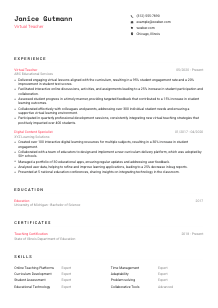
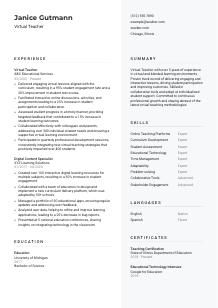
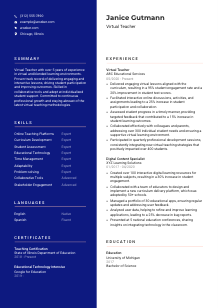
Mastering the e-learning realm, but your resume feels offline? Check out this Virtual Teacher resume example, created with Wozber free resume builder. It shows how to match your remote instructional prowess with job requirements, so your teaching career clicks as seamlessly as a Zoom breakout room!
Virtual teaching is judged in practice by what happens on the screen and after the lesson ends. Schools want teachers who can keep students engaged remotely, run structured online activities, track progress accurately, and respond to individual learning needs without losing momentum across the class. Your resume needs to make that day-to-day teaching range visible, not just state that you are comfortable with online learning.
When a resume is tailored for virtual instruction, the first pass becomes much more concrete. Wozber's free resume builder helps you line up your language with the posting, support ATS optimization, and present online teaching experience in a format that makes lesson delivery, student engagement, and progress tracking easy to recognize at a glance.
For a Virtual Teacher, the top of the resume should answer a few practical questions immediately. Can the school contact you easily, do you present yourself professionally in a digital setting, and do you meet any stated location requirement? Keep this section clean and factual so the reader can move straight to your teaching background.
Use your full name as the clearest identifier on the document, set in a readable size that stands out from the rest of the text. Virtual teaching roles still begin with a human introduction, and a cluttered header can undermine an otherwise polished application.
Place "Virtual Teacher" directly under your name if that matches the role you are pursuing. This helps frame the rest of the resume around online instruction, digital classroom management, and remote student support from the first line.
Include a current phone number and a professional email address you check regularly. For teaching roles, responsiveness matters because interview scheduling often moves through email quickly, and schools expect clear communication from the start.
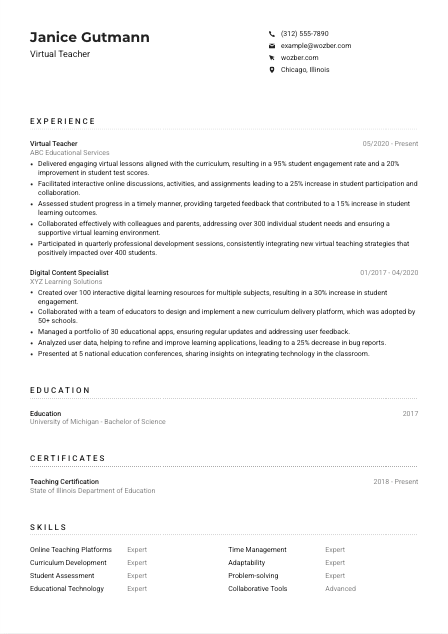
If the employer specifies a location, list your city and state plainly. In this example, Chicago, Illinois should appear because the posting requires candidates to be based there. That small detail can remove an avoidable screening question before your teaching experience is even reviewed.
A LinkedIn profile, teaching portfolio, or personal site can help if it includes material relevant to virtual instruction, such as digital lesson samples, learning resources, or professional development in edtech. Only include it if the content is current and consistent with the resume.
This section does not need personality statements or extra decoration. It should confirm that you are reachable, professionally presented, and aligned with any stated logistics so the focus can stay on your virtual teaching record.




This is the section most likely to decide whether your resume moves forward. Schools hiring virtual teachers look for signs that you can deliver instruction remotely, sustain participation, assess learning consistently, and work with families and colleagues when students need support. Show how your teaching translated into outcomes, not just duties.
Read the job description like a teaching brief. Note the recurring work: delivering virtual lessons, facilitating discussions and assignments, monitoring student progress, providing timely feedback, and collaborating with parents and staff. Those points should shape the order and wording of your experience bullets.
List positions in reverse chronological order and give the most space to experience that reflects virtual or blended learning. If you have been a Virtual Teacher, that role should carry the strongest detail. In the example resume, the current teaching role naturally takes priority because it maps directly to lesson delivery, engagement, assessment, and student support.
Replace broad phrases like "responsible for online classes" with statements that show what you taught, how you taught it, and what improved. Strong bullets mention curriculum alignment, online discussions, assignment design, intervention work, or family communication. The sample does this well by tying virtual lessons to a 95% engagement rate and stronger test performance.
Metrics are especially useful when they reflect real teaching outcomes. Participation rate, assessment growth, test score improvement, student caseload, feedback turnaround, or number of students supported can all help. The example resume includes gains in participation, learning outcomes, and the scale of student needs addressed, which gives hiring teams a clearer view of classroom impact.
Not every prior role needs equal weight. Experience in curriculum design, digital content creation, learning platforms, or educational technology can strengthen your case when it shows skills you now use in virtual teaching. The Digital Content Specialist role in the sample works because it reinforces platform fluency, interactive resource development, and collaboration in education settings.
Your experience section should show that you can run a virtual classroom, measure learning, and adapt support for individual students. If those outcomes are clear in the first few bullets, the rest of the resume has a much stronger foundation.
For teaching roles, education is rarely a background detail. It confirms subject preparation and often clears an early requirement check before a school spends time on the rest of the application. Present it clearly, especially when the posting asks for a Bachelor's degree in Education or a related field.
List the degree that satisfies the role's baseline requirement first, including the field of study. For a Virtual Teacher opening that asks for a Bachelor's degree in Education or a related area, a direct entry such as "Bachelor of Science, Education" immediately answers that question.
Include the institution, degree, field, and graduation year in a clean structure. Hiring teams reviewing many resumes do not need extra wording here. They need to confirm credentials quickly and move on to your teaching history.
If your degree closely matches the posting, do not bury that match. In the example, the University of Michigan degree in Education lines up cleanly with the requirement, so it should remain simple and prominent rather than overexplained.
Coursework can be useful if you are early in your teaching career, changing subject areas, or trying to support limited classroom experience. Include classes tied to instructional design, assessment, child development, literacy, subject pedagogy, or educational technology only if they add something your experience section cannot yet show.
Honors, student teaching highlights, research, or education-focused projects can add value when they connect to instruction, curriculum, or learning technology. Keep these selective and role-related so they reinforce your readiness rather than turning the section into a full academic profile.
A school should be able to confirm your academic preparation in seconds. Once that is clear, your experience and certifications can do the heavier work of proving virtual teaching capability.
Certifications matter in education because they are not optional polish. They often determine whether you are eligible to teach a grade level, subject, or state curriculum at all. For virtual teaching roles, they can also show that you have kept pace with digital instruction methods and classroom technology.
Place your teaching certification or license first when the posting requires it. Include the issuing body and, if relevant, the active date range. In this case, an Illinois teaching certification deserves top placement because it addresses a stated requirement directly.
After the core license, include certifications that support virtual classroom work, such as educational technology training, LMS coursework, online pedagogy, accessibility training, or assessment tools. The example's "Educational Technology Intensive" is useful because it reinforces platform fluency and digital teaching practice.
Dates help the reader understand whether a license is active and whether training is recent. This matters in education, where compliance and up-to-date teaching methods both carry weight.
Professional development is part of the job in many online teaching environments. Continue adding certifications that reflect current practice, such as remote engagement strategies, differentiated instruction online, or student data tools. That ongoing learning can support the responsibility for participating in training and improving virtual teaching methods.
This section should quickly answer two questions: are you licensed to teach, and have you developed skills that fit online instruction? If both are clear, your application looks far more complete.
A Virtual Teacher's skills section should reflect what you actually use to run instruction and support learning online. That includes classroom technology, lesson delivery, assessment, communication, and the practical habits that keep remote teaching organized. Generic skill lists waste space. Target the tools and capabilities that show up in the role.
Pull both explicit and implied skills from the job description. Here, that includes online teaching platforms, collaborative tools, communication, assessment, record-keeping, student engagement, and parent collaboration. Those are stronger anchors than broad terms with no classroom context.
Lead with capabilities that affect learning delivery and student progress, such as online teaching platforms, curriculum development, student assessment, educational technology, and collaborative tools. The sample resume also includes time management and adaptability, which make sense because virtual teaching depends on pacing, responsiveness, and smooth transitions between live instruction and follow-up work.
Use a simple list that can be read quickly by both recruiters and school administrators. Grouping hard skills with a few well-chosen professional strengths works well, but every entry should support actual teaching work. If a skill does not help you teach, assess, communicate, or manage the virtual classroom, leave it out.
A hiring team should be able to connect your skills directly to online lessons, student feedback, collaboration with families, and daily platform use. That kind of specificity makes the section far more useful than a long generic list.
Language proficiency can matter more in virtual teaching than candidates sometimes realize. Online instruction depends heavily on written directions, live explanation, feedback comments, and communication with parents or guardians. If the posting mentions English proficiency, treat that as an operational requirement, not a minor note.
Some schools call this out directly, especially when the job includes English-language instruction, written feedback, or parent communication. In this posting, the ability to handle English language tasks efficiently should be reflected clearly on the resume.
List English prominently and use an accurate proficiency label such as "Native" or "Fluent." That helps the school confirm you can manage lesson delivery, written communication, and classroom interaction at the required level.
Extra languages are useful when they can strengthen communication with multilingual students or households. They are not mandatory for every Virtual Teacher role, but they can add value in diverse school communities. The example resume's Spanish proficiency is a good illustration of a secondary language that can broaden communication reach.
Use plain, standard labels and avoid vague claims. Schools may rely on this section to understand whether you can teach, write feedback, or support family communication in that language, so accuracy matters.
Language skills carry the most weight when they support instruction, accessibility, and relationship-building. Frame them as practical classroom assets rather than as general personal traits.
For a virtual teaching resume, language ability is valuable when it supports instruction, feedback, and family engagement. Keep the section clear, honest, and connected to how you teach.
The summary sets the frame for everything that follows. In a virtual teaching resume, it should quickly establish your teaching experience, your comfort with online learning environments, and the kind of results or strengths you bring to students. Keep it short, but make it specific enough to separate you from a general classroom applicant.
Before writing the summary, identify the few qualities the school cares about most. For this posting, that includes virtual or blended teaching experience, online platform proficiency, student engagement, communication, and progress monitoring. Those themes should shape your wording.
Start with your title and years of relevant experience. A direct line such as "Virtual Teacher with 5+ years of experience in virtual and blended learning environments" immediately places you in the right hiring lane.
Choose strengths tied to actual classroom delivery, such as interactive lesson design, student participation, targeted feedback, curriculum alignment, or collaboration with families. The sample summary works because it combines online teaching experience with improved student outcomes and individualized support.
Aim for a short paragraph that can be read quickly at the top of the page. Avoid broad passion statements and focus on what you teach well, how you operate online, and what tends to improve under your instruction.
A good summary tells the school, early and clearly, that you already know how to teach effectively in a virtual environment. When this section is specific, the rest of the resume reads with more context and confidence.
Once each section is aligned with the role, your resume should read like the profile of someone who can step into an online classroom and manage instruction, engagement, assessment, and communication with confidence. That is the standard hiring teams are trying to confirm.
Wozber can help you get there faster through ATS-friendly resume templates, structured tailoring, and an ATS resume scanner that maps job requirements to the right sections of your resume. The final result should make one thing easy to judge: you are prepared to teach effectively in a virtual learning environment.




