




Use Wozber and land your dream job
Create Resume
No registration required
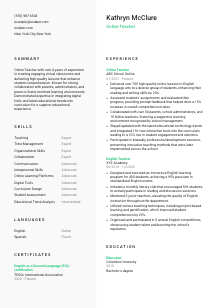
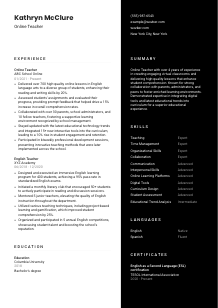
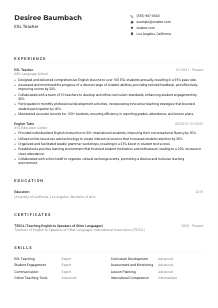
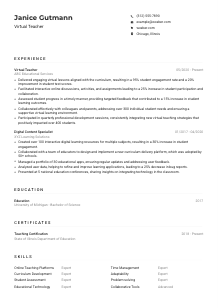
Navigating virtual classrooms, but your resume feels offline? Log into this Online Teacher resume example, created with Wozber free resume builder. Learn how to clearly present your digital instruction skills to match job requirements, leading your career journey straight to the top of the WiFi tower!

Online teaching asks for more than subject knowledge. Schools want teachers who can hold student attention through a screen, turn digital tools into real instruction, and keep progress moving with clear feedback, steady communication, and reliable lesson delivery. Your resume should make that classroom presence visible, not just list teaching duties.
When an online teaching resume is tailored well, it quickly shows whether you can teach effectively in a virtual environment rather than in a traditional classroom alone. Wozber's free resume builder helps you align your wording with the posting and produce an ATS-compliant resume that surfaces the right experience first, so hiring teams can immediately see your teaching scope, online platform fluency, and student support style.
For online teaching roles, the top of the resume should confirm the basics fast. School administrators need to know who you are, how to reach you, and whether you meet straightforward filters such as location before they move on to your classroom results and digital teaching experience.
Use your full name exactly as you want it to appear in professional correspondence. Keep the formatting simple and easy to scan. In education hiring, clean presentation matters because the rest of the resume should already suggest organization, consistency, and professionalism.
Place "Online Teacher" under your name when that matches the role you are pursuing. This helps frame the rest of your resume around virtual instruction, student assessment, and online classroom management from the first line.
List one reliable phone number and a professional email address you check regularly. Hiring for teaching roles often involves quick follow-up about interviews, demo lessons, onboarding documents, or certification review, so this information needs to be accurate and easy to find.
If the employer asks candidates to be based in a specific city or state, show that clearly in your personal details. Here, listing New York City, New York directly answers a stated requirement and removes uncertainty about availability or local eligibility.
If you have a professional website, teaching portfolio, or LinkedIn profile that supports your application, include it. For an online teacher, this can be especially useful when it shows sample lesson materials, virtual classroom projects, ESL background, or broader teaching credentials.
This section should answer the simplest screening questions immediately: who you are, how to contact you, and whether you meet obvious requirements such as location. Once that is clear, the hiring team can focus on your teaching record.




This section carries the most weight for an Online Teacher resume. Schools want to see how you teach remotely, how you track learning, and what changed for students because of your instruction. Focus on outcomes, online delivery, and the collaboration that keeps virtual learning effective.
Start by identifying the teaching work the employer cares about most. For online roles, that usually includes delivering lessons remotely, assessing student progress, using learning platforms well, giving timely feedback, and working with parents or school staff. Those themes should appear naturally across your bullets, not as copied phrases.
Put your most recent and most relevant teaching experience first. Include your job title, school or institution, and dates of employment. If you have direct online teaching experience, give it prime placement, as the example does with an Online Teacher role before earlier in-person teaching work.
Replace generic duty statements with what you delivered and what improved. A line such as "Delivered over 700 high-quality online lessons" says far more than "taught students online," especially when it is paired with a subject area and an outcome like stronger reading or writing performance.
Quantify results with education metrics that feel native to the work: lesson volume, comprehension gains, pass rates, engagement increases, number of students taught, or parent and staff collaboration scope. The sample resume works because its numbers connect directly to teaching outcomes, such as a 15% increase in comprehension and a 10% rise in engagement after adding interactive tools.
Prioritize experience that shows virtual instruction, curriculum delivery, assessment, classroom engagement, and collaboration. If earlier roles were not online, pull forward the parts that still matter here, such as exam results, program design, mentoring, project-based learning, or work with diverse learners.
Your experience section should show that you can run an online classroom, monitor progress, and communicate consistently with students, families, and colleagues. The clearer your teaching outcomes and digital delivery experience are, the stronger your case becomes.
For teaching jobs, education is more than background information. It confirms that you meet the academic baseline for the role and helps position you within the right subject or instructional track. Keep it straightforward, but make sure the alignment is visible.
If the posting asks for a Bachelor's degree in Education or a related field, place that information plainly in this section. A direct match, such as a Bachelor's degree in Education, should be easy to spot because it satisfies one of the employer's first checklist items.
List the degree, school name, field of study, and graduation year or date. Avoid overloading this section with extra detail unless it adds hiring value. Education hiring often moves quickly through qualification checks, so clarity matters.
When your degree supports teaching directly, name the field fully instead of abbreviating it away. In the example, "Bachelor's degree" plus "Education" immediately supports the posting's academic requirement without forcing the reader to infer relevance.
Include relevant coursework, honors, student teaching, or academic projects if they strengthen your fit, especially if you are earlier in your career. This can help if your experience section is still developing or if your training included online instruction methods, literacy education, ESL, or instructional technology.
If you earned honors, led education-focused organizations, or completed notable teaching-related research or practicum work, include those details selectively. They are most useful when they reinforce classroom preparation, subject expertise, or instructional leadership.
This section should confirm, without effort, that you meet the degree requirement and have a credible foundation for the classroom work described elsewhere on the resume.
Certifications matter quickly in teaching searches because they often determine whether a candidate can move forward at all. List active, role-relevant credentials in a way that makes eligibility and specialization easy to confirm.
When the posting asks for a valid teaching certification or license, put that credential first. A state teaching certificate, license, or equivalent teaching authorization should never be buried below less relevant training.
Include credentials that strengthen your profile for the type of students or instruction involved. For example, an ESL certification is especially relevant when your teaching work involves language development, diverse learners, or English instruction in online settings.
Show when each certification was earned and whether it is current. Schools need to know if your credential is active, renewable, or ongoing, so date ranges such as "2019 - Present" are useful and easy to review.
Online teaching changes with platform updates, digital pedagogy, and student engagement practices. If you have recent instructional technology training, online teaching coursework, or ongoing certification work, include it when it supports your classroom delivery and current practice.
A well-organized certifications section tells the employer that you meet licensing expectations and continue to invest in current teaching practice. That matters in online environments where instructional methods and tools keep evolving.
The skills section should reflect how online teaching actually works. Schools are looking for a combination of instructional ability, digital fluency, communication, and day-to-day classroom management habits that translate well to virtual learning.
Read the job description for explicit requirements and the skills implied by the responsibilities. Here, online learning platforms, digital tools, communication, interpersonal skills, and student assessment all deserve space because they connect directly to how the work gets done.
Choose skills that support teaching outcomes, not just generic strengths. Strong options include curriculum design, online instruction, student assessment, learning platform proficiency, classroom engagement techniques, communication with families, and time management for feedback and lesson prep.
Group your strongest and most relevant skills instead of turning the section into a long inventory. A concise list works better for ATS scanning and for human reviewers who want to quickly confirm that you can teach, assess, communicate, and work confidently in digital learning environments.
For an Online Teacher, the right skill list shows that you can combine instruction, technology, and communication in a setting where student engagement has to be created through the screen.
Language fluency matters in online teaching because so much of the job runs on spoken explanation, written feedback, parent communication, and clear lesson instructions. This section should support that part of your teaching profile directly.
If the employer specifies oral and written English proficiency, list English first and show your level clearly. That immediately confirms you can handle instruction, written feedback, and day-to-day communication in the language of delivery.
Put the most role-critical language at the top, then follow with additional languages that broaden your teaching value. For many schools, English must be confirmed first before anything else in this section matters.
Extra languages can support communication with multilingual students or families and may be especially useful in diverse school communities. In the sample resume, Spanish adds practical value without distracting from the required English proficiency.
Use plain labels such as Native, Fluent, Intermediate, or Basic. In teaching roles, overstating language ability can create immediate problems once interviews move into instruction examples, parent communication, or written materials.
If the role involves ESL learners, bilingual support, or an internationally diverse student body, additional languages can be a meaningful advantage. Include them when they strengthen your ability to explain, support, and connect across different learner needs.
This section should confirm that you can teach, write feedback, and communicate with confidence in the required language while also showing any added language range that helps in a diverse online classroom.
The summary sits at the top of the resume, so it needs to frame your teaching profile quickly and credibly. For online teaching, that means combining your years of experience with the kind of instruction you deliver, the learning environment you work in, and the results or strengths that define your practice.
Before writing, identify the recurring themes in the posting. For an online teaching role, those usually include virtual lesson delivery, student progress tracking, digital tool use, collaboration with families and staff, and ongoing development of teaching methods.
Lead with your title and years of experience so the reader immediately understands your profile. A line like "Online Teacher with over 4 years of experience" works because it establishes role alignment and seniority in one move.
Use the next lines to name the parts of your teaching that matter most for the role. Good examples include building engaging virtual classrooms, improving comprehension, integrating online tools into instruction, or partnering well with parents and administrators.
Aim for a short paragraph, usually three to five sentences. Use specific language and avoid broad claims like "passionate educator" unless you back them up with something concrete, such as measurable learning gains, strong online engagement, or successful digital curriculum delivery.
By the time someone finishes this paragraph, they should understand what you teach, how you operate online, and why your students and school community benefit from your instruction.
Your Online Teacher resume should now show the essentials clearly: required education and certification, online teaching experience, digital platform fluency, student progress tracking, and collaboration with families and school staff. That combination tells a school you can step into a virtual classroom and manage both instruction and communication with confidence.
Use Wozber's free resume builder to tighten role-specific wording, improve ATS optimization, and structure your content in an ATS-friendly resume format. With the right details in the right order, your resume makes it easier to judge your readiness to teach effectively online.




