



Use Wozber and land your dream job
Create Resume
No registration required
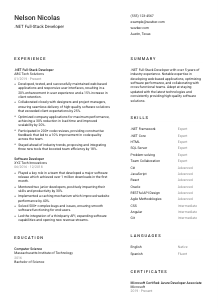
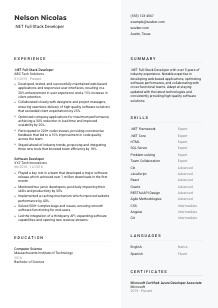
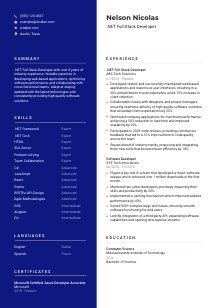
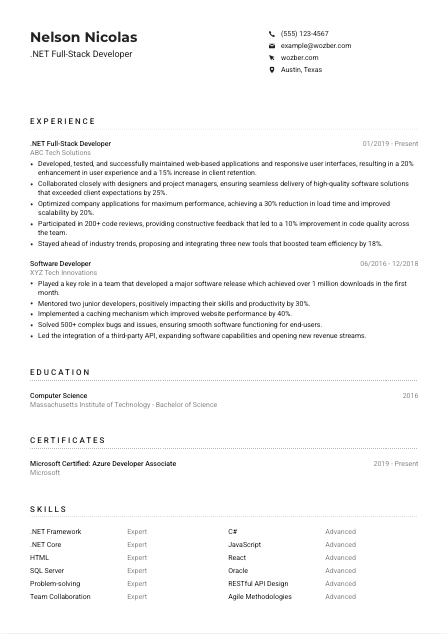
Building application layers, but feel your resume is stuck in maintenance mode? Check out this .NET Full-Stack Developer resume example, created with Wozber free resume builder. It shows how to weave your front-end and back-end excellence to match job specifics, forging a career that stays ahead of the CLR!
Full-stack .NET work is judged in production terms. Hiring teams want to see whether you can build and maintain web applications that hold up under real use, move comfortably between C# services and browser-based interfaces, and improve performance without breaking reliability. A resume for this field should make your technical range visible through shipped features, API work, database depth, and measurable gains such as lower load times, cleaner code, or stronger client outcomes.
When that experience is tailored to the target stack, the resume reads much faster for both reviewers and screening systems. Wozber's free resume builder helps you line up your wording with the posting and keep an ATS-compliant resume easy to parse, which matters when employers are scanning for .NET Framework, .NET Core, front-end tools, SQL, and REST API work before they spend time on the finer details. The clearer your stack and impact are, the easier it is to see you can contribute quickly.
For a .NET Full-Stack Developer, the top of the resume should confirm who you are, what role you do, and whether basic logistics line up. Keep this section clean and professional so nothing distracts from your engineering background, project history, and technical scope.
Use your name as the main heading, then place the exact target title directly beneath it when it matches the job you want. For this opening, ".NET Full-Stack Developer" immediately tells the reviewer they are looking at a candidate aligned with both the back-end and front-end scope rather than a more generic software developer profile.
Your phone number and email should be easy to scan and ready for immediate outreach. Use a professional email format, preferably based on your name. In technical hiring, small mistakes in obvious fields can raise questions about care and review habits before anyone even gets to your code-related achievements.
If a role specifies geography, show it clearly in your header. The example job asks for someone located in Austin, Texas, so listing Austin, Texas directly removes an avoidable question about relocation or local availability. Use this tactic when location is explicitly relevant, not as a default rule for every application.
A portfolio, GitHub, or LinkedIn link can strengthen your case when it shows source code, shipped web applications, API projects, or technical write-ups that support the stack on the page. Do not add links just to fill space. If you include them, make sure they are current and reflect the same technologies and level of work described in your resume.
Do not add age, marital status, photo, or other personal details unrelated to software delivery. This section should stay focused on practical hiring information that supports communication and confirms your professional identity.
This header does a simple but important job. It should confirm the role, contact path, and any stated logistics so the reader can move straight to your application development experience.




This section carries the most weight for .NET Full-Stack Developer hiring. Employers want to see what you built, how you worked across the application stack, which tools and frameworks you used, and what changed because of your work in performance, quality, scalability, or delivery.
Read the job description closely and pull the core technologies into your experience where they truthfully apply. Here, that means surfacing .NET Framework, .NET Core, C#, HTML, CSS, JavaScript, Angular or React, SQL Server or Oracle, and ASP.NET Web API or RESTful API design. This is not about copying keywords mechanically. It is about making sure your actual work is described in the same technical language the employer is using.
List roles in reverse chronological order with title, company, and dates clearly shown. For software roles, title clarity matters because ".NET Full-Stack Developer" signals a different scope than "Software Developer" or "Front-End Engineer." A clean timeline helps the reviewer see progression from implementation work to broader responsibility such as optimization, collaboration, or code review leadership.
Write bullets that connect engineering tasks to business or product results. The example does this well by pairing web application maintenance and responsive UI work with a 20% improvement in user experience and a 15% increase in client retention. Other strong measures for this profession include load-time reduction, defect reduction, uptime improvements, faster release cycles, code quality gains, and successful API integrations.
Metrics help hiring teams understand scope quickly. If you improved application performance, say by how much. If you participated in code reviews, mention the volume and the result. If you handled bug fixes, feature releases, or integrations, add numbers that show complexity or reach. In the sample resume, 200+ code reviews, a 30% reduction in load time, and 500+ resolved issues all give substance to the work.
Keep this section centered on application development, testing, maintenance, collaboration with designers or project managers, database work, API development, and technical improvement. Side achievements are only worth keeping if they reinforce the role, such as mentoring junior developers, proposing new tooling, or improving delivery practices. Every bullet should help the reader understand how you contribute to software quality and product outcomes.
A hiring manager should be able to scan this section and understand your stack, your level of ownership, and the results your code produced. That is what turns experience from a job list into a compelling engineering profile.
Education matters most here as a qualification check, then as supporting context for your technical base. Keep it straightforward, especially when the posting asks for a bachelor's degree in Computer Science or a related field.
If you have the degree requested, list it in direct terms. This job asks for a bachelor's degree in Computer Science or a related field, so a "Bachelor of Science in Computer Science" should appear clearly and without abbreviations that could confuse screening. The closer your wording is to the posting, the easier the qualification is to confirm.
Include degree, field of study, school name, and graduation year or date. This section does not need extra explanation unless you are early in your career or your academic path is especially relevant to the role. Clean formatting keeps the focus on the credential itself.
If you have less professional experience, consider adding courses or academic projects tied to web development, databases, software engineering, distributed systems, or user interface work. For a more experienced .NET developer, production experience will carry more weight, so coursework can usually stay off the page.
Honors, scholarships, thesis work, or technical clubs can be useful when they reinforce problem-solving, software development, or engineering depth. Add them only if they strengthen your case. A senior candidate with several years of .NET experience usually benefits more from space devoted to projects, performance improvements, or architecture-related contributions.
The more years you have building applications, the more compact education can be. In the provided resume, listing the MIT degree and graduation year is enough because the stronger proof sits in the work history. Let experience lead once you have substantial production work to show.
For most .NET Full-Stack Developer applications, education should confirm the expected technical foundation without taking attention away from your software delivery record.
Certifications are not always required for .NET Full-Stack Developer roles, but the right ones can strengthen your profile when they support the platform, cloud environment, or development practices tied to the job.
Start with the job description. If certifications are required or preferred, prioritize those exactly. In this case, none are listed, so certifications are a supporting asset rather than a gatekeeping requirement. That means relevance matters more than quantity.
For .NET developers, the most useful certifications often relate to Microsoft technologies, Azure, cloud development, architecture, security, or data platforms. The sample resume includes "Microsoft Certified: Azure Developer Associate," which fits naturally because many .NET teams build, deploy, or maintain applications in the Microsoft ecosystem.
Certification dates help show whether the credential is current, recently earned, or actively maintained. This is especially useful in fast-moving technical areas such as cloud services, API security, and modern development workflows where current knowledge matters.
A certificate works best when it supports real hands-on development history. It can reinforce that you stay current with tools and practices, but it should not crowd out the experience section. Think of it as added proof of current engagement with the platform and ecosystem.
If your certificates connect directly to the Microsoft stack, cloud deployment, or application development practices, they add useful depth. Keep them focused and clearly tied to the kind of work you want to do next.
A .NET Full-Stack Developer skills section should read like a concise technical inventory, not a catch-all list. Group the tools, languages, and collaboration strengths that are most likely to matter for building, maintaining, and improving web applications in the target environment.
Start with the stack named in the role and compare it with your actual experience. For this job, that includes .NET Framework, .NET Core, C#, HTML, CSS, JavaScript, Angular or React, SQL Server or Oracle, and RESTful API development. If you have those skills, place them high enough that both ATS filters and human reviewers see them quickly.
Full-stack work usually sits between product, design, and engineering concerns, so it helps to show both platform knowledge and collaboration habits. Technical skills should lead, but supporting skills such as problem-solving, code review, team collaboration, Agile work, or mentoring can reinforce that you can contribute inside a delivery team, not just code in isolation.
Do not overload the section with every framework, package, or tool you have touched once. Focus on the technologies you can defend in an interview and that support the target job. The example resume does this reasonably well by emphasizing .NET, SQL Server, JavaScript, React, RESTful API design, and collaboration-related skills rather than listing an endless tool catalog.
This section should make your technical coverage obvious in seconds. Prioritize the languages, frameworks, databases, and development practices that match the role and back them up in your experience bullets.
Language skills are usually a supporting section for developers, but they matter when the role calls out communication requirements. Use this section to confirm working fluency for documentation, collaboration, code reviews, and client or cross-functional discussion.
If the job description names a required language, list it clearly. Here, English proficiency is explicitly required, so English should appear first with an accurate proficiency level. That removes ambiguity about your ability to work in meetings, write technical updates, and discuss implementation details with teammates.
Additional languages can be useful when teams work across regions or support international clients. They are not usually a deciding factor for a .NET engineering role, but they can add value when communication spans multiple offices or customer groups.
Choose levels that match how you actually communicate, such as Native, Fluent, Intermediate, or Basic. Overstating language ability can become obvious quickly in interviews or on the job, especially in roles that rely on written technical communication and collaborative problem-solving.
If your projects involve distributed teams, vendor coordination, or client-facing implementation, extra language capability can be worth keeping on the page. If not, keep the section brief and let your engineering experience remain the main focus.
A developing language skill can be included if it is real and relevant, but there is no need to stretch this section. For most .NET Full-Stack Developer resumes, one required language and one additional fluent language is more than enough.
For this kind of role, the languages section should quickly answer one question: can you communicate clearly with the team and stakeholders the work requires?
The summary should give a compact read on your development background before the reviewer reaches the detail below. For .NET Full-Stack Developer roles, that means years of experience, core stack coverage, and the kind of application or performance work you are trusted to handle.
Pull the few requirements that define the position and weave them into a short opening. For this role, that means established .NET experience, front-end development, database knowledge, API work, and a track record of maintaining and improving web applications. Keep the focus on what you actually do well, not every keyword in the posting.
Open with your years of experience and the environments you work in. A line such as ".NET Full-Stack Developer with 5+ years building web applications with C#, .NET Core, JavaScript, SQL Server, and REST APIs" is much more informative than a generic statement about being results-driven.
Add one or two concrete strengths tied to delivery, such as performance optimization, responsive UI development, cross-functional collaboration, API design, or application stability. The sample summary points in the right direction by highlighting web-based application development, software performance, and teamwork, though it becomes even stronger when a few core technologies are named directly.
Aim for three to five lines. The summary should introduce your profile, not retell your entire career. If every sentence adds a stack detail, a delivery strength, or a measurable area of impact, you are on the right track.
A well-written summary tells the reviewer what kind of .NET developer you are before they reach the first bullet point. Make your stack, experience level, and delivery strengths clear from the start.
A tailored .NET Full-Stack Developer resume should now show three things quickly: the Microsoft stack you work in, the kinds of web applications and APIs you have delivered, and the measurable results tied to your code, collaboration, and optimization work.
Use Wozber's free resume builder and ATS resume scanner to align your wording with the posting, surface missing requirements, and present everything in an ATS-friendly resume format that keeps your technical background easy to read. When the resume is this focused, hiring teams can judge your readiness for production work much faster.




