



Use Wozber and land your dream job
Create Resume
No registration required
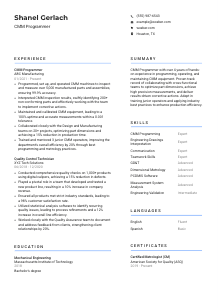
Measuring parts with precision, but your resume doesn't align? Calibrate your career trajectory with this CMM Programmer resume example, created with Wozber free resume builder. Learn how to match your metrology mastery to job demands, paving a professional path as accurate as your dimensional checks!
CMM programming work gets judged in thousandths, and your resume should reflect that same level of control. Hiring teams want to see more than machine familiarity. They look for proof that you can translate prints, GD&T, and inspection data into reliable measurements, clear nonconformance findings, and practical support for production and quality teams.
A tailored resume changes how quickly that metrology background comes through, especially when ATS screening is involved. Using Wozber's free resume builder helps you align your wording with the job's language, keep an ATS-compliant resume structure, and surface the details that matter first, such as PCDMIS use, calibration work, drawing interpretation, and collaboration on corrective action.
For a CMM Programmer, the personal details section should be clean, practical, and aligned with the posting. This is where you confirm the basics quickly so attention stays on your inspection experience, software knowledge, and metrology background.
Use your full name in a clear, readable format so it anchors the page without competing with the technical content below. CMM hiring usually moves fast from identity to qualifications, so a polished header helps the reader get to your PCDMIS, GD&T, and inspection experience immediately. Wozber's ATS-friendly resume template keeps this section straightforward and easy to parse.
Place "CMM Programmer" directly under your name if that is the role you are pursuing. Matching the title used in the posting helps frame your experience correctly from the start, especially if your earlier roles were listed as Quality Technician, Metrology Technician, or Inspector. It also reinforces relevance in ATS matching.
List one phone number and one professional email address, and make sure both are current. A role that depends on precise setup, measurement discipline, and accurate reporting does not benefit from avoidable mistakes in the first line of the resume. If you include a website, it should lead to something useful, such as a professional profile or portfolio with manufacturing or quality-related content.
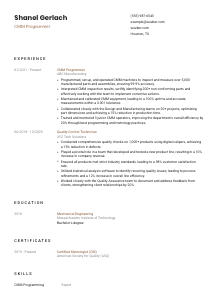
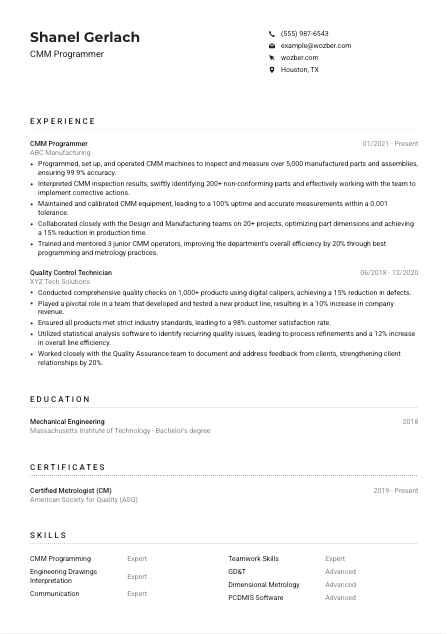
If a job asks for local availability or relocation, state your city and state clearly. In the example, "Houston, TX" directly supports a posting that requires being located in or willing to relocate to Houston. Keep this practical. Location is a tailoring point, not a headline achievement.
Add a LinkedIn profile or personal website only if it strengthens your case. For a CMM Programmer, that might mean a profile showing manufacturing, quality, aerospace, automotive, or precision inspection experience. Skip links that do not support your work with CMM equipment, metrology processes, or engineering environments.
This section should confirm that you are reachable, professionally presented, and aligned with any basic posting requirements. Once that is clear, the hiring team can focus on the part that matters most for this role: your measurement work, programming depth, and shop-floor impact.




This section carries the most weight for a CMM Programmer. Employers want to see what equipment you programmed, what inspection work you handled, how you used metrology data, and what changed because of your work on the floor, in quality, or with engineering.
Read the job description closely and pull out the work that must appear in your experience bullets. For this role, that includes programming and operating CMM equipment, using PCDMIS, interpreting engineering drawings, applying GD&T, identifying nonconforming parts, supporting corrective action, and maintaining calibrated measurement systems. Those are the terms and responsibilities your resume should reflect naturally if they match your background.
List positions in reverse chronological order and describe them in terms that fit manufacturing and metrology workflows. Include the company, title, and dates, then focus your bullets on inspection programming, setup, dimensional validation, reporting, and cross-functional coordination. In the example, the move from Quality Control Technician to CMM Programmer shows a clear progression from general inspection work into dedicated metrology programming.
Numbers matter here because precision work is measured by throughput, tolerance control, defect detection, uptime, and process improvement. Useful metrics include part volume inspected, accuracy rates, nonconformances identified, downtime reduced, calibration performance, scrap reduction, or cycle-time improvement. The sample bullets do this well by tying work to outcomes such as 5,000 parts inspected, 99.9% accuracy, 100% uptime, and a 15% reduction in production time.
Do not give equal space to every manufacturing job you have held. Prioritize roles that show CMM programming, dimensional metrology, print reading, first article or in-process inspection, and collaboration with engineering or manufacturing teams. Earlier quality roles still help if they show transferable strengths, such as defect analysis, statistical review, or standards compliance, but your strongest CMM-specific experience should lead.
ATS optimization works best when the posting's language appears inside credible work examples. Instead of dropping in isolated terms like "GD&T" or "PCDMIS software," connect them to what you actually did, such as developing inspection programs, validating dimensions against engineering drawings, or working with manufacturing to resolve tolerance issues. Wozber's ATS resume scanner can help map those requirements to your experience so the language stays aligned and natural.
A hiring manager should be able to scan your experience and understand the level of CMM responsibility you have handled, the software and metrology practices you know, and the production problems you have helped solve. That is what moves a CMM Programmer resume forward.
Education matters here because the role sits close to engineering drawings, tolerancing, measurement systems, and manufacturing processes. Your degree does not need a long explanation, but it should clearly support your technical foundation for dimensional inspection work.
When a posting asks for a bachelor's degree in Mechanical Engineering or a related field, present that match directly. If you hold the exact degree requested, use the full wording. In the example, "Bachelor's degree" in "Mechanical Engineering" immediately answers one of the job's stated requirements.
List your degree, field of study, school, and graduation year in a simple format. This is not the section for dense explanation. CMM hiring teams usually scan education to confirm baseline engineering or technical preparation, then return to experience for the deeper evaluation. Wozber's ATS-friendly resume format helps keep this section readable for both ATS and human reviewers.
Mechanical Engineering is especially relevant because it connects directly to prints, tolerances, materials, manufacturing processes, and dimensional requirements. If your degree is in a related field, make sure the rest of the resume strengthens the connection through metrology, quality, or production experience so the fit remains clear.
If you are early in your career, selected coursework, lab work, or senior projects can help bridge the gap between education and shop-floor experience. Prioritize topics like GD&T, manufacturing processes, CAD interpretation, quality engineering, or measurement systems. If you already have several years of direct CMM work, keep this section lean and let your experience do the heavy lifting.
Additional academic honors, technical projects, or closely related credentials can support your profile if they connect to inspection or manufacturing precision. A certification such as Certified Metrologist is usually better placed in the certifications section, but it complements an engineering degree well by showing that your knowledge extends into applied measurement practice.
This section should confirm the technical base behind your measurement work. Once the degree requirement is covered clearly, the rest of the resume should carry the deeper proof through CMM programming, inspection results, and production support.
Certifications can strengthen a CMM Programmer resume when they point to real measurement expertise. They are especially useful when they support your work with dimensional inspection, software proficiency, calibration discipline, or quality systems.
Start with credentials that strengthen your metrology profile rather than listing every training course you have completed. For this profession, certifications tied to dimensional metrology, GD&T, quality engineering, or CMM software are the most relevant. The sample's Certified Metrologist credential works because it supports the inspection and measurement core of the role.
A short list of targeted certifications reads better than a broad inventory of loosely connected credentials. If you have training in PCDMIS, geometric tolerancing, measurement system analysis, or calibration methods, those usually carry more value here than general business or unrelated software certificates.
Use dates when they show that a certification is active, current, or recently completed. In a field where software versions, inspection standards, and quality practices evolve, recency can matter. A date range like "2019 - Present" can help indicate continued standing for an active credential.
CMM work changes with new part complexity, updated software functions, and tighter manufacturing requirements. If you keep current through formal certification, vendor training, or advanced metrology coursework, include that selectively. It shows that your programming and measurement practices are current enough for production demands, audits, and tolerance-critical work.
Certifications should deepen the picture already formed by your experience. When they are relevant to metrology, software, or inspection quality, they help position you as a candidate who brings current technical discipline to CMM programming work.
The skills section should read like the toolkit of someone who can program, inspect, interpret results, and work with engineers and production teams. Keep it focused on capabilities that matter in dimensional metrology rather than broad traits that could belong to any manufacturing role.
Start with the exact capabilities the posting emphasizes, then add supporting skills that make those capabilities credible in practice. Here, that means software and metrology terms like PCDMIS, GD&T, dimensional metrology, and engineering drawing interpretation, along with communication and teamwork because the role includes corrective action and cross-functional collaboration.
Choose skills you can back up with examples in your experience section. "CMM Programming," "Measurement System Analysis," and "Engineering Drawings Interpretation" are strong because they connect directly to daily work and inspection output. Avoid padding this section with generic items unless they matter to the job and appear in your work history.
Place the most role-specific technical skills first, then follow with supporting strengths. For many CMM Programmer roles, that means starting with CMM programming, PCDMIS, GD&T, dimensional metrology, calibration, print reading, and validation work before softer skills like communication. This ordering helps both ATS systems and hiring managers find the core qualifications fast.
A well-built skills section should mirror the language of real CMM work. When the right technical terms appear in the right order, the rest of the resume becomes easier to read as a match for inspection, programming, and tolerance-driven manufacturing work.
Language skills are usually a secondary section for CMM Programmer roles, but they still matter when the posting names a required level of communication. Use this section to confirm fluency where it affects reporting, team coordination, training, or documentation.
If English fluency is listed in the posting, place English first and show your proficiency level clearly. For this role, that matters because inspection findings, nonconformance communication, engineering discussions, and operator training all depend on accurate technical communication.
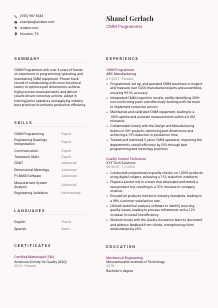
Additional languages can be useful in manufacturing environments with diverse teams, supplier interaction, or multinational operations. In the example, Spanish at a basic level adds context without overstating its importance. Include extra languages when they are genuine and may help on the floor, in documentation, or during cross-team communication.
Use straightforward levels such as Fluent, Conversational, Intermediate, or Basic. Precision matters here too. A role that depends on clear measurement reporting and exact terminology does not benefit from inflated language claims.
Not every CMM Programmer job requires multilingual ability, but some environments do benefit from it, especially where you are explaining inspection results to operators, coordinating with engineering, or helping train junior staff. Include language skills when they support those interactions rather than as filler.
If you are learning another language that has workplace value, list it honestly at the right level. Even basic ability can be worth mentioning when it improves day-to-day coordination in a plant or quality setting, but keep the emphasis on usable communication, not on collecting extra resume lines.
For most CMM Programmer resumes, languages should confirm communication readiness, not distract from technical qualifications. When listed clearly and honestly, they add useful context without taking focus away from your metrology work.
Your summary should quickly establish what kind of CMM work you have done and what level of responsibility you can handle. In a few lines, connect your experience, software knowledge, metrology strengths, and production impact so the reader knows what to expect from the rest of the resume.
Begin with a direct description of your current professional identity and years of experience. A line such as "CMM Programmer with over 4 years of hands-on experience" works because it immediately anchors the reader in the right function and seniority level. If your background includes inspection or quality work before full programming responsibility, you can reflect that progression briefly.
Use the summary to name the responsibilities that define your value for the target role. For this job, that could include programming and operating CMM equipment, using PCDMIS, interpreting engineering drawings, maintaining measurement accuracy, and supporting corrective action on nonconforming parts. The sample summary does this effectively by focusing on equipment use, cross-functional collaboration, and precision results.
A strong CMM Programmer summary does not stop at software or inspection tasks. It should also show how you work with design, manufacturing, quality, or junior operators. If mentoring, cross-functional problem solving, or process improvement is part of your background, include it briefly because those points often distinguish a programmer from a pure operator.
Limit the summary to what a hiring manager should know before reading your bullets. Skip generic claims and focus on the combinations that matter in this profession, such as CMM programming plus GD&T fluency, or metrology accuracy plus production support. Wozber's AI resume builder can help refine this section so it matches the posting's terminology while staying concise and readable.
Once your summary clearly states your programming background, metrology strengths, and production-facing value, the rest of the resume has a clear direction. The hiring team can then read your experience with the right expectations in mind.
A CMM Programmer resume works when it makes your measurement discipline, software capability, and production impact easy to find. Focus on the parts of your background that show how you program inspection routines, interpret results, maintain accuracy, and help teams act on dimensional data.
Use Wozber to shape that experience into an ATS-friendly resume format with stronger ATS optimization and cleaner alignment to the posting. When the language, structure, and metrics all point to real metrology performance, your resume gives a hiring team a clear read on your readiness for the role.