



Use Wozber and land your dream job
Create Resume
No registration required
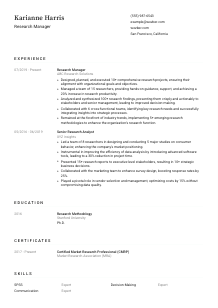
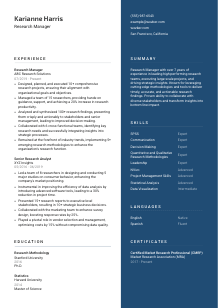
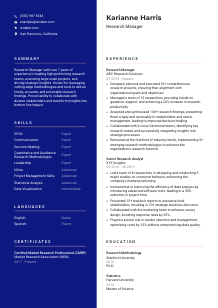
Working with data, but your resume feels inconclusive? Check out this Research Manager resume example, created with Wozber free resume builder. It shows how to synthesize and present your research talents to match job expectations, taking your career insights to a more research-focused vantage point!
Research Managers are hired to turn messy questions into structured studies, lead analysts through execution, and translate findings into decisions senior stakeholders can actually use. Your resume should make that operating range visible fast, especially your command of research design, team leadership, and the quality of insight you delivered.
A generic resume can blur the difference between a strong individual contributor and someone ready to run a research function. Using Wozber's free resume builder helps you tailor your wording into an ATS-compliant resume that reflects the language of the posting, so hiring teams can quickly see your experience with managing projects, guiding researchers, and presenting actionable findings.
This section does more work than many candidates realize. For a Research Manager, it should confirm the basics without friction and immediately align your profile with the target role, including any practical requirement the employer has stated.
Use your full name as the clearest element on the page. Keep it easy to scan and professionally styled so it reads like the heading of a formal report, not an afterthought.
Place "Research Manager" directly under your name when that is the role you are pursuing. Matching the posted title helps frame the rest of the resume correctly from the first line and avoids ambiguity with titles like Research Analyst or Insights Lead.
List a current phone number and a professional email address, then verify both carefully. A resume can show strong study design, data analysis, and leadership experience, but a simple typo in your contact details can stop the process before an interview is scheduled.
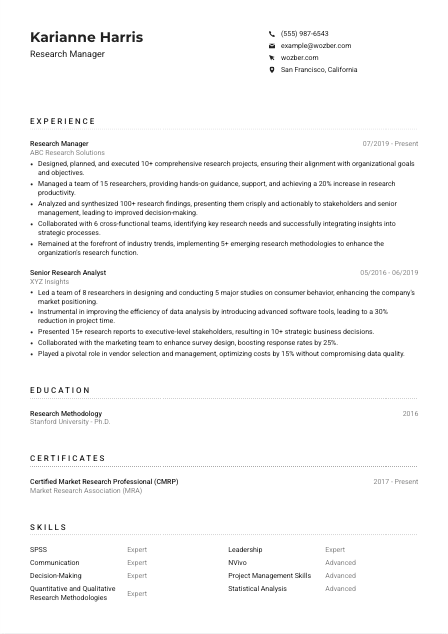
If the posting specifies a location, include it exactly and keep it simple. Here, "San Francisco, California" matters because it answers a stated requirement and removes questions about availability or relocation timing.
Include LinkedIn or a professional website if it reinforces your research background. For this kind of role, that could mean publications, research portfolios, speaking engagements, or a profile that supports your experience with methodologies, stakeholder reporting, or team leadership.
Keep this section accurate, polished, and easy to scan. It should confirm that you are reachable, professionally presented, and logistically aligned with the opening before the reader gets into your research record.




Hiring teams spend the most time here because this is where management scope, methodological depth, and business impact become concrete. For a Research Manager, your bullets should show how you led studies from design through delivery and what changed because of your work.
Start by identifying the repeated priorities in the job description. In this case, they include designing and executing research projects, leading researchers, synthesizing findings, working with cross-functional partners, and improving the research function. Those themes should shape the language and examples you choose in your experience section.
List roles in reverse chronological order and include title, employer, and dates for each one. Research hiring often involves comparing progression from analyst work into leadership, so a clear timeline helps show when you moved from execution into supervision, planning, and stakeholder ownership.
Replace generic statements like "responsible for research projects" with accomplishment-driven bullets that show scope and results. The example resume does this well with points such as leading 10+ research projects, managing a team of 15 researchers, and presenting 100+ findings in ways that improved decision-making.
Quantification matters when it reflects how the work is judged. Useful measures include number of studies delivered, team size, turnaround time, response rate gains, productivity improvements, cost savings, stakeholder adoption, or strategic decisions influenced. Metrics like a 20% productivity increase or a 30% reduction in project time immediately give your leadership more weight.
Prioritize experience that supports a Research Manager brief: research design, qualitative and quantitative methods, data interpretation, stakeholder presentations, mentoring, and project ownership. Leave out bullets that are impressive but unrelated if they distract from your ability to run a research agenda and lead a team.
This section should leave no doubt that you can lead studies, manage researchers, and turn analysis into action. When your bullets combine scope, methods, and measurable outcomes, your management experience reads as earned and ready for the next role.
Research Manager roles often place real weight on academic background because research design, statistics, and interpretation standards matter. Your education section should quickly confirm that you meet the required degree level and, where relevant, show advanced study that strengthens your credibility.
Start with the degree that best aligns with the posting. Here, a bachelor's degree is required, while a master's degree or Ph.D. is preferred, so listing an advanced degree near the top immediately strengthens your positioning if you have one.
Include degree, field of study, institution, and graduation year in a simple structure. Hiring managers should be able to spot your academic preparation for research methodology, statistics, behavioral science, public health, or another related field within seconds.
Degree titles matter more when the specialization supports the role. "Ph.D. in Research Methodology" or "Master of Science in Statistics" tells a much clearer story than a broad degree label and connects directly to responsibilities like study design, analysis, and interpretation.
If coursework, dissertations, theses, or honors strengthen your case, include them selectively. This is most useful when you are earlier in your career or when the academic work directly supports advanced qualitative methods, quantitative analysis, mixed-methods research, or sector-specific expertise.
Significant research projects, published work, or leadership in academic research settings can add value if they reinforce your professional profile. Keep these additions brief and relevant so the section stays focused on qualifications that matter for managing a research function.
This section does not need decoration. It should confirm degree level, relevant field, and any advanced training that supports your command of research methods and analytical rigor.
Certifications are usually secondary to experience in research management, but the right one can strengthen your authority in methodology, market research, analytics, or leadership. Include them when they add clear relevance to how you run studies or manage teams.
If the posting does not require certifications, treat them as support rather than filler. A credential like Certified Market Research Professional can still help because it reinforces professional standards and commitment to the discipline.
Prioritize certifications that connect to research practice, analytics, project management, or leadership development. One relevant certification carries more weight than a long list that has little to do with study design, synthesis, or team oversight.
Listing the year earned or active date range helps show that your knowledge is current. That matters when employers want someone who keeps pace with evolving methods, software, compliance expectations, or reporting standards.
A good certification section suggests that you keep sharpening your approach, whether through research methodology, advanced analytics, or managerial development. That matters in a role expected to improve processes and adopt better ways of working across the research team.
Well-chosen certifications add credibility when they support your actual research practice. They should strengthen your profile as a leader who stays current with methods, tools, and standards.
This section should read like a concise map of your working toolkit. For a Research Manager, that means balancing methodology, software, leadership, and communication skills that show you can guide studies and the people delivering them.
Pull out the specific capabilities the employer called for and mirror them where they match your background. In this case, that includes quantitative and qualitative research methodologies, data analysis and interpretation, SPSS, NVivo, project management, leadership, and communication.
Do not list only tools or only soft skills. Research Managers need a mix of method expertise and team leadership, so pair items such as survey design, statistical analysis, qualitative coding, stakeholder presentation, researcher coaching, and cross-functional collaboration where they reflect your real work.
Use a focused set of skills that support the role rather than an exhaustive inventory. The sample resume works because it highlights software, research methods, leadership, communication, and decision-making without losing the thread of what kind of manager the candidate is.
Every skill here should help the reader picture how you lead research work, interpret findings, and communicate insight. If a skill does not support that picture, it probably does not need space on the page.
Language ability matters differently depending on the research environment. In some teams it is essential for stakeholder communication, interviewing, moderation, fieldwork, or international projects. In others, it is a useful bonus. Present it in a way that matches the actual demands of the role.
If the job description names a language requirement, list it clearly and use an honest proficiency label. Here, strong English communication is essential, so English should appear first with a level that reflects your real writing, presentation, and collaboration ability.
Ordering matters. Lead with the language tied to reporting, stakeholder meetings, and written synthesis, especially in roles where findings need to be presented clearly to senior management.
Other languages can be valuable when the role involves multilingual audiences, international research, or cross-market studies. They are especially worth listing if they expand your ability to conduct interviews, review source material, or collaborate with regional teams.
Use terms such as Native, Fluent, Advanced, or Intermediate and keep them accurate. Overstating language ability can become a problem quickly in interview settings where communication skill is tested directly.
Only give this section space if it adds context to your candidacy. For some Research Manager roles, multilingual ability supports participant engagement or global insights work. For others, clear English communication is the main point to confirm.
Handled well, this section supports your ability to communicate research clearly across teams, stakeholders, or markets. Keep it factual and relevant to the kind of studies you will be leading.
The summary is your fastest chance to establish level, specialization, and leadership scope. For a Research Manager, it should tell the reader what kinds of research you lead, how you work with teams and stakeholders, and what kind of decisions your insights have influenced.
Read the posting closely before writing this section. Pull forward the two or three themes that define the opening, such as research leadership, mixed-methods expertise, stakeholder communication, or team management, then make those the backbone of your summary.
Start with a direct line that states your title or specialty and your experience range. A line such as "Research Manager with 7+ years of experience leading research teams and delivering strategic insights" quickly sets level and context without wasting space.
Use the next sentence to show the kind of work you actually lead. Mention methodologies, research software, team scope, or the kind of decisions your work informs. The sample summary is effective because it links leadership, large-scale projects, and actionable findings rather than staying abstract.
Aim for a short paragraph that sounds grounded in real practice. Skip broad claims and focus on what you repeatedly deliver, whether that is faster study execution, stronger decision support, better research operations, or high-quality synthesis across qualitative and quantitative work.
A well-written summary helps the reader understand, within a few lines, that you are prepared to lead research programs rather than simply contribute to them. It should make your management scope and analytical credibility easy to recognize from the start.
Your Research Manager resume should now present a clear story: you can design studies, lead researchers, interpret data, and deliver insights that shape decisions. When each section supports that story with relevant methods, tools, scope, and results, the application reads with much more authority.
Use Wozber's free resume builder to organize that experience into an ATS-friendly resume format, refine role-specific phrasing with AI support, and check alignment with an ATS resume scanner. The final result should make it easy to judge your readiness to lead research work from day one.




