



Use Wozber and land your dream job
Create Resume
No registration required
Inventing the future, but your resume is stuck in the lab coat pocket? Step into this R&D Specialist resume example, created with Wozber free resume builder. Learn how to channel your breakthrough proficiencies to match career curves, so your career advancement is always one discovery ahead!
R&D hiring usually turns on one question fast: can you move from hypothesis to usable result in a real development environment? For an R&D Specialist, that means your resume should make research execution visible, from experimental design and lab work to data interpretation, product improvement, and the way you work with manufacturing, regulatory, or commercial teams.
Screening gets much easier when those research outcomes are tailored to the target role's language. Wozber's free resume builder helps you shape an ATS-compliant resume around the posting's terms, so scientific methods, analysis tools, collaboration patterns, and compliance work are easier to recognize in both ATS filters and human review. That is what helps a hiring team quickly see whether your background translates into productive R&D work.
In R&D, small inaccuracies create avoidable doubt. Your contact section should be clean, current, and aligned with the role you want, so nothing distracts from your technical background, publications, or project results.
Place your full name at the top in a clear, readable format. Recruiters often review many technical resumes in one sitting, so your name should be immediately visible, much like the lead author line on a paper or report.
Add the role title directly under your name when it reflects your background. Using "R&D Specialist" helps frame your experience around research execution, experimentation, and product development rather than leaving reviewers to guess whether you are closer to QA, manufacturing, or pure academic research.
List the phone number and email address you actually monitor. This is basic, but in technical hiring it matters because interview scheduling often moves quickly once a candidate's project experience and analytical background line up with the role.
If the employer specifies a location requirement, include your city and state clearly. Here, San Francisco, CA is part of the stated criteria, so listing it removes a basic screening question early. If you are relocating, note that in a way that is direct and realistic.
A LinkedIn profile, publication page, or personal website can help if it adds substance. For R&D work, this might include patents, papers, presentations, technical projects, or a more detailed career record that supports the claims in your resume.
Skip details such as age, marital status, or other non-job-related identifiers unless they are explicitly required in your region. Keep the section focused on information that helps the employer contact you and place your candidacy correctly.
This section should do one job well: make you easy to identify, contact, and place against the posting's logistical requirements. When the basics are clean, the hiring conversation can stay on your research work.




This is the section where scientific work becomes tangible. Hiring teams want to see what you researched, how you ran the work, which functions you collaborated with, and what changed because of it, whether that was better product performance, faster development cycles, stronger data quality, or published findings.
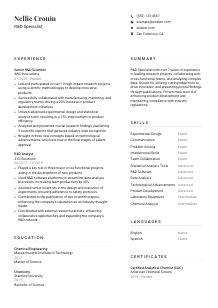
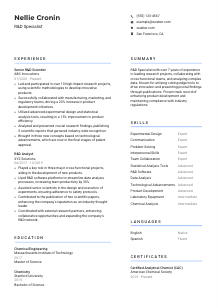
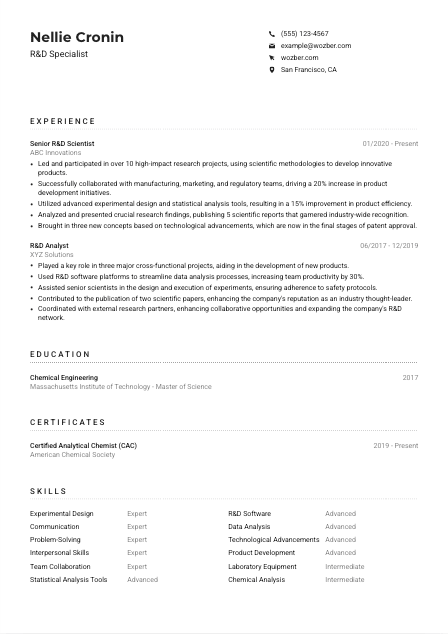
Read the responsibilities closely and map your experience to them before you start writing bullets. For an R&D Specialist, that usually means research project ownership, experimental design, data analysis, product improvement, cross-functional collaboration, and compliance with safety or quality standards. The sample resume does this well by tying prior work to research projects, product development initiatives, and reporting of findings instead of listing generic lab duties.
Use reverse chronological order and make each entry easy to scan. Include your title, employer, and employment dates so reviewers can quickly understand your progression from analyst or scientist roles into broader project leadership or technical ownership.
Describe what you contributed and what changed because of your work. In R&D, that can include developing a new formulation, improving product efficiency, streamlining an analysis workflow, supporting a patentable concept, or publishing findings that influenced next steps. The strongest bullets combine method, scope, and outcome, such as leading multiple projects, applying statistical tools, and improving product performance by a measurable percentage.
Numbers help hiring teams judge scale and credibility. Use metrics that make sense for R&D work: number of projects led, improvement in yield or efficiency, reduction in analysis time, number of reports or publications, patent-stage concepts, cross-functional initiatives supported, or productivity gains from software and process improvements. In the example, gains like 15% product efficiency improvement and 30% productivity growth give the work operational weight.
Choose bullets that reinforce the kind of R&D work the employer needs. If the posting emphasizes scientific methodology, statistical analysis, collaboration with manufacturing and regulatory, and compliance, those points should take priority over unrelated administrative work. Every line should help answer whether you can contribute to product development in a controlled, data-driven environment.
A well-built experience section makes your technical judgment, collaboration, and research output easy to trust. By the end of it, a hiring team should be able to picture you contributing to active development programs, not just supporting them from the sidelines.
R&D roles often start with formal scientific training because the work depends on disciplined methodology, data interpretation, and lab or technical fluency. Your education section should show that foundation clearly and, when relevant, underline deeper specialization that supports the target industry.
If the posting asks for a bachelor's degree in a relevant scientific field and prefers a master's, present those credentials clearly and in order of highest qualification. That immediately addresses a common screen for R&D roles where scientific training is a baseline requirement, not a nice extra.
For each entry, include the institution, degree, and field of study. That is usually enough for experienced R&D candidates. The example shows this effectively with a Master of Science in Chemical Engineering and a Bachelor of Science in Chemistry, both directly reinforcing scientific depth.
When the employer mentions a relevant scientific discipline, do not bury yours. Put the field name front and center, especially if it connects closely to the industry's products, materials, processes, or analytical methods. This helps distinguish you from candidates whose background sits farther from the role's technical core.
If you are early in your career, changing sectors, or applying to a highly specialized R&D area, selected coursework, thesis work, or major lab projects can add real value. Choose items tied to experimental design, materials characterization, formulation, analytical chemistry, statistics, or whatever is most relevant to the target role.
Academic honors, research fellowships, lab distinctions, or technical society involvement can help when they add context to your scientific training. Keep them if they reinforce research capability or subject-matter commitment, not simply to lengthen the section.
This section should quickly confirm that you have the academic base to work with research methods, technical data, and controlled development processes. Keep it direct, relevant, and easy to match to the posting.
Certifications are rarely the main qualifier for an R&D Specialist, but they can strengthen your profile when they reflect analytical methods, lab practice, regulated environments, or specialized technical knowledge. Present them as useful extensions of your core scientific background.
Some R&D postings do not require certifications at all, which is the case here. That does not mean the section has no value. It means you should use it to highlight credentials that support your work in analysis, laboratory operations, safety, regulated processes, or specialized instrumentation.
List the credentials that connect most directly to the role's research environment. The example includes analytical chemistry and laboratory technician certifications, which make sense because the job emphasizes scientific methodology, data work, and familiarity with laboratory protocols.
Show when the certification was earned and whether it is still active. In technical fields, current credentials can matter because standards, safety requirements, and regulated procedures change over time.
Add new certifications when they support the direction of your R&D work, such as design of experiments, statistical software, quality systems, GMP or GLP environments, validation, or industry-specific lab methods. Ongoing development is most persuasive when it matches the work you want to do next.
Certifications work best when they reinforce the technical setting of your experience. Keep the section focused on credentials that add credibility to your lab work, analytical discipline, or regulated product development background.
An R&D skills section should read like the toolkit behind your project results. The most useful mix includes technical methods, analytical tools, lab capability, and the collaboration skills needed to move ideas through development and into a viable product or process.
Start with the skills the employer actually names. Here, that includes experimental design, statistical analysis, R&D software, data analysis tools, laboratory protocols, collaboration, and English communication. Build your list from those signals first, then add adjacent strengths you genuinely use on the job.
R&D hiring usually looks for both scientific depth and the ability to work across functions. Your list should reflect that reality. A useful mix might include design of experiments, data interpretation, laboratory equipment, product development, technical reporting, regulatory awareness, and team collaboration. The sample resume gets this balance right by pairing analytical tools with communication and interpersonal strengths.
Avoid dumping every skill you have ever used into one long block. Choose the skills that best support the type of research and development work you are targeting. If the role is more formulation-heavy, emphasize methods and lab techniques. If it leans toward product development, make room for cross-functional execution and analysis software. Relevance carries more weight than volume.
Your skills section should support the story told in your experience bullets. When the methods, tools, and collaboration strengths line up across the resume, your R&D profile feels much more credible.
Research work depends on clear communication, whether you are documenting experiments, presenting findings, or working with cross-functional teams. Your language section should support that reality, especially when the posting explicitly asks for strong English communication.
If the role calls for fluent English, list English first and label your proficiency accurately. In this case, articulate English communication is a stated requirement, so it should be impossible to miss.
After the required language, list additional languages in the order most useful to the role or industry. This keeps the section practical and easy to scan, especially for employers working across international suppliers, research partners, or regional teams.
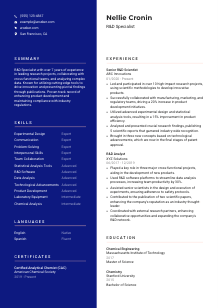
Additional languages can support collaboration, documentation review, partner communication, or work in global R&D organizations. The example's Spanish entry adds breadth without distracting from the required English proficiency.
Choose ratings you can defend in an interview or on the job. If you can present technical findings, write reports, or participate in professional discussions in a language, say so clearly. If not, use a lower rating rather than overstating your level.
For many R&D roles, language is supportive rather than central, unless the job involves frequent international coordination or publication work. Give it enough space to cover the requirement, then let your research experience carry most of the argument.
If the role asks for strong English, your language section should confirm it quickly and cleanly. Any additional languages should add practical value to collaboration or external communication, not clutter the resume.
Your summary should read like the opening abstract to the rest of the resume. In a few lines, it should establish your level, your scientific focus, and the kind of research or product-development contribution you are ready to make.
Start by identifying the work the employer needs done. For an R&D Specialist, that often includes leading or supporting research programs, designing experiments, analyzing data, collaborating across functions, and improving products or processes within safety and quality constraints.
Lead with your years of experience and your scientific area or R&D focus. That gives immediate context. The sample summary does this well by combining 7+ years of experience with strengths in research leadership, collaboration, and data analysis.
Use the rest of the summary to connect your background to the employer's priorities. Mention outcomes such as innovation work, product development support, publication or reporting experience, technical tool usage, or compliance discipline. Keep it selective. A few strong points are better than a compressed list of every keyword in the job ad.
Aim for a compact paragraph that can be read quickly before the reviewer moves into your experience section. Three to five lines is usually enough to establish your technical profile, your scope, and the value you bring to an R&D team.
A good summary gives the hiring team a clear starting point: your experience level, your research strengths, and the kind of development work you can support. From there, the rest of the resume should back up every claim with specifics.
You now have a clear structure for presenting yourself as an R&D Specialist with substance behind the title. Focus your resume on research execution, analytical rigor, cross-functional product work, and the measurable outcomes that show you can contribute in a live development setting.
Use Wozber to tighten that alignment from section to section. Wozber's ATS resume scanner can highlight missing requirements, surface role-specific terminology, and improve ATS optimization, while the builder helps you organize everything in an ATS-friendly resume format. When the resume is tailored well, hiring teams can quickly judge your readiness to lead experiments, interpret data, and move development work forward.




