



Use Wozber and land your dream job
Create Resume
No registration required
Inventing ideas, but your resume feels uncharted? Check out this R&D Generalist resume example, created with Wozber free resume builder. Learn how to bring together your multidisciplinary expertise in a way that speaks to specific research and development roles, charting a career course as groundbreaking as your innovations!
R&D Generalist work sits at the intersection of experimentation and execution. Hiring teams want to see whether you can turn ideas into testable concepts, interpret data with rigor, and document findings in a way engineers, product partners, and other technical stakeholders can actually use. Your resume should make that pattern visible quickly, not bury it under broad claims about innovation.
The first screen often comes down to whether your background clearly connects research methods, product or process development, and collaboration across functions. Wozber's free resume builder helps you shape that story into an ATS-compliant resume, using language that matches the job description without sounding forced, so reviewers can quickly see where your analysis, testing, and cross-team work line up with the role.
For an R&D Generalist, the header does more than identify you. It sets up practical details that can affect whether your application moves forward, especially when a posting includes location, communication, or role-specific filters. Keep it clean, direct, and aligned with the target opening.
Use your full name as the most visible text in the header. In technical hiring, resumes often move quickly between recruiters, hiring managers, and team leads, so your name should be immediately recognizable at the top of the page.
Place "R&D Generalist" directly beneath your name when that is the role you are pursuing. This removes guesswork and helps position your background around research, testing, and product or process development from the first line.
List a phone number you answer and a professional email address you check regularly. Small errors here can stall an otherwise strong application, especially when interview scheduling moves fast between technical and cross-functional stakeholders.
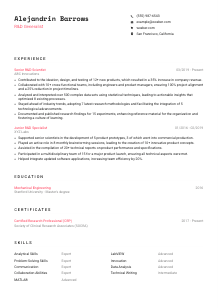
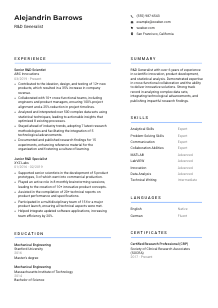
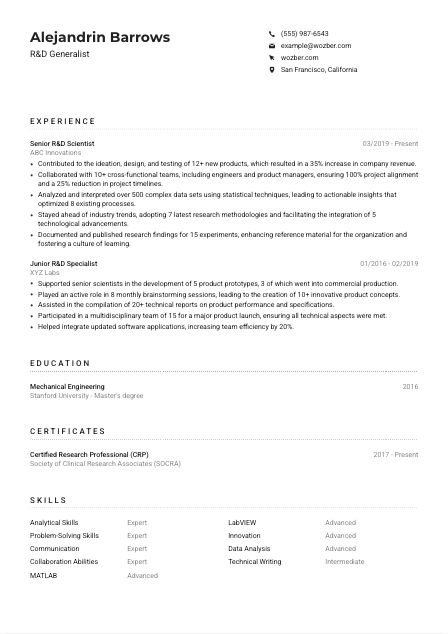
If a role specifies a location, include your city and state plainly. Here, "San Francisco, California" matters because the job description calls for candidates to be based there. When a posting includes a geographic requirement, meeting it in the header can prevent unnecessary screening friction.
Include LinkedIn or a professional website if it strengthens your case with technical depth. For R&D roles, that can mean published papers, patent work, project portfolios, conference activity, or detailed product and prototype work that does not fit neatly into resume bullets.
Leave out details such as age, marital status, or other personal identifiers unless they are explicitly requested for a formal application process. They do not help demonstrate research capability, software proficiency, documentation habits, or cross-functional collaboration.
Your header should confirm that you are easy to contact, correctly positioned for the role, and aligned with any practical requirement in the posting. Keep it lean, accurate, and useful.




This section carries the most weight for an R&D Generalist. Hiring managers look for proof that you have moved work from concept to experiment to outcome, while collaborating with engineers, product teams, or scientists and keeping the documentation strong enough for others to build on.
Start by identifying the recurring themes in the posting, then shape your bullets around them. For this role, that includes ideation, design and testing, data analysis, cross-functional collaboration, staying current with methods and technology, and documenting findings. If your experience covers those areas, make them explicit instead of assuming the reader will infer them.
List positions in reverse chronological order and keep each entry easy to scan. Include your title, company, and dates first, then move straight into bullets that show the scale of your research work, product contribution, or process improvement.
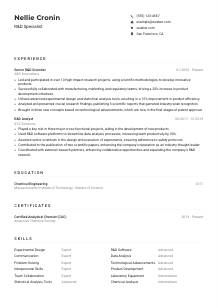
Focus each bullet on something you helped develop, test, analyze, improve, or document. Strong R&D bullets often reference prototypes, experiments, datasets, validation work, process changes, or product contributions. The sample resume does this well by tying work to concrete outputs such as new products, published findings, and optimized processes instead of relying on vague statements about innovation.
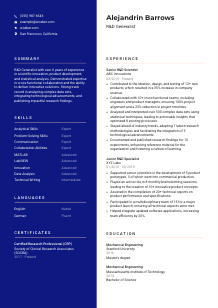
Numbers matter when they reflect how R&D work is actually judged. That may include number of products tested, datasets analyzed, process improvements delivered, reduction in development timelines, yield or efficiency gains, or revenue tied to successful launches. In the example, metrics such as 12+ new products, 500 analyzed datasets, and a 25% reduction in project timelines give the reader a clear sense of scope and contribution.
Trim bullets that do not support your case for this target role. If you have broad technical experience, prioritize work that shows analytical problem-solving, experimentation, software use such as MATLAB or LabVIEW, and collaboration with multidisciplinary teams. Save less relevant operational detail for interviews unless it directly supports the position you are targeting.
By the end of the experience section, a reader should understand the kind of R&D problems you have worked on, how you approached them, and what changed because of your work. That is the clearest route from past projects to present hiring confidence.
In R&D hiring, education often establishes your technical base before the reader gets to your project history. Degrees in engineering or scientific fields signal whether you have the academic grounding to work with experiments, product development, modeling, or structured analysis.
Mirror the posting's academic requirement clearly. Here, the employer asks for a bachelor's degree in a scientific or engineering field and notes that a master's is preferred. If you meet both, list them prominently, as the example resume does with a master's and bachelor's in Mechanical Engineering.
Keep each education entry easy to review by listing the degree, field of study, institution, and, when useful, graduation date. Technical recruiters do not need decorative formatting here. They need to confirm your discipline and level of study quickly.
If your degree title alone does not tell the full story, include a relevant concentration, thesis topic, lab focus, or capstone project. For an R&D Generalist, useful details often relate to materials, product design, systems modeling, manufacturing processes, experimental methods, or applied data analysis.
Relevant coursework can help if you are early-career or pivoting within technical fields. Choose subjects that map to the work, such as statistics, experimental design, controls, materials science, or product development. Leave it out if your professional experience already proves that depth more convincingly.
Honors, research assistantships, lab projects, competition teams, or published academic work can strengthen this section when they support the target role. Prioritize academic achievements that demonstrate experimentation, technical communication, or problem-solving under real research constraints.
Your education section should confirm that you meet the role's technical foundation and, where relevant, show added depth through advanced study or research-focused work. Keep it concise, but make the match unmistakable.
Certifications are usually a secondary factor in R&D hiring, but they can still sharpen your profile when they reinforce a method, domain, compliance area, or research practice that matters to the role. Include them selectively and make the relevance clear.
Start with the job description. If it requires or prefers a certification, match that wording closely. If no certificate is specified, use this section to support your broader technical profile rather than filling space with unrelated badges.
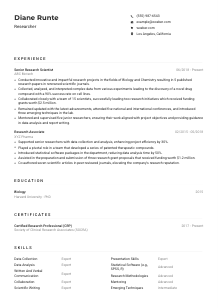
Prioritize credentials tied to research practice, product development, quality systems, laboratory operations, data analysis, or industry-specific standards. The sample resume includes a Certified Research Professional credential, which works because it reinforces structured research capability, though not every R&D Generalist role will require that exact certification.
Add the issue date or active period when the credential is current, recently earned, or subject to renewal. In technical environments, date context helps show whether your knowledge is current, especially for regulated methods, software-related certifications, or evolving research standards.
When your field changes quickly, recent certifications can show that you stay current with methods, tools, or emerging technologies. That is especially useful if you want to reinforce areas such as statistical analysis, instrumentation, validation, or specialized software beyond what appears in your degree history.
Treat certifications as supporting proof, not decoration. A short list of relevant, current credentials can strengthen your technical profile and show that your development has continued beyond formal education.
The skills section should read like a concise map of how you work. For an R&D Generalist, that usually means a mix of analytical tools, experimental thinking, technical communication, and the ability to work across disciplines without losing rigor.
Read the job description closely and note the software, analytical capabilities, and collaboration skills it names. Here, MATLAB, LabVIEW, analytical problem-solving, innovation, communication, and multidisciplinary teamwork all deserve attention because they are directly tied to the day-to-day work.
Lead with the abilities that are most likely to affect screening and interview decisions. In this case, that means technical analysis tools and research-oriented strengths before broader capabilities. The example resume handles this well by including both software skills and role-critical strengths such as data analysis, technical writing, collaboration, and problem-solving.
Group your skills around the actual work rather than trying to inventory everything you know. A shorter list with strong relevance is better than a long list of generic claims. If you use ratings, make sure they are honest and consistent with the complexity of work described in your experience section.
A hiring manager should be able to scan this section and understand the tools you use, the kind of problems you can solve, and how you contribute within an R&D team. Relevance matters more than volume.
Language ability matters in R&D when the work depends on clear documentation, cross-functional meetings, and accurate communication of methods and results. Keep this section practical and tied to how you actually operate in technical settings.
If the posting names a language requirement, list it clearly and at the right proficiency level. Here, effective English is a stated requirement, so it should appear first and be represented accurately.
Place the required or primary workplace language at the top of the section. For this role, English is central because the work involves documenting research findings, discussing data, and collaborating with engineers and product managers.
Additional languages can be useful when your work involves global suppliers, international research partners, multinational teams, or technical documents across regions. Include them when they are genuine strengths, not filler.
Use clear labels such as "Native," "Fluent," "Advanced," or "Intermediate." Overstating language ability can create problems quickly in interviews or collaborative technical work, especially when written documentation and precise terminology matter.
If multilingual ability has helped you in research collaboration, vendor communication, training, or publication work, it can add context to your candidacy. For many R&D roles, it is a bonus rather than a requirement, so present it as added capability rather than the center of your application.
List languages that support how you communicate in research and product environments. For this posting, clear English proficiency is essential, and any additional language should strengthen that technical communication profile.
The summary is your opening argument in a few lines. For an R&D Generalist, it should connect experience level, technical focus, and the type of outcomes you deliver, so the reader immediately understands where your background fits within the company's research and development work.
Before writing, identify the themes the role emphasizes most. Here, those are product or process development, testing, data analysis, innovation, documentation, and multidisciplinary collaboration. Build your opening around the mix you can genuinely support with experience.
Lead with your title or closest equivalent, your years of experience, and the domain where you have worked. The sample summary does this effectively by combining 6+ years of experience with scientific innovation, product development, and statistical analysis, giving the reader an immediate sense of level and focus.
Choose two or three strengths that are central to the position and likely to be backed up in your experience section. For this role, that may include analyzing complex datasets, working with engineers and product managers, improving processes, or integrating new methodologies and technologies.
Aim for a short paragraph, not a biography. Every sentence should earn its place by pointing to how you work and what results follow from that work. If your summary can be said about almost any technical professional, it needs more detail tied to research, experimentation, or product development.
A well-written summary gives the reader a fast, accurate read on your R&D background before they reach the rest of the page. Keep it specific enough to guide interpretation of your experience, skills, and education.
With the right revisions, your R&D Generalist resume should show a clear through-line from technical training to experimentation, analysis, collaboration, and documented results. Wozber's free resume builder helps organize that material into an ATS-friendly resume format that stays easy to review for both recruiters and technical hiring teams.
Before you send it, run a final check for language drawn from the posting, measurable outcomes, and section-level clarity. Wozber's ATS resume scanner can help surface missing requirements and strengthen ATS optimization, so the finished resume makes your research depth, software fluency, and cross-functional contribution easy to judge.