




Use Wozber and land your dream job
Create Resume
No registration required
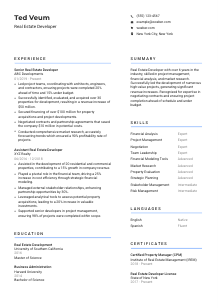
Building landscapes, but your resume feels foundation-less? Check out this Real Estate Developer resume example, created with Wozber free resume builder. It shows how to blueprint your property prowess to match job demands, ensuring your career skyline always reaches impressive heights!
Real estate development work is judged long before a project breaks ground. Hiring teams want to see whether you can move an opportunity from site evaluation to financing, entitlement, negotiation, and delivery without losing control of budget, schedule, or margin. Your resume needs to make that progression visible through concrete project outcomes, not broad claims about leadership or strategy.
When the resume is tailored well, the first scan quickly shows whether your background leans toward acquisitions, underwriting, full-cycle development, or a mix of all three. Using Wozber's free resume builder to shape an ATS-compliant resume helps you mirror the language of the posting while keeping project scale, financial results, and coordination scope easy to read. That makes it easier for a hiring team to see where you have already delivered profitable developments.
For real estate development roles, the header is practical. It should confirm who you are, how to reach you, and whether basic requirements like location can be checked immediately. Keep this section clean and businesslike so the reader can move straight into your deal and project background.
Place your full name at the top in a clear, readable format. This is standard, but it matters. A hiring manager reviewing acquisition pipelines, financial modeling experience, and development results should be able to identify your resume instantly without visual clutter.
Add "Real Estate Developer" directly under your name when that reflects your current or target role. It aligns your profile with the opening right away and helps frame the rest of the resume around development experience rather than adjacent backgrounds like brokerage, asset management, or construction operations.
Include a reliable phone number and a professional email address. Real estate development hiring often moves through calls with internal teams, lenders, partners, or executive stakeholders, so make it easy for employers to contact you without hunting through the page.
If the role requires you to be in a specific market, state your city and state in the header. For this opening, listing "New York City, New York" immediately answers a stated requirement. If you are relocating, note that clearly instead of leaving the employer guessing about market availability.
Include LinkedIn or a professional website only if it supports your candidacy. For a Real Estate Developer, that could mean a profile that reinforces transaction history, project portfolio, capital markets exposure, or major development milestones. Skip any link that looks outdated or thin compared with the rest of the resume.
This section does not need personality flourishes. It needs accuracy, professionalism, and any basic requirement the employer will check before reading your project record.




This is the section hiring teams read most closely. For a Real Estate Developer, titles alone are not enough. They want to know what you sourced, financed, negotiated, built, and delivered, along with the scale, timeline, and profitability behind those projects.
Start by marking the responsibilities that appear repeatedly in the job description. In this case, property acquisition, financial analysis, project leadership, contract negotiation, and market research are central. Those themes should shape which accomplishments you emphasize and how you describe each role.
List jobs in reverse chronological order with company name, title, and dates. Then make sure the bullets beneath each role show the type of development work you handled, such as residential or commercial projects, acquisition support, financing activity, or cross-functional delivery with architects, engineers, and contractors.
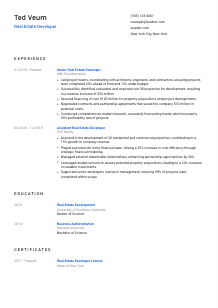
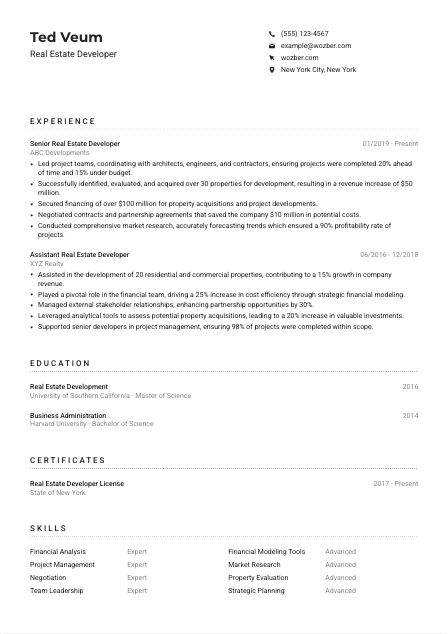
Each bullet should show an action and a business result. Strong examples for this profession include properties acquired, financing secured, contracts negotiated, revenue created, budget savings, or delivery performance. The sample resume does this well with results like securing more than $100 million in financing and acquiring over 30 properties, both of which map directly to this employer's priorities.
Numbers carry real weight in development hiring because they show scale and judgment. Include project counts, deal value, square footage when relevant, budget responsibility, schedule improvement, profitability, or cost savings. Metrics like "20% ahead of schedule" or "15% under budget" tell a hiring manager far more than saying you managed projects successfully.
Keep the section centered on work that supports a development mandate. If a past role included unrelated administrative tasks, remove them in favor of underwriting work, stakeholder coordination, due diligence, entitlement support, or partnership negotiations. Every bullet should help the reader picture you handling active development projects with commercial discipline.
The best experience sections make it easy to trace your contribution from opportunity assessment through execution. If the reader can quickly see project scale, financial responsibility, and delivery results, this section is doing its job.
Education matters in real estate development because it helps anchor your technical and commercial training. Most employers are looking for a relevant degree first, then using this section to understand how closely your academic path connects to finance, development, or business decision-making.
Start with the degree most aligned with the posting. Here, the employer asks for a bachelor's degree in Real Estate, Business Administration, Finance, or a related field, so that qualification should be easy to find. If you hold an advanced degree in development or real estate, place it above the bachelor's degree.
For each entry, include school, degree, field of study, and graduation year. Keep the structure simple so the employer can confirm your academic qualifications quickly. The example resume handles this well by listing both the master's in Real Estate Development and the bachelor's in Business Administration in a direct, readable format.
Name the exact field rather than leaving it implied. "Master of Science in Real Estate Development" or "Bachelor of Science in Business Administration" tells the employer more than a degree title alone, especially when the job calls for commercially grounded education.
If you are earlier in your career, include coursework, capstone projects, or development-related academic work tied to financial modeling, urban development, investment analysis, or market feasibility. If you already have more than 5 years of experience, keep this section tighter unless a project is unusually relevant.
Honors, scholarships, leadership roles, or major academic projects belong here if they support your development profile. A finance competition, real estate case study, or graduate development thesis is useful. Generic campus activities are usually not worth the space once your professional track record is established.
This section should confirm that your education supports the analytical and commercial side of development work. Make the degree match obvious, then let your experience carry most of the weight.
In real estate development, certifications can matter for regulatory credibility, market access, and professional standing. They are especially useful when a posting explicitly asks for a license or certification, as this one does.
If the employer names a specific license or certification, list it at the top of this section. For this posting, an active Real Estate Developer License or similar credential should be impossible to miss. That placement helps the reader confirm compliance within seconds.
Choose credentials that reinforce your ability to work in acquisitions, project oversight, property operations, or development leadership. The sample includes both a Real Estate Developer License and a CPM designation, which works because each supports a different part of the real estate business.
Include issuer and dates, especially when the credential is active, renewable, or market-specific. In regulated fields, outdated licensing information creates doubt quickly. Make sure the dates on your resume match your current standing.
Recent certifications in project finance, commercial real estate analysis, construction management, or sustainability can strengthen your profile when they relate to the role. Add them selectively. The point is to show relevant professional development, not to build a long inventory of unrelated courses.
A short, targeted certifications section can remove uncertainty fast. Prioritize active, relevant credentials that support the type of development work the employer needs you to handle.
A Real Estate Developer's skills section should read like the toolkit behind successful deals and project execution. The most useful mix includes commercial judgment, financial capability, negotiation strength, and the operational skills needed to move projects through multiple stakeholders and deadlines.
Start with the terms used in the posting. Here that includes financial analysis, financial modeling tools, project leadership, contract negotiation, market research, and the ability to manage multiple large-scale projects. Those should appear naturally if they reflect your actual background.
This profession sits between finance, execution, and relationship management, so your skills list should reflect that range. Pair hard skills like underwriting, feasibility analysis, pro forma modeling, and property evaluation with leadership skills such as team coordination, stakeholder management, and negotiation.
Keep the strongest, most job-relevant skills near the top. The sample resume does this well by leading with Financial Analysis, Project Management, Negotiation, and Team Leadership before listing supporting capabilities like Market Research and Risk Management. That ordering helps the reader understand the candidate's operating strengths quickly.
This section should reinforce how you operate in development, from underwriting an opportunity to closing agreements and guiding delivery. If the skills echo the job description and your experience bullets, they will feel credible.
Language ability matters in real estate when the role involves negotiations, investor communication, public-facing coordination, or work across diverse markets. Even when only one language is required, this section can still help clarify communication strength.
If the job asks for a specific language level, put that language first. This employer requires advanced English speaking and comprehension, so English should be listed prominently and with an accurate proficiency level.
Additional languages can strengthen your profile when you work with varied communities, international capital, or multilingual stakeholders. For example, Spanish can be useful in many urban markets and may support tenant, partner, or community communication depending on the project context.
Choose simple ratings such as Native, Fluent, Advanced, Intermediate, or Basic. Hiring teams do not need a long explanation here. They need a quick, reliable sense of whether you can operate in meetings, negotiations, reporting, or day-to-day communication.
If you have worked on developments involving cross-border investors, multilingual communities, or regionally diverse stakeholder groups, language skills become more than a nice extra. They support smoother communication in approvals, negotiations, and relationship management.
Do not overstate the strategic value of languages if the role is primarily domestic and English-led. List them honestly and let them complement the main story. For a market like New York City, additional languages can be relevant, but they should support, not overshadow, your development credentials.
Language skills are most convincing when they clearly support the kind of stakeholders and markets you work with. Keep the section factual and relevant to the communication demands of the role.
The summary should quickly tell the reader what kind of Real Estate Developer you are. In a few lines, show your years of experience, your development strengths, and the type of commercial results you have delivered so the rest of the resume has a clear frame.
Start with your title and years of experience in real estate development or a closely related area. That immediately positions you for roles that require a minimum experience threshold, like the 5+ years requested here.
Mention two or three strengths that sit at the heart of development work, such as project leadership, financial analysis, acquisitions, market research, or contract negotiation. The sample summary works because it centers on project management, financial analysis, and market research rather than offering generic leadership language.
A summary becomes more convincing when it includes measurable impact. That could be revenue growth, financing secured, cost savings, project profitability, or delivery performance. Even a short reference to high-value projects completed ahead of schedule gives the reader a clearer picture of your operating level.
End by reinforcing the kind of contribution you bring to a development team, such as identifying profitable opportunities, delivering projects within budget, or leading cross-functional execution. Avoid vague future-facing statements. Use the final line to strengthen the business case for your candidacy.
A good summary should sound like someone who understands deals, delivery, and profitability. If those points are clear in the first few lines, the hiring team will read the rest of the resume with the right context.
A Real Estate Developer resume should make one thing clear fast: you know how to evaluate opportunities, structure deals, lead project teams, and deliver profitable outcomes. When each section supports that story with relevant education, active credentials, measurable project results, and the right terminology, the resume starts reading like a development professional's track record rather than a generic management profile.
Use Wozber's free resume builder to tighten structure, strengthen ATS optimization, and shape your content into an ATS-friendly resume format that reflects the language of the role. The end result should make it easy to judge your readiness for acquisitions, financing, negotiation, and project delivery.