



Use Wozber and land your dream job
Create Resume
No registration required
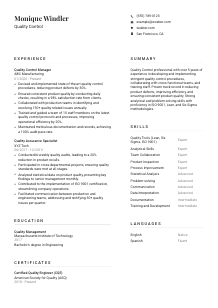
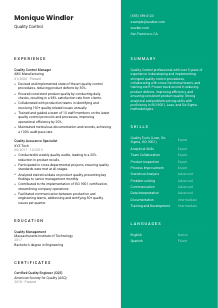
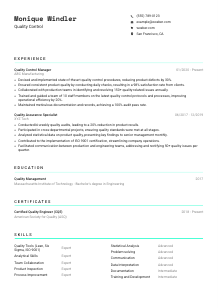
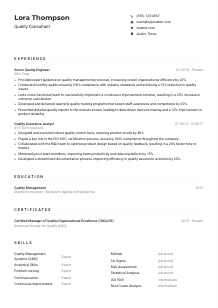
Maintaining high standards, but your resume isn't passing the test? Learn from this Quality Control resume example, created with Wozber free resume builder. It shows how to showcase your attentiveness and expertise to match job requirements, paving your professional path to top-grade success!
Quality Control work sits where process discipline meets business risk. Hiring teams want to see whether you can prevent defects, catch issues early, keep documentation audit-ready, and work with production without slowing output. Your resume should make that operating standard visible, not just list inspections or quality tasks.
When a Quality Control resume is tailored well, the first read quickly shows whether your background matches the plant floor, reporting discipline, and continuous improvement work behind the title. Wozber's free resume builder helps shape that into an ATS-compliant resume by aligning your wording with the job description and making core terms such as audits, inspections, statistical analysis, and ISO standards easy to find. That gives hiring teams a clearer view of how you handle product quality in real operations.
This section is simple, but it still affects how smoothly your application moves. For Quality Control roles, hiring teams should be able to identify you, contact you, and confirm practical details such as location without hunting through the page.
Place your full name at the top in a clean, readable format. Keep it more prominent than the rest of the contact details so the document feels professional and structured from the first line.
Add "Quality Control" under your name if that matches the role you are pursuing. This helps frame the rest of the resume immediately, especially when recruiters are reviewing several adjacent profiles such as quality assurance, production, and process improvement candidates.
Use a phone number you answer and an email address that looks business-ready. A small typo here can cost an interview, so check every character. If you include a website or LinkedIn profile, make sure the content supports your resume with consistent titles, dates, and quality-focused achievements.
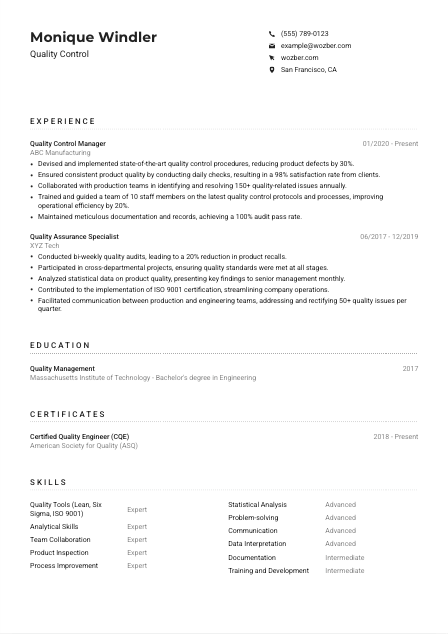
If the employer asks for a specific location or relocation willingness, answer that requirement plainly in this section. In the example, listing San Francisco, CA directly supports the posted requirement and removes an avoidable question from the screening process.
A polished LinkedIn profile, portfolio, or professional site can help if it reinforces your quality background with certifications, process improvement work, audit exposure, or manufacturing experience. Only include links that are current and aligned with the role you are targeting.
Your personal details do not need flair. They need accuracy, professionalism, and any logistics the employer asked for, so the resume can move straight to your quality credentials.




For Quality Control hiring, this is usually the section that carries the decision. Employers look for process ownership, defect reduction, audit discipline, root-cause problem solving, and collaboration with production or engineering teams. Write your experience so those responsibilities appear in clear, measurable terms.
Read the posting for the work behind the title. Here, the priorities are clear: implement quality control procedures, run regular checks and audits, resolve quality issues with production, train staff, and maintain records. Those are the themes your experience bullets should reflect, using language that matches your actual background.
List roles in reverse chronological order and give the most space to positions tied to manufacturing, production quality, inspections, process control, or compliance systems. If you have held both broader QA and direct shop-floor QC roles, emphasize the parts involving product consistency, corrective action, and documented quality procedures.
Do not stop at "performed inspections" or "handled audits." Show what changed because of your work. The sample resume does this well with bullets such as reducing product defects by 30%, resolving 150+ quality issues annually, and achieving a 100% audit pass rate. Those numbers make your contribution easier to evaluate in a production setting.
Shape bullets around work that matters in Quality Control: inspections, nonconformance tracking, CAPA support, process improvement, statistical analysis, documentation, supplier or internal audits, and cross-functional problem solving. If the job asks for collaboration with production teams, include examples where you worked across functions to correct recurring defects or improve process compliance.
Use metrics that belong naturally to quality work. Strong examples include defect reduction, recall reduction, audit pass rates, first-pass yield, issue resolution volume, customer complaint trends, scrap reduction, training coverage, or process efficiency gains. Numbers are especially persuasive in Quality Control because they show whether your methods held up under real operating conditions.
A strong experience section shows how you controlled variation, improved product consistency, and kept quality systems working day to day. If your bullets connect process actions to results, hiring teams can picture you in the role quickly.
Quality Control roles often sit close to engineering, manufacturing, and compliance, so education helps establish your technical base. Keep this section straightforward and make the connection to quality methods easy to understand.
If the posting calls for a bachelor's degree in Engineering, Quality Management, or a related field, list that credential clearly. Meeting the academic requirement early removes doubt and keeps attention on your experience and results.
Include degree, field of study, school, and graduation year. That is usually enough for Quality Control roles unless the employer specifically asks for more academic detail.
When your major directly supports quality work, state it clearly. In the example, a bachelor's degree tied to Engineering and Quality Management reinforces the candidate's grounding in process control and technical analysis.
You do not need to overload this section, but relevant coursework can help earlier-career candidates. Subjects such as statistical quality control, manufacturing systems, reliability, process engineering, or data analysis are worth mentioning when they connect directly to the job.
If you are early in your career, a senior project, lab work, or quality improvement initiative can add useful context, especially if it involved defect analysis, process validation, Lean methods, or documented improvement outcomes. Once you have substantial work experience, keep these details brief.
Your education section should confirm that you have the academic grounding for quality systems, process analysis, and production-facing problem solving. Clear formatting is usually all it takes.
Certifications carry weight in Quality Control because they point to recognized methods, standards, and discipline. They are especially useful when the role mentions Lean, Six Sigma, ISO 9001, or other structured quality frameworks.
Lead with credentials that connect directly to inspection, process improvement, compliance, or statistical quality work. A certification such as Certified Quality Engineer can quickly strengthen your profile for roles that require structured quality knowledge.
Only include certifications that support the type of work you want to do. For this profession, employers usually care more about recognized quality and process credentials than unrelated general training courses.
List the year earned and, if relevant, the active period or renewal status. That helps employers see whether your certification is current, which matters for standards-based environments and regulated production settings.
Recent or advanced certifications can help demonstrate that you stay current with process improvement and compliance expectations. In a field shaped by audits, documentation standards, and corrective action discipline, recent learning adds credibility.
Well-chosen certifications support the story your experience already tells. They work best when they reinforce the quality tools, standards, and improvement systems you have actually used on the job.
The skills section should read like a practical snapshot of how you operate in Quality Control. Focus on the methods, tools, and collaboration strengths that support inspection, analysis, corrective action, and process consistency.
Pull out the skills that appear in the job description and use equivalent wording where it matches your background. For this opening, that includes quality control procedures, statistical analysis, problem-solving, relevant software tools, communication, and collaboration with cross-functional teams.
Prioritize skills tied to actual QC work: audits, inspections, ISO 9001, Lean, Six Sigma, statistical analysis, data interpretation, documentation, root-cause analysis, process improvement, and production support. The example skills list works because it stays close to the methods and work habits used in quality environments.
If your format allows it, group skills by category such as quality systems, analytical tools, and collaboration or training. That makes it easier for both ATS screening and human readers to see your technical depth and your ability to work across production, engineering, and operations.
Every skill listed should connect to work you can discuss in an interview. In Quality Control, specificity matters more than volume.
Language ability matters in Quality Control when the role involves documentation, audit communication, production support, or coordination across teams and suppliers. Keep this section factual and tied to how you work.
If the posting explicitly requires strong verbal and written English, list English clearly with your proficiency level. That matters in Quality Control because reports, deviations, audit records, and training instructions all depend on precise communication.
Put English first when it is the working language of the role. Label it honestly as Native, Fluent, or another accurate level so there is no ambiguity.
Additional languages can be useful when working with multilingual teams, suppliers, clients, or global quality standards. Include them if they are real working strengths, not just partial familiarity.
Use clear levels such as Native, Fluent, Advanced, or Intermediate. In quality work, misjudging language ability can affect report accuracy, training effectiveness, and issue escalation, so keep this section honest.
Extra language skills are most valuable when they improve communication in audits, supplier discussions, cross-border manufacturing, or documentation review. They are a plus, but they should support, not replace, your core quality credentials.
Language skills matter when they improve reporting, training, and coordination. Present them clearly, and let them complement your technical quality background.
Your summary should quickly establish the kind of Quality Control professional you are. In a few lines, show your level of experience, the environments you know, the quality methods you use, and the results you have delivered.
Before writing, identify the few requirements that define the job. For this posting, the essentials are quality control procedures, inspections and audits, statistical analysis, cross-functional issue resolution, staff guidance, and documentation discipline. Those points should shape your summary language.
Start with a direct description such as your years in Quality Control and the type of environment you know best, especially if you have manufacturing or production experience. That context helps employers place your background quickly.
Mention the quality frameworks, tools, or standards you actually use, then support them with outcomes. The example summary works because it combines five-plus years of experience with defect reduction, efficiency improvement, and familiarity with ISO 9001, Lean, and Six Sigma.
Aim for 3 to 5 lines. That is enough room to cover experience, core strengths, and one or two business results without repeating the experience section. In Quality Control, a concise summary with real methods and measurable outcomes carries more weight than broad statements about passion or excellence.
A well-written summary tells the reader, early on, that you understand process control, documentation, and quality improvement in practical terms. It should make the rest of the resume feel consistent and credible.
A Quality Control resume works when each section supports the same conclusion: you can maintain standards, solve recurring quality issues, and keep records, audits, and production processes under control. Use the job description to shape your language, then back it up with concrete results from your own work.
Wozber's free resume builder can help you organize that story into an ATS-friendly resume format, and its ATS resume scanner can surface missing requirements or terminology before you apply. The final resume should make one thing easy to judge. Can you protect product quality in a real operating environment?




