



Use Wozber and land your dream job
Create Resume
No registration required
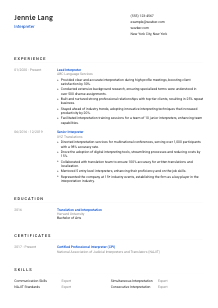
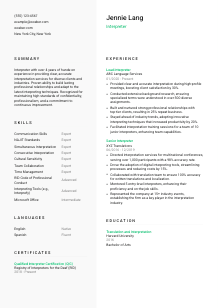
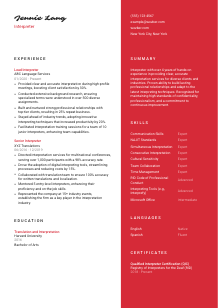
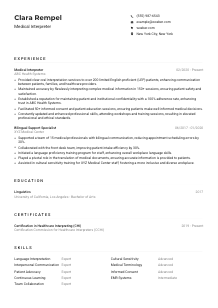
Breaking language barriers, but your resume feels lost in translation? Learn what makes an Interpreter resume example compelling, created with Wozber free resume builder. It shows how to present your bilingual brilliance to match job requirements, positioning your career as the voice that resonates in any linguistic soundscape!
Interpreting work is judged in the moment. One missed nuance, one poorly handled term, or one lapse in neutrality can change the outcome of a meeting, hearing, conference, or client conversation. Your resume needs to show more than bilingual ability. It should make clear that you can interpret accurately under pressure, prepare for subject matter in advance, and handle confidential communication with professional discipline.
Hiring teams often sort interpreter resumes by whether the candidate can already operate in the settings they serve, not just by language pairs alone. Using Wozber's free resume builder to tailor your wording and keep an ATS-compliant resume clean helps surface the right details fast, such as interpretation formats, domain exposure, certifications, and measurable client-facing results. That gives employers a clearer read on how you will perform when accuracy and trust matter.
For interpreters, the header should confirm availability and professional identity without clutter. Keep it clean, direct, and aligned with the practical filters that affect whether you can be contacted, screened, and scheduled for assignments.
Use your full name as the most visible line on the page. Interpreting is a trust-based profession, and a clean header sets a professional tone before the reader reaches your experience. Keep formatting simple and easy to scan.
Place "Interpreter" directly under your name if that matches the role you are applying for. If your background is more specialized, you can use a precise title when it reflects your work, such as "Medical Interpreter" or "Conference Interpreter," but only when it fits the opening.
Add a phone number you answer and a professional email address, ideally based on your name. Since interpreter hiring can move quickly for scheduled events, interviews, or contract coverage, make it easy for employers or agencies to reach you without hesitation.
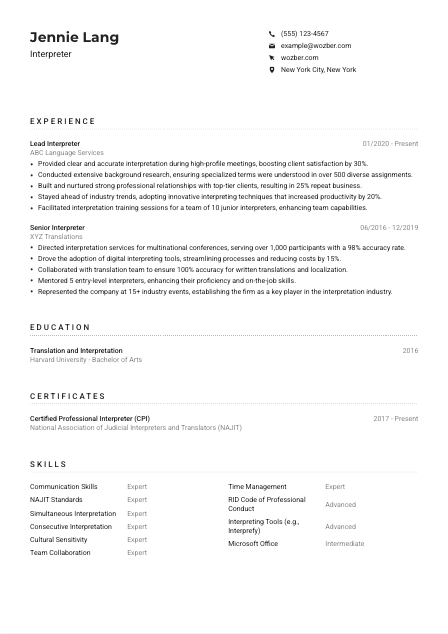
Some interpreter roles are tied to on-site meetings, hearings, or local client coverage. In the example posting, New York City is a stated requirement, so listing "New York City, New York" immediately removes doubt about availability. If relocation is relevant, make that clear in a concise way.
Include LinkedIn or a professional website if it reinforces your credibility with relevant experience, certifications, language pairs, or interpreting specialties. Keep it current. If an employer checks it, the same titles, dates, and credentials should match your resume exactly.
Your personal details should answer the basic operational questions right away: who you are, what role you do, how to contact you, and whether you meet location requirements for the assignment.




This section carries the most weight for an interpreter. Employers want to see where you have interpreted, what settings you handled, how you prepared for specialized content, and whether clients trusted you with sensitive communication.
Read the posting closely and highlight the verbs and responsibilities tied to actual interpreting work. For this role, that includes providing clear and accurate interpretation, researching terminology, maintaining confidentiality, and working well with clients and other interpreters. Mirror that language where it matches your real experience so your resume reflects the employer's operating priorities.
Start with your most recent interpreting position and include job title, organization, and dates. This makes it easy to track your progression from assignments or staff roles into senior, lead, or specialized interpreting work. A clear timeline also helps employers gauge whether you meet experience requirements such as the 3+ years requested here.
Each bullet should show what you interpreted, in what environment, and what result followed. Good interpreter bullets often reference meeting types, participant volume, domain complexity, repeat client business, accuracy, or satisfaction. The sample resume does this well by pairing core work with outcomes like a 30% rise in client satisfaction and 25% repeat business.
Metrics are especially useful when they describe assignment volume, conference size, repeat bookings, turnaround improvements, productivity gains, or quality indicators. You do not need a number in every bullet, but when you can say you supported more than 500 assignments or served 1,000 conference participants, the scale becomes much easier to understand.
Prioritize bullets that show interpretation formats, client-facing communication, confidentiality, terminology research, collaboration with linguists, and adoption of interpreting tools. Cut achievements that do not help explain your value in live language work. Even leadership points, such as training junior interpreters, should connect back to interpreting quality or team capability.
Your experience section should leave no doubt that you can handle real assignments, prepare for subject matter, and deliver accurate interpretation in professional settings.
Education matters most when it clarifies your training in interpretation, translation, linguistics, or a closely related field. Keep it easy to verify and place the most relevant qualification where it can be found quickly.
If the employer asks for a bachelor's degree in Translation, Interpretation, or a related field, make sure that credential is clearly listed. In the example, a Bachelor of Arts in Translation and Interpretation aligns directly with the posting and strengthens the first pass review.
List degree, field of study, school, and graduation year in a consistent format. Interpreter hiring often moves through quick screening before a deeper review, so clarity matters more than design flourishes in this section.
If your degree title, major, concentration, or program track reflects interpreting, translation, bilingual communication, or language studies, do not bury it. That detail helps employers distinguish formal training from general language exposure.
Recent graduates can include selected coursework when it strengthens the resume, especially in legal, medical, conference, sign language, or terminology-heavy training. For experienced interpreters, professional experience usually carries more weight, so coursework should stay brief or be omitted.
Honors, capstone projects, interpreting labs, study abroad with language immersion, or research in intercultural communication can all be relevant when they support your professional direction. Choose details that connect to actual interpreting practice rather than general campus activity.
Education should confirm that your language ability is backed by structured study, especially when the role asks for formal preparation in interpretation or a related discipline.
Certifications carry real weight in interpreting because they point to ethical standards, tested competence, and commitment to ongoing practice. Use this section to show credentials that matter in the settings you serve.
When a posting mentions credentials from organizations such as NAJIT or RID, move related certifications to the top of the section. Even when certification is listed as preferred rather than required, it can strengthen your standing, especially for regulated, legal, or accessibility-focused environments.
List the certifications most relevant to the target role first. For example, a judicial, community, medical, or deaf interpretation credential says much more than a broad training certificate if it matches the assignments you want to handle.
If a certification is active, renewed, or valid through an ongoing date range, include that information. It reassures employers that your professional standing is current and that you continue to meet the standards attached to the credential.
Interpreting practice changes with remote platforms, terminology demands, and industry expectations. Recent certifications or renewals can show that you are keeping pace with current methods and tools, not relying only on older training.
Well-chosen certifications show that your work is grounded in recognized standards, not just informal fluency or experience alone.
A skills section for interpreters should read like the toolkit behind reliable language delivery. Focus on capabilities that affect live interpretation quality, client communication, research, and workflow in professional settings.
Use the job description to identify the skill mix the employer actually needs. Here, that includes interpersonal communication, written and verbal clarity, confidentiality, collaboration, and staying current with interpreting techniques and tools. Add the ones you genuinely use, using wording close to the posting when accurate.
Include hard skills such as simultaneous interpretation, consecutive interpretation, terminology research, note-taking, remote interpreting platforms, or localization collaboration where relevant. Pair them with role-critical qualities like impartiality, cultural sensitivity, and client communication, since interpreter performance depends on both.
Do not crowd this section with every transferable skill you have. Choose the skills that best support the assignments you want. The sample resume works because it combines interpretation methods, standards awareness, cultural sensitivity, collaboration, and tools in one focused list rather than scattering attention across unrelated software.
Your skills list should quickly show the methods, judgment, and professional habits you bring to live interpreting work.
For an interpreter, language listing is a core qualification, not a side detail. Employers need a clear, honest view of your working languages so they can match you to the right meetings, clients, and subject matter.
If the role calls for English plus at least one other language, list those languages at the top and state your proficiency level clearly. This posting requires exactly that, so the language section should make compliance obvious within seconds.
Use familiar levels such as Native, Fluent, Advanced, Intermediate, or Basic, and be honest. In interpreting, overstating proficiency is especially risky because employers may test you in conversation, scenario work, or terminology-heavy settings.
Extra languages can strengthen your profile when they are genuinely usable in professional or community settings. They are particularly helpful if you work across multilingual client populations, events, or international business environments.
If helpful, let the rest of the resume reinforce where you use your languages, such as conference interpretation, legal proceedings, client meetings, or cross-functional business support. The section itself should stay clean, while your experience provides the context.
Only list languages you could responsibly use in the settings you are pursuing. A credible language section helps employers staff interpreters with confidence, which is far more valuable than an inflated list.
Your language section should make your working language pair or pairs immediately clear and believable for the level of interpretation the role requires.
Your summary should quickly establish the kind of interpreter you are, how much experience you bring, and what environments or standards define your work. Keep it short, specific, and grounded in real practice.
Before writing, identify the few requirements that matter most in the target job. For this interpreter opening, the biggest themes are accurate interpretation, confidentiality, subject-matter preparation, and professional communication. Those are stronger anchors than broad claims about being passionate or hardworking.
Open with your years of experience and the type of interpreting work you do. If you have supported conferences, client meetings, legal settings, or multilingual business communication, mention the relevant area so the reader can place your background quickly.
Include details that show how you work, such as handling specialized terminology, maintaining impartiality, building client trust, or improving service quality. The example summary works because it ties years of experience to accuracy, relationship building, and professional standards without trying to cover an entire career.
Aim for three to five lines with tight language. The summary should set context for the rest of the resume, not repeat every skill or credential. A hiring manager should finish it with a clear sense of your language work, reliability, and likely fit for the assignment.
A well-written summary gives hiring teams a fast, credible picture of your interpreting background and the level of responsibility you can handle.
A tailored interpreter resume should show how you handle live communication where accuracy, neutrality, and preparation all matter. When each section supports that story, employers can quickly connect your language skills to the kinds of meetings, clients, and subject matter they need covered.
Use Wozber to keep that tailoring consistent across wording, structure, and ATS optimization, whether you are refining a first draft or updating an existing resume. The result should be an ATS-friendly resume format that makes your certifications, language proficiency, interpreting experience, and professional judgment easy to evaluate.
That is the standard your resume needs to meet before you send it.




