



Use Wozber and land your dream job
Create Resume
No registration required
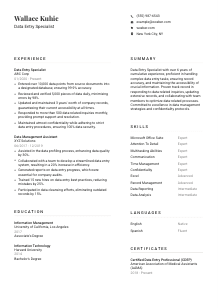
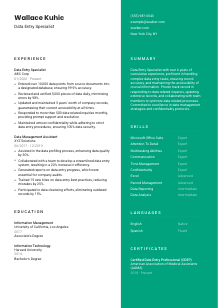
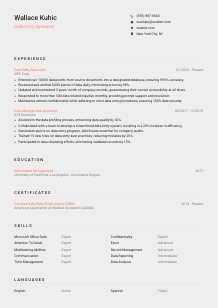
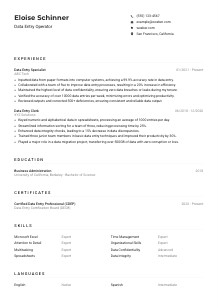
Keying in details, but your resume feels disconnected? Check out this Data Entry Specialist resume example, created with Wozber free resume builder. Learn how to put your attention to detail and accuracy to work so they match job requirements, making your career path as clean and organized as your data entries!
Data entry work is measured in the details. A hiring team wants to see that you can move high volumes of information from source documents into databases, forms, or spreadsheets without introducing errors, and that you can keep records current when accuracy affects reporting, service, or compliance. Your resume needs to make that operating standard visible early.
In this field, small wording choices change how your background is read by both recruiters and ATS filters. Wozber's free resume builder helps you shape an ATS-compliant resume around the exact language of the job, so terms like Excel, record maintenance, data verification, and confidentiality show up where they matter. That makes it easier to see whether you can handle the pace, precision, and record ownership the role requires.
For data entry positions, the header does more than provide contact information. It confirms basic eligibility, shows professionalism, and removes avoidable friction before anyone reaches your experience section. Keep it clean, accurate, and aligned with the posting.
Put your full name at the top in a readable format, then place your target title directly underneath. Using "Data Entry Specialist" helps the recruiter and the ATS connect you to the role immediately, especially when they are reviewing many administrative or operations profiles at once.
Data entry hiring naturally puts a spotlight on precision, so your own phone number and email address need to be flawless. Choose a professional email, double-check every digit, and avoid decorative formatting that can create parsing issues or make a simple typo look like a pattern.
Some openings have a fixed on-site or local requirement. Here, New York City, NY is specifically requested, so listing that in your personal details removes an immediate question about availability. Treat location this way when it is a stated condition, not as a universal rule for every data entry resume.
If your previous title was broader, such as Data Management Assistant, you can still use a target headline that reflects the role you are pursuing, as long as the rest of the resume supports it. This helps position your background around data entry, record accuracy, and database maintenance rather than around unrelated admin work.
A LinkedIn profile can support your application when it reflects the same dates, titles, and responsibilities shown on your resume. If you include one, make sure it reinforces experience with spreadsheet work, record updates, reporting, or data support rather than introducing inconsistencies.
Your header should answer the practical basics fast: who you are, how to reach you, whether you meet stated location requirements, and whether your profile is clearly aimed at data entry work.




This section carries the most weight for a Data Entry Specialist. Employers want to know what systems you worked in, how much information you handled, how accurately you maintained records, and whether you supported the people who relied on that data every day.
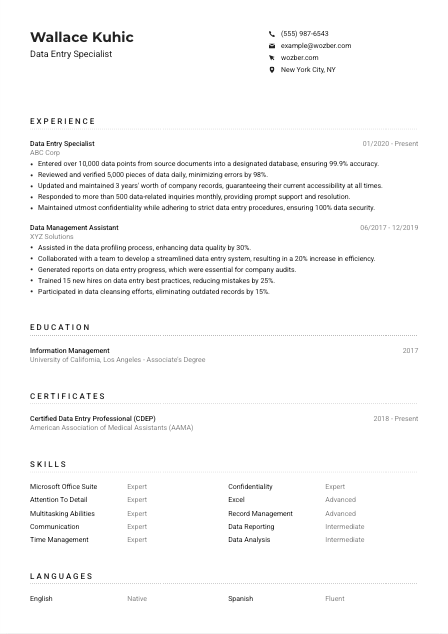
Prioritize positions where you entered, updated, reviewed, or organized data in databases, files, forms, or spreadsheets. Even if a prior title was not identical, keep the emphasis on tasks that match the role, such as document-to-system entry, record maintenance, data validation, or responding to data-related requests. The sample resume does this well by connecting both roles to data quality and process support.
List your most recent role first, then work backward with company name, title, and dates. For data entry hiring, this structure helps reviewers quickly track your recent workflow exposure, whether that means daily Excel use, database updates, or production-volume entry work.
Numbers matter here because they show scale and reliability. Metrics like "entered over 10,000 data points," "reviewed 5,000 pieces of data daily," or "maintained 99.9% accuracy" tell a hiring team far more than general claims about being detail-oriented. Use measures that reflect the work you actually did, including daily volume, turnaround, error reduction, response load, or record count.
Rework your bullets so they reflect the employer's wording where it truthfully matches your background. If the posting mentions entering data from source documents, verifying accuracy, maintaining current records, and supporting inquiries, those ideas should appear in your experience section in natural language. That strengthens ATS optimization and makes your relevance easier to read.
A data entry resume benefits from focus. Leave out older or unrelated jobs unless they clearly involve high-volume documentation, system updates, confidential records, or administrative data handling. The space is better used on bullets that show consistency, accuracy, and familiarity with the pace of structured information work.
By the end of the experience section, a recruiter should understand your data volume, your accuracy level, the systems or tools you used, and the business support your recordkeeping made possible.
Education is usually a supporting section for data entry roles, but it still helps establish baseline qualifications and relevant technical grounding. Present it clearly, and give extra attention to it if the posting names a required diploma or a preferred field of study.
If the job asks for a high school diploma or equivalent, make sure that baseline is visible. If you also hold an Associate's or Bachelor's degree in a related area, include it because it can strengthen your profile. In the example, degrees in Information Management and Information Technology reinforce comfort with structured data and systems.
List school, degree, field of study, and graduation year in a consistent format. Data entry roles usually do not require long academic descriptions, so a straightforward layout works best and keeps attention on your experience and skills.
Programs connected to information management, office administration, business technology, or IT can add context for your ability to handle records, software, and organized workflows. If your degree is in an unrelated subject, you can still include it without forcing a connection that is not there.
If you are early in your career, short coursework in Excel, database basics, records management, or business software can strengthen this section. Use it selectively, especially when that training helps bridge limited direct experience.
Honors, scholarships, or student roles are worth mentioning if they show organization, consistency, or technical competence. Keep them brief. For experienced candidates, formal achievements should not crowd out stronger proof from day-to-day data work.
Education should confirm that you meet the posted requirement and, when relevant, add useful context for your comfort with systems, structured information, and office tools.
Certifications are not mandatory for most data entry openings, yet they can still help when they show stronger command of office software, records handling, or data quality practices. The key is relevance, not quantity.
If a posting does not require certification, treat this section as supporting proof rather than filler. A credential related to data entry, office systems, or records management can help underline your seriousness about accurate information handling.
Prioritize certifications that connect to the actual workflow of the role, such as spreadsheet proficiency, business software, database work, or document control. The example's Certified Data Entry Professional credential fits because it speaks directly to the function of the job.
Include the issue date and, if relevant, the expiration or active range. Current credentials matter more than old ones in software-related work, especially when the role depends on present-day familiarity with office tools and process standards.
If you are building toward stronger administrative or data operations positions, ongoing training in Excel, reporting, data quality, or confidentiality practices can add weight. Keep the list selective so it sharpens your resume instead of diluting it.
A short, relevant certification list can reinforce your technical discipline and show that your approach to data accuracy is supported by formal training, not just routine repetition.
For a Data Entry Specialist, the skills section should read like the toolkit you actually use to process information accurately and keep records usable. That means software competence, data handling habits, and dependable execution under volume.
Start with the language the employer already used. In this job description, that includes Microsoft Office Suite, Excel, attention to detail, multitasking, communication, and time management. If you genuinely have those capabilities, mirror them so your resume matches the role in both substance and terminology.
Data entry hiring usually looks for a combination of hard and soft skills. List tools such as Excel, record management, database entry, or reporting alongside work habits like accuracy, confidentiality, and deadline management. The sample resume handles this balance well by pairing Office skills with detail orientation and record maintenance.
Order matters. Lead with the skills most likely to be screened for, especially spreadsheet proficiency, data accuracy, and record upkeep. If you use proficiency levels, keep them believable and consistent with the experience section so the resume reads as credible.
Your skills section should quickly confirm that you can work in the tools named in the posting and that you have the accuracy, pace, and organization needed for repetitive, high-stakes data work.
Language ability is usually a supporting detail for data entry, but it becomes important when the posting names a required working language or when the role involves internal support, customer-facing responses, or records coming from multiple sources.
This posting states that performing the job in English is essential, so English should appear clearly with an accurate proficiency level. That is especially important in a role where source documents, forms, and inquiry handling all depend on precise reading and written communication.
Extra languages can help if the company serves multilingual customers, processes international records, or supports diverse teams. They are a useful bonus, not a replacement for the core data entry qualifications.
Terms such as Native, Fluent, Intermediate, and Basic are easy to understand and ATS-friendly. Avoid vague descriptions. In administrative roles, overstating language ability can create practical problems once communication or document handling begins.
If another language has helped you process forms, answer data-related inquiries, or work with records from bilingual environments, that is worth keeping on the resume. Keep the mention practical rather than decorative.
For most data entry jobs, languages should support the application, not dominate it. A concise list is enough unless multilingual work is central to the position.
Used well, language details confirm you meet required communication standards and can support record handling accurately in the environments where you have actually worked.
The summary needs to establish your profile in a few lines and point the reader toward the right strengths. For data entry roles, that usually means years of experience, accuracy, familiarity with office tools, record maintenance, and the kind of operational support your work enables.
Start with your title and years of relevant experience so the reviewer immediately knows your lane. A phrase like "Data Entry Specialist with 6+ years of experience" is direct and effective because it frames the rest of the resume around sustained work in data handling.
Choose the abilities the posting emphasizes most, such as accurate data entry, record updates, Excel proficiency, and response support. The sample summary does this by focusing on complex data entry tasks, record accuracy, accessibility of information, and confidentiality.
A summary should not repeat every skill or every bullet from your work history. Use a few precise details that reflect the role's core workflow and leave the metrics for the experience section, where they have more room to work.
This section should shift with the target job. If one employer stresses database updates and document accuracy while another stresses reporting support or confidential records, adjust your wording so the first lines of the resume point to the right strengths. Wozber's AI resume builder is especially useful here for aligning your summary language with the posting without making it sound robotic.
A well-tailored summary tells the reader, within seconds, that you already understand the rhythm of data entry work and can be trusted with accurate, current, and confidential records.
A Data Entry Specialist resume should leave very little open to interpretation. The hiring team should be able to spot your experience level, your accuracy standards, your comfort with Excel or similar office tools, and your ability to keep records current and confidential.
Before sending it out, run a final tailoring pass with Wozber's free resume builder, ATS-friendly resume templates, and ATS resume scanner so the wording, structure, and requirements are aligned with the job you want. The finished resume should make one thing easy to judge: you can handle data carefully, consistently, and at working speed.




