



Use Wozber and land your dream job
Create Resume
No registration required
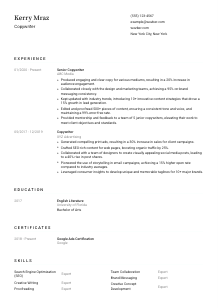
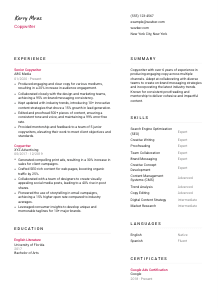
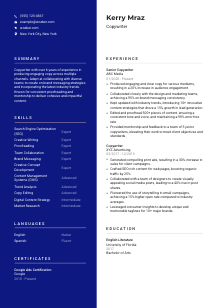
Crafting compelling campaigns, but your resume lacks the hook? Check out this Copywriter resume example, created with Wozber free resume builder. It shows how to match your word wizardry to job needs, ensuring your career story captivates just as much as your taglines do!
Copywriting gets judged fast. Hiring teams can tell within a few lines whether someone understands audience, brand voice, and channel-specific messaging, or whether they simply write clean sentences. Your resume has to show that you can move between campaign copy, digital content, social posts, and editing work while keeping the message sharp and on-brand.
A tailored resume also helps separate broad "content" experience from actual copywriting experience. When the language on the page reflects the posting's priorities, including SEO, CMS familiarity, editing discipline, and collaboration with design and marketing, your background reads as a direct match instead of an adjacent one. Wozber's free resume builder helps structure that story in an ATS-friendly resume format so the employer can quickly see where your writing process, campaign results, and brand judgment line up.
For copywriters, the top of the resume should already feel deliberate. Clean contact details, the right professional title, and a credible portfolio link all reinforce the same message: you understand presentation, and you know how to package work for an audience. Here is how to make that first section support the role you're targeting:
Your name should be easy to find and easy to read. Use a clear font treatment that gives it presence without turning it into a design exercise. For a copywriter, polished presentation matters because it hints at editorial judgment before anyone reads a bullet point.
Place "Copywriter" directly under your name when that is the role you are applying for. This removes ambiguity for both recruiters and ATS software. If your recent title was "Senior Copywriter" or "Content Writer," keep the headline aligned with the target job unless seniority is a specific advantage you want to signal.
List a working phone number and a professional email address in a simple format. Add a portfolio website if you have one, especially in copywriting, where employers often want to see landing pages, ads, email sequences, social campaigns, or brand messaging samples before they move forward.
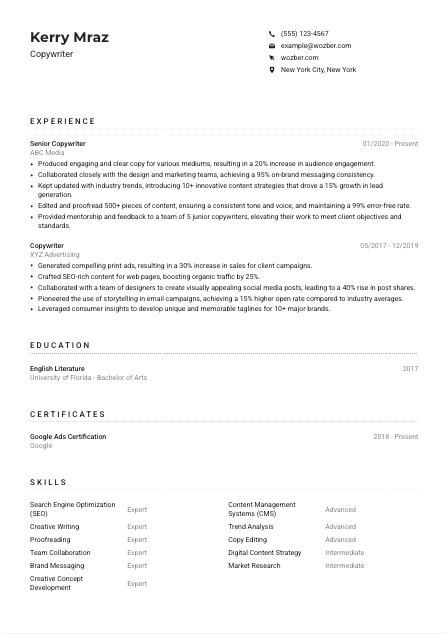
If the posting includes a location requirement, handle it directly. In the example here, the employer asks for someone based in New York City, so listing "New York City, New York" removes a practical objection immediately. Only do this when location is relevant to the role or application process.
Include LinkedIn or your portfolio site only if the content strengthens your application. For copywriters, that means current job history, published work, campaign samples, or a portfolio that reflects your tone range across print, digital, and social channels. Broken links, dated bios, or weak samples do more harm than leaving the field out.
This section should answer the basics without friction and reinforce that you present your work with the same care you bring to copy, editing, and brand communication.




This is where a copywriter resume either becomes concrete or stays vague. Employers want more than "wrote content". They want to see what you wrote, where it ran, who you partnered with, and what moved because of it, whether that was engagement, traffic, conversions, lead generation, or message consistency across channels.
Start by marking the requirements and responsibilities that shape the role. For this opening, the important themes are multi-channel copy, collaboration with design and marketing, SEO, CMS familiarity, trend awareness, editing accuracy, and guidance for junior writers. Those are the threads your experience bullets should pick up.
List jobs in reverse chronological order with title, company, and dates. For copywriters, career progression often shows up through larger campaign scope, more ownership of brand voice, broader channel coverage, or leadership of junior writers. Make that progression visible instead of leaving the reader to infer it.
Each bullet should tie writing work to a business or campaign result. "Produced clear copy" is too generic. "Produced copy across multiple mediums, resulting in a 20% increase in audience engagement" gives the employer a better read on both craft and impact. The sample resume handles this well by pairing channel-specific work with measurable performance.
Quantify what matters in this field: engagement rate, organic traffic, sales lift, open rate, lead generation, volume edited, turnaround, campaign reach, or brand consistency. In the example, metrics such as 25% organic traffic growth, 40% rise in social shares, and 99% error-free editing make the writing work easier to value because they connect copy decisions to campaign performance.
Choose bullets that match the kind of copywriting job you want next. If the posting leans toward advertising and marketing, lead with campaigns, brand messaging, SEO content, and cross-functional work with designers and marketers. General writing tasks that do not show audience, channel, or outcome can be trimmed to make room for stronger proof.
Your experience section should make it easy to picture you producing effective copy, refining it to brand standards, and contributing to campaign results across the channels the employer actually uses.
Education usually sits behind portfolio and experience in copywriting hiring, but it still matters when a posting names a degree requirement. Keep it straightforward and relevant, especially when your degree supports writing, communications, advertising, or marketing work.
This posting asks for a bachelor's degree in English, Journalism, Communications, or a related field. If you have that background, make it explicit. A degree such as the sample's Bachelor of Arts in English Literature clearly fits because it supports writing, analysis, and language fluency.
List your degree, field of study, school, and graduation year or date. That is usually enough. In a copywriter resume, concise formatting here works in your favor because it reflects clarity and restraint, both useful traits in client-facing and brand-facing writing.
If your major or concentration directly connects to the role, do not bury it. English, Journalism, Communications, Advertising, and similar fields should be easy to spot. When your degree is adjacent, use the field name accurately and let your experience and portfolio carry the rest of the argument.
Relevant coursework can help early-career applicants or career changers. Include it if it points to copywriting-related training such as advertising writing, digital marketing, media studies, rhetoric, editorial practice, or SEO content strategy. Skip generic course lists that do not sharpen your positioning.
If you are newer to the field, honors, publication credits, student media work, or campaign projects can add useful context. For experienced copywriters, these details matter less unless they connect directly to writing quality, editorial leadership, or a strong industry niche.
This section should confirm that you meet the academic requirement and, when relevant, show that your writing foundation supports the kind of copy, research, and editing the job calls for.
Certificates are not always central for copywriters, but the right ones can strengthen your positioning in areas like digital marketing, paid media, SEO, analytics, or platform-specific content work. Include them when they add practical relevance, not just extra lines.
Focus on credentials tied to the channels or strategy work around copywriting. A Google Ads Certification, like the one in the example, makes sense because it supports paid messaging, campaign thinking, and performance-driven writing. A certificate should deepen your story, not distract from it.
Add the issue date and, if relevant, the expiration or active range. Current certifications suggest that your platform knowledge is up to date, which matters in areas like digital campaigns, ad copy, SEO, and content operations that change quickly.
Review certificates regularly and remove ones that no longer support your target role. If you are applying to brand or agency copywriting roles, recent credentials in SEO, analytics, email marketing, or paid social usually carry more weight than outdated general-learning badges.
When a posting does not require certifications, use them strategically. They can help reinforce technical fluency with search, ads, content systems, or digital measurement, especially if your formal education is not directly in writing or communications.
A focused certificate list can strengthen the commercial and digital side of your copywriting profile, especially when it supports the campaign channels and performance goals named in the job description.
The best copywriter skills sections are selective. Hiring teams already expect strong writing. What helps them faster is seeing the supporting capabilities around the writing itself, such as SEO, CMS use, editing, brand voice control, concept development, research, and collaboration with creative and marketing teams.
Pull direct requirements from the posting and match them to real abilities you can back up elsewhere on the resume. For this job, that means SEO best practices, CMS familiarity, proofreading, editing, English fluency, trend research, and cross-functional collaboration. Use the employer's language when it accurately reflects your experience.
Prioritize the capabilities that shape daily output. For copywriters, that often includes brand messaging, copy editing, SEO, creative concept development, content strategy, and CMS proficiency before softer skills like communication or teamwork. The sample skills list works because it leads with copy-related strengths instead of generic workplace traits.
Put the most relevant skills first so both recruiters and ATS systems catch them early. Group them in a logical way if needed, such as writing and editing skills, digital and SEO skills, and collaboration or strategy skills. Keep the list tight enough that every item still points to work you have actually done.
Your skills section should quickly show the writing, editing, digital, and collaboration abilities that make you effective in real campaign work, not just capable of drafting copy.
Language fluency matters in copywriting because precision, tone, and audience nuance sit at the center of the job. Even when the role is focused on English, listing additional languages can still be useful if they support audience reach, multilingual campaigns, or collaboration across markets.
This job explicitly says the candidate must be able to express ideas clearly in English, so English proficiency should be impossible to miss. If the role depends on one primary language, make sure that language appears first and at the right level.
List the languages that matter most to the role first, then add others in descending order of proficiency or business value. For a copywriter working in English-language campaigns, "English - Native" or an equivalent level belongs at the top, followed by any additional languages that could support broader audience work.
Choose direct labels such as Native, Fluent, Advanced, or Conversational and be accurate. The example's "English - Native" and "Spanish - Fluent" gives a hiring team a clear picture of where the candidate could contribute, including possible multilingual or transcreation work.
Additional languages are most useful when they support campaign adaptation, audience research, localized messaging, or international brand work. If a second language has helped you write, edit, or collaborate across markets, that context belongs in experience bullets or a portfolio, not only here.
Do not overstate proficiency, especially in a writing profession where nuance matters. If you could handle meetings in a second language but not produce polished client-facing copy, label it accordingly. Accuracy here protects your credibility.
For copywriters, language proficiency should reinforce your command of tone and audience, and any additional language should point to practical value such as broader market reach or multilingual content support.
The summary needs to establish your copywriting profile in a few lines, not repeat your whole resume. A hiring manager should come away with a clear sense of your experience level, the kinds of content you produce, the teams you work with, and the results your writing tends to drive.
Read the posting closely before writing the summary. If the employer wants multi-channel copy, SEO familiarity, editing discipline, and collaboration with design and marketing, those themes should shape your opening lines. Skip broad claims that could describe any communications professional.
Open with your years of experience and your primary copywriting scope. A line like "Copywriter with 6+ years of experience creating campaign and digital content across print, web, email, and social" does more work than vague self-description. It sets a professional level and gives immediate channel context.
Include accomplishments or strengths that reflect the job's priorities, such as engagement growth, SEO traffic gains, editorial accuracy, or mentoring junior writers. The sample summary works because it mentions cross-channel copy, team collaboration, trend awareness, proofreading consistency, and mentorship without turning into a list of bullets.
Aim for a short paragraph that sounds credible and role-specific. Four concise sentences are often enough. Focus on what kind of copywriter you are, where you create value, and what the employer can expect from your writing process and results.
Your summary should quickly position you as a copywriter who can produce on-brand work, collaborate across creative teams, and contribute to measurable campaign performance from the first read.
A copywriter resume works when it shows more than polish. It should connect your writing to channels, collaboration, editing discipline, and measurable campaign outcomes in language that matches the role you're pursuing.
Use Wozber to shape that content into an ATS-compliant resume, refine wording with role-specific terminology, and strengthen ATS optimization without losing your voice. The finished document should make it easy to judge how you write, what you can deliver, and where your copy has already performed.




