



Use Wozber and land your dream job
Create Resume
No registration required
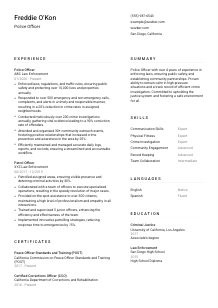
Upholding law, but your resume feels unlawful? Patrol this Police Officer resume example, created with Wozber free resume builder. Learn how to clearly present your policing prowess to meet job requirements, ensuring your career stays "ten codes" ahead!
Police work is reviewed through what you can handle when pressure spikes. Agencies want to see whether you have held up in patrol work, emergency response, report writing, evidence handling, and public contact where judgment, composure, and procedure all matter at once.
A targeted resume changes how quickly that operational picture comes through. When your wording reflects the posting's priorities, whether that is POST certification, community outreach, investigations, or daily logs, Wozber's free resume builder helps you shape an ATS-compliant resume that surfaces those qualifications cleanly for both screening systems and command staff reviewing who is ready to work the street, the scene, and the paperwork that follows.
This section should confirm basic eligibility fast. For police hiring, that means your identity, contact information, job title, and location need to be easy to find before anyone gets to your patrol history or certifications.
Use your full name in a clean, readable format at the top. In law enforcement hiring, presentation counts because your resume is expected to reflect the same order and professionalism you would bring to reports, court testimony, and daily interactions with the public.
Place "Police Officer" under your name when that is the role you are pursuing. That immediate match helps frame your resume around patrol, response, public safety, and enforcement duties instead of leaving the reader to guess whether your background is corrections, security, or another public safety track.
List a phone number you answer reliably and an email address that looks professional. Hiring timelines in law enforcement can involve interviews, background steps, fitness testing, and certification review, so this information needs to support prompt contact without confusion.
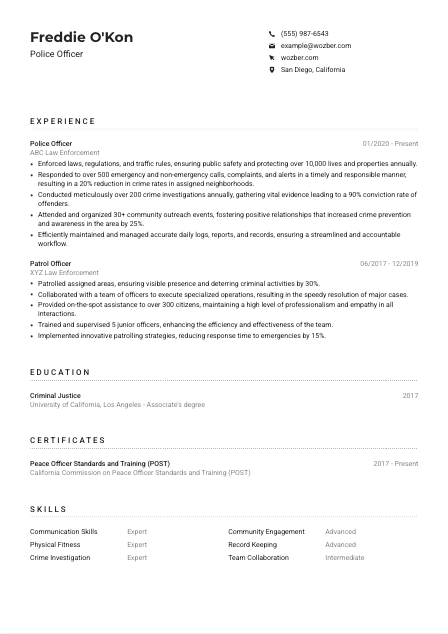
If the employer specifies a city or jurisdiction, show that clearly. In the example, listing San Diego, California directly answers a stated location requirement and removes an early question about availability. Use this only when it is relevant to the posting you are targeting.
A LinkedIn profile can be useful if it reinforces your service record, training, community work, or leadership history. Make sure the dates, titles, and credentials match your resume exactly. Inconsistent public information can create avoidable friction in a field where background review is thorough.
Keep personal details precise and job-aligned. At a glance, the reader should know who you are, how to reach you, what role you are applying for, and whether you meet any location-based requirement.




Police experience needs to read like operational history, not a generic employment list. Hiring teams look for patrol exposure, call volume, investigations, documentation, teamwork, public contact, and outcomes that show you can perform under real field conditions.
Start by marking the duties and conditions named in the job ad. For this opening, the priorities include enforcing laws and traffic rules, responding to emergency and non-emergency calls, conducting initial investigations, building community relationships, and maintaining accurate records. Those points should shape which bullets you keep, rewrite, or move higher.
List positions in reverse chronological order with title, agency, and dates. For policing roles, clear progression matters. Moving from Patrol Officer to Police Officer, as shown in the example, helps the employer see continuity in field work, responsibility, and readiness for the next assignment.
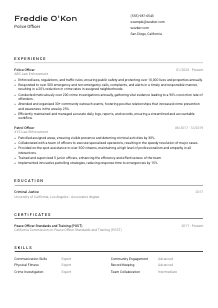
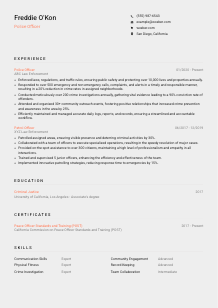
Your bullets should show what you handled and what changed because of your work. Good examples include call response volume, reductions in crime or response time, number of investigations completed, arrests supported by evidence collection, or community events led. The sample resume does this well by pairing actions with metrics such as 500+ calls handled and 200 investigations annually.
Quantify scope where it reflects real police work. That can include patrol area coverage, citizens assisted, junior officers trained, outreach events attended, case outcomes, or improvement in emergency response. Numbers work best when they describe workload, accountability, or public safety results rather than padded claims.
If you have worked in corrections, security, military police, dispatch, or probation, keep the parts that connect directly to enforcement, incident response, de-escalation, reporting, or investigation support. Remove bullets that do not help prove field judgment, public interaction, and procedural discipline for the role at hand.
Your experience section should make it easy to picture you on patrol, at a scene, in an interview room, and behind the report. Show scope, composure, and the kind of follow-through police work requires every shift.
Education is usually not the deciding factor for sworn roles, but it still carries weight when it supports academy preparation, criminal justice knowledge, or a preferred degree listed in the posting. Present it cleanly and keep the relevance obvious.
If the employer asks for a high school diploma and prefers an associate's degree in Criminal Justice or a related field, list the strongest relevant credential first. In the example, the associate's degree in Criminal Justice directly supports that preference and should stay prominent.
Include degree, field of study, school, and graduation year. Police hiring already involves enough document review through applications, academy records, and certification checks. A straightforward education section keeps your resume easy to scan.
When your education lines up with the posting, do not bury it. A Criminal Justice degree, public safety coursework, or related academic training can strengthen your case, especially if the employer lists it as preferred rather than required.
If you are early in your career, related coursework or academy-linked training can add context. Focus on subjects that translate to police work, such as criminal law, investigative procedure, report writing, crisis response, or community policing. Skip long course lists if you already have substantial field experience.
Honors, leadership roles, or public-service activities belong here only when they support the role. Criminal justice club leadership, peer training, or community service can help. Generic school achievements without a public safety link usually do not add much value on a police resume.
Keep this section practical. It should confirm that you meet the baseline requirement and, where relevant, show added preparation in criminal justice or related public safety study.
For police hiring, certifications often move from helpful to essential. This section should quickly show that your mandatory credentials are current and that your training aligns with the type of work the department needs covered.
Start with any certification named in the posting. Here, a valid Peace Officer Standards and Training, or POST, certification is a core qualification, so it belongs at the top of the section where it cannot be missed.
Prioritize credentials tied to sworn service, detention, firearms, crisis response, defensive tactics, field training, or specialized policing functions. The example includes POST first and then a corrections-related credential, which works because both support public safety experience.
Include the year earned and, if relevant, the active date range or renewal status. Police departments need to know whether a credential is valid now, especially when it affects hiring eligibility, assignment readiness, or compliance requirements.
Law enforcement practice evolves through statute updates, reporting standards, de-escalation protocols, investigative procedure, and community engagement expectations. Ongoing certification and refresher training show that your methods are current, not outdated.
Your certifications should confirm more than professional interest. They should show you meet core standards, keep required credentials active, and stay current with the training that supports safe, lawful police work.
A police skills section works best when it reflects how the job is actually done. Focus on abilities that affect field performance, communication under stress, investigations, teamwork, and the accuracy of reports and records.
Pull both hard and soft skills from the job description. In this case, that includes communication, calm decision-making under pressure, law enforcement experience, investigation, and record keeping. Matching that language helps your resume line up with both ATS filters and human review.
Choose skills that also appear in your work history or certifications. If you list crime investigation, there should be bullets about evidence gathering, witness interviews, or case support. If you list community engagement, show outreach work or public-facing service in your experience section.
A shorter list of role-specific strengths reads better than a long mix of vague traits. Skills such as emergency response, report writing, de-escalation, traffic enforcement, evidence collection, interpersonal communication, and team coordination are more useful than broad claims like "hardworking" or "leadership."
Use this space to highlight the capabilities that affect real police performance. Every skill should connect to something you have already done in the field, in training, or in direct public safety work.
Language ability can matter a great deal in policing because calls, interviews, victim interactions, and community outreach all depend on clear communication. List languages in a way that reflects both the posting and the population you may serve.
If the posting requires command of English, include it clearly with your proficiency level. That requirement affects report writing, radio communication, interviews, testimony, and daily interaction with the public, so it should be easy to spot.
Use plain labels such as native, fluent, advanced, or conversational. Police work leaves little room for guesswork in communication, especially during emergencies, witness interviews, or conflict de-escalation.
Additional language skills can strengthen your profile when they are useful in the community you would serve. In the example, Spanish is a strong addition because it can support field communication, outreach, and trust-building in a diverse population. Treat that as role-relevant tailoring, not a universal requirement.
Do not overstate fluency. If you can handle routine conversation but not detailed incident interviews or legal nuance, label your level honestly. Departments value accuracy because communication mistakes can affect safety, witness statements, and report quality.
If you speak multiple languages, think about where that mattered in your experience. Community events, victim support, neighborhood patrol, and on-scene communication all become stronger examples when language ability directly improved service or response.
Handled well, this section shows more than vocabulary. It shows how you can communicate clearly, reduce friction in the field, and serve a broader community with accuracy and respect.
Your summary should read like the opening of a professional profile, not a slogan. In a few lines, show your experience level, your policing strengths, and the parts of your background that best match the assignment.
Before writing, identify the two or three capabilities the employer emphasizes most. Here, those include law enforcement experience, calm performance in high-pressure situations, investigations, public interaction, and accurate record keeping. Your summary should reflect that mix rather than trying to cover everything.
Start with your title and relevant experience, such as "Police Officer with 4+ years of law enforcement experience." That gives immediate context and helps separate you from applicants coming from adjacent fields without sworn patrol experience.
Use the next sentence to highlight the work you are known for. That might include emergency response, conducting initial investigations, traffic enforcement, community outreach, or maintaining reliable incident documentation. The example summary works because it combines years of service with calm performance under pressure and investigation experience.
Aim for a compact paragraph of three to five lines. Command staff, recruiters, and HR reviewers should be able to understand your background in seconds and then move into the experience section for detail.
Your summary should quickly establish experience, assignment-ready strengths, and the kind of police work you handle well. Once that is clear, the rest of the resume can prove it with specifics.
When each section reflects actual police work, your resume becomes easier to trust. Clear service history, valid credentials, field-relevant skills, and accurate language around investigations, response, and community contact give hiring teams a realistic picture of how you would perform.
Use Wozber's free resume builder to organize that experience into an ATS-friendly resume template, strengthen ATS optimization with role-specific wording, and check alignment through the ATS resume scanner. The finished document should make one thing easy to judge: whether you are prepared to step into police work with professionalism, procedure, and composure.




