



Use Wozber and land your dream job
Create Resume
No registration required
Manipulating minds, but your resume isn't mind-blowing? Check out this Social Engineer resume example, created with Wozber free resume builder. Learn how to tailor your social engineering prowess to job cues, crafting a career narrative that opens doors and minds!
Social engineering work sits at the point where security controls meet human behavior. Hiring teams want to see whether you can uncover exploitable patterns, run controlled assessments responsibly, and turn what you learn into training and policy changes that reduce real exposure. Your resume needs to make that operational range visible, from phishing simulations and awareness programs to reporting that leadership can act on.
When that scope is tailored clearly, your resume is easier to sort from adjacent profiles like general security analysts or penetration testers who touched awareness work only occasionally. Wozber's free resume builder helps organize that experience into an ATS-compliant resume, so assessment work, training outcomes, and tools such as SET or Kali Linux are parsed and prioritized in a way that shows you can handle the human side of security with structure and control.
For a Social Engineer, the top of the resume should read like a professional header, not a placeholder. Keep it clean, direct, and aligned with a role that depends on credibility, clear communication, and trust from the first line.
Use your full name as the most visible text in the header so it is easy to identify in a recruiter inbox, PDF, or ATS record. A simple, professional presentation works best for security roles where clarity matters more than visual flair.
Place the job title directly under your name when it matches the role you are pursuing. Writing "Social Engineer" immediately frames your background around assessment, awareness, and influence-based security work instead of leaving the reader to infer it from later sections.
List one reliable phone number and a professional email address you check regularly. Social engineering roles often move through multiple interview rounds with security leads, HR, and management, so your contact details should be easy to use and impossible to question.
Add your city and state when location is part of the screening criteria. In the example posting, Los Angeles, California is explicitly required, so showing that in the header removes a logistical question before it slows down your application.
If you have a LinkedIn profile, portfolio, or professional site that reflects security work, training content, speaking, or thought leadership, include it. Keep the content consistent with your resume, especially if it mentions phishing simulations, awareness campaigns, red team support, or security education.
This section does not need personality statements or extra detail. It needs to confirm who you are, how to reach you, and, when relevant, whether you satisfy practical requirements like location for the role.




Experience is where a Social Engineer separates from candidates with broader cyber roles. Hiring teams look for direct evidence that you have tested social vulnerabilities, influenced employee behavior, partnered with security teams, and produced recommendations that changed controls or reduced risk.
Before rewriting bullets, identify the recurring actions in the posting. For this role, that includes running social engineering assessments, delivering tailored training, collaborating on security policy, tracking evolving attack methods, and reporting findings to management. Your experience bullets should echo that operating pattern with your own results and scope.
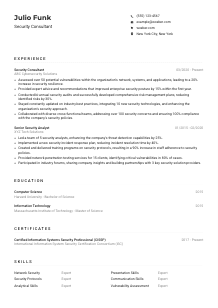
List your most recent position first and keep each entry easy to scan with title, employer, and dates. That format helps hiring managers quickly trace whether your background has progressed from broader security work into direct social engineering ownership, as the example does from Security Analyst to Senior Social Engineer.
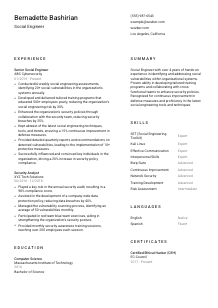
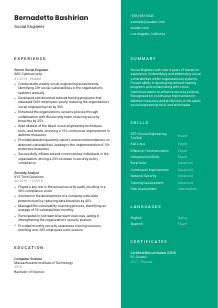
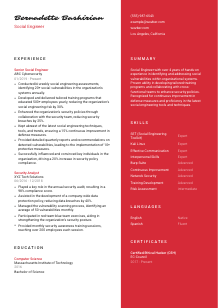
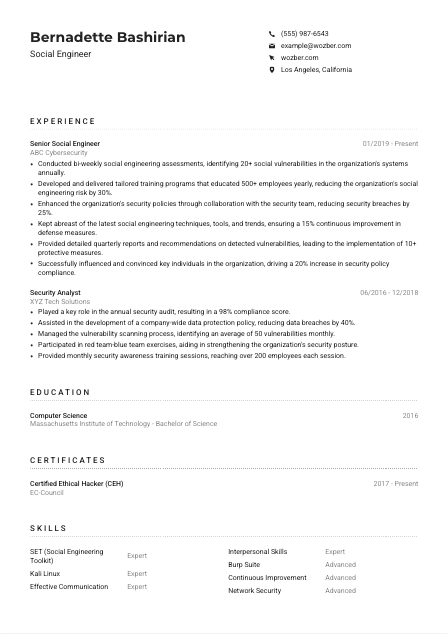
Replace generic task descriptions with what changed because of your work. A bullet like "Conducted bi-weekly social engineering assessments, identifying 20+ social vulnerabilities annually" is stronger than simply saying you performed assessments, because it shows cadence, output, and the kind of vulnerability discovery the role cares about.
Metrics are especially persuasive here because social engineering work often affects behavior, compliance, and incident exposure. Use numbers tied to employee reach, vulnerability counts, policy adoption, breach reduction, simulation frequency, or training effectiveness. The sample resume does this well with figures such as 500+ employees trained yearly and a 30% reduction in social engineering risk.
Lead with bullets that show assessment design, awareness delivery, influence, and reporting to leadership. If part of your background comes from adjacent roles like security analysis, red teaming, or vulnerability management, keep the bullets that support social engineering credibility, such as awareness sessions, audit support, or policy development, and cut less relevant technical detail.
A hiring team should be able to read your experience section and understand how often you ran assessments, who you trained, what changed, and how your recommendations improved security posture. That is the level of proof this role needs.
Education usually will not carry the application on its own for this role, but it still matters because employers often want proof of a formal technical foundation. A clear degree listing helps confirm you can operate comfortably in a security environment where human behavior and technical systems intersect.
If you hold a bachelor's degree in Computer Science, Information Technology, or a related field, list it plainly and completely. That directly addresses a common requirement for Social Engineer roles, especially when employers want candidates who can connect behavioral attack methods with technical security context.
Write the degree, field of study, school, and graduation year in a simple order. Recruiters and ATS systems should be able to read it quickly without extra formatting or missing details.
Use the official degree name if it naturally lines up with the requirement. "Bachelor of Science in Computer Science" mirrors the educational baseline in the example posting and makes the match obvious without any extra explanation.
If you are earlier in your career or your degree does not obviously point to security work, coursework in cybersecurity, network security, psychology, human-computer interaction, or information assurance can help. Keep it brief and include it only when it adds context that your experience section cannot yet carry alone.
Include projects, research, or honors when they relate to phishing simulations, security awareness, penetration testing, behavioral analysis, or defensive program design. For experienced candidates, this is secondary, but it can still add depth if the work connects directly to social engineering methods or security education.
This section should confirm the technical foundation behind your work without taking attention away from your practical experience. Clean formatting and accurate degree details are usually all you need.
Certifications are useful in social engineering because they show continued development in offensive and defensive security practice. They are especially helpful when they support your technical fluency, ethical handling of assessments, or knowledge of current attack methods.
Choose certifications that reinforce security assessment, ethical testing, awareness, or related cyber disciplines. A credential like Certified Ethical Hacker fits naturally because it supports the kind of adversarial thinking and testing mindset that social engineering work often requires.
Do not crowd this section with every course completion badge you have earned. Lead with certifications that strengthen your case for assessment work, security operations knowledge, or training credibility, especially if they complement tools and methods named in the job description.
Show when the certification was earned and whether it is still active if that applies. In security hiring, recency matters because tooling, threat patterns, and testing practices change quickly.
Social engineering tactics evolve with communication platforms, business workflows, and employee habits. Ongoing certification work signals that you stay current with phishing trends, adversary techniques, awareness practices, and the broader security landscape rather than relying on outdated playbooks.
Certifications should support the experience already on the page. When chosen well, they tell employers that your security knowledge is active, relevant, and maintained over time.
A Social Engineer's skills section should quickly show two things: you can run the technical side of assessments, and you can handle the human side of influence, training, and communication. The mix matters because the role depends on both.
Start with the tools, methods, and competencies the employer names, then keep only the ones you genuinely use. In this case, that includes SET, Burp Suite, Kali Linux, communication skills, interpersonal influence, and understanding of social dynamics. This makes your alignment visible in both ATS screening and human review.
Social engineering is not purely a tooling role. Pair offensive security and assessment tools with skills such as training development, stakeholder communication, persuasion, and risk awareness. The sample resume handles this balance well by combining SET and Kali Linux with communication and interpersonal strengths.
Use the skills section to sharpen your profile, not to dump every security term you know. Focus on the capabilities that support the target role, such as phishing assessment tools, awareness program design, reporting, policy collaboration, and human-factor risk analysis, so the section reinforces the story told in your experience bullets.
The right skills list should immediately show that you can assess people-centered attack paths, explain risk clearly, and work with the tools used to test and improve defenses. That combination is what makes the section useful.
Language matters more in this role than it does in many technical positions because the work depends on persuasion, instruction, reporting, and credibility across different audiences. If a posting mentions communication in English, treat that as a core requirement, not a minor detail.
If the role requires clear expression in English, list your English level directly. For a Social Engineer, this affects training delivery, management reporting, employee interviews, and the wording used in controlled simulations or awareness materials.
Additional languages can be useful if you work in multilingual organizations, global awareness programs, or culturally varied employee populations. They can also support more nuanced communication during training or social vulnerability testing, as long as you list them honestly.
Choose plain labels such as Native, Fluent, Intermediate, or Basic. Inflating a language level is risky in a role built on communication, where interviewers may quickly test how well you explain scenarios, influence behavior, or present findings.
If you speak more than one language, think about how that helps with security work. It may improve training delivery, cross-functional communication, or understanding of cultural cues that influence user behavior and awareness outcomes.
Do not oversell language skills if the role mainly needs strong English communication. Still, if you can support employee education or stakeholder coordination across multiple language groups, that is worth noting because social engineering defense often depends on message clarity.
This section should confirm that you can communicate your ideas cleanly to employees, security peers, and leadership. For social engineering roles, that is part of the job, not an extra.
Your summary should quickly establish the kind of security professional you are and the level at which you operate. For Social Engineer roles, that usually means showing hands-on assessment work, training impact, and the ability to translate human risk into concrete security action.
Read the job description closely before writing this section. Pull out the themes that define the role, such as social vulnerability assessment, employee education, collaboration with security teams, and reporting to management, then reflect those themes in your opening lines using your own experience.
Start with your professional identity and a realistic experience level. A line such as "Social Engineer with 4+ years of experience" works well because it immediately places you in the field and answers a common screening question without wasting space.
Use the next sentence or two to highlight the capabilities that matter most for the role. Good examples include identifying social vulnerabilities, designing training that changes employee behavior, improving policy compliance, or working with security teams to strengthen defenses. The sample summary does this by combining hands-on assessment work with training and continuous improvement.
Aim for a short paragraph that reads cleanly in one pass. Three to five lines are usually enough to show your specialty, experience, and strongest contributions without repeating details that will appear in the experience section.
After reading these lines, the employer should already understand that you work at the intersection of security testing, human behavior, and awareness improvement. That gives the rest of the resume a clear direction.
A Social Engineer resume works best when every section supports the same hiring picture: you can identify human vulnerabilities, influence safer behavior, and turn assessment findings into concrete defensive improvements. Keep the language precise, mirror the posting where it matches your real background, and use results that show scope, cadence, and security outcomes.
With Wozber's free resume builder, ATS-friendly resume templates, and ATS resume scanner, you can tailor the document around the employer's terminology without losing the detail that makes your experience credible. The finished resume should make it easy to judge how you assess risk, train users, and strengthen the organization's human security layer.




