



Use Wozber and land your dream job
Create Resume
No registration required
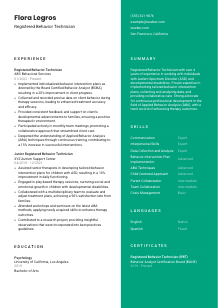
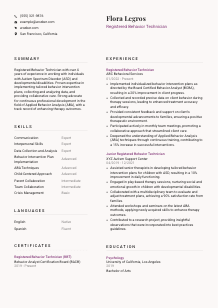
Shaping behavior, but your resume seems out of sync? Check out this Registered Behavior Technician resume example, made with Wozber free resume builder. Learn how to highlight your intervention skills to match job criteria, setting your career trajectory on the path to reinforcement and success!

Registered Behavior Technicians work where consistency matters. Hiring teams look for people who can follow a BCBA's direction, carry intervention plans into real sessions, collect clean behavior data, and communicate progress to families without losing accuracy or rapport. Your resume should make that practical, session-level work visible from the first few lines.
When an RBT resume is tailored well, the reader can quickly tell whether your background matches the clinical workflow they need, especially around ABA implementation, data collection, and family communication. Wozber's free resume builder helps shape that experience into an ATS-compliant resume by aligning your wording with the posting and keeping the structure easy to scan. That matters when a team needs to confirm, fast, that you can step into supervised care and contribute from day one.
This section is brief, but it still carries hiring value. For a Registered Behavior Technician, your contact details should immediately confirm who you are, what role you are targeting, and whether you meet any stated logistics such as local availability.
Use your full name as the clearest identifier on the page. Keep it easy to read, slightly larger than the rest of the text, and consistent with your professional records, especially if your RBT certification and employment documents use the same format.
Place "Registered Behavior Technician" directly under your name when that is the role you are pursuing. This helps hiring teams and ATS software connect your resume to the opening right away, especially when the posting is looking for a certified RBT rather than a broader therapy support title.
Include a phone number you answer and a professional email address you check often. In this field, interviews can move quickly when clinics need coverage or are building caseload capacity, so missed calls and outdated email addresses create avoidable friction.
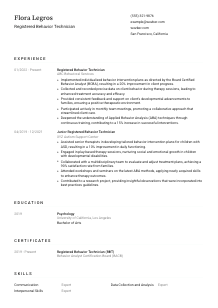
If an employer specifies a city or state requirement, show that clearly in your contact section. Here, listing San Francisco, California directly supports a stated location requirement. Treat that as tailoring to the specific opening, not a rule for every RBT resume.
A LinkedIn profile can be useful when it reflects the same titles, dates, certifications, and ABA-related experience shown on your resume. If you include it, make sure it reinforces your work with ASD or developmental disabilities rather than introducing conflicting details.
Your contact section should confirm the basics without distractions. For an RBT role, that means clear identification, an exact target title, dependable contact info, and any location detail the posting specifically asks for.




For Registered Behavior Technicians, experience is where employers look for proof that you can work inside an ABA program, document behavior accurately, and support children and families consistently. Titles matter, but the bullet points carry the real weight.
Before editing your experience, identify the operational tasks the employer repeats or emphasizes. In this case, that includes implementing behavior intervention plans, collecting session data, supporting families, collaborating with service providers, and continuing ABA training. Those duties should shape the wording and order of your strongest bullets.
List your most recent role first and include job title, organization, and dates for each position. For RBT hiring, this layout makes it easier to follow your progression from junior support work into more independent intervention-plan implementation, data tracking, and team collaboration.
Focus on the parts of your work that reflect day-to-day RBT practice. Good bullets mention carrying out individualized behavior plans under BCBA direction, tracking target behaviors, supporting skill acquisition, and updating caregivers or team members on progress. The sample resume does this well by tying plan implementation to a 20% improvement in client progress instead of leaving the work at a generic "provided support."
Numbers are especially useful when they describe therapy outcomes, treatment accuracy, family satisfaction, intervention success, or caseload contribution. You do not need to force a percentage into every line, but when you have measurable results, use them. Improvements in client progress, successful interventions, or family satisfaction rates are more convincing than vague claims about being effective.
Remove accomplishments that do not help explain your value as an RBT. If an activity did not involve ABA techniques, client progress, behavior data, caregiver communication, or multidisciplinary coordination, it may not earn space. The strongest experience sections stay close to the actual work of supervised behavior intervention.
Your experience section should show that you can execute a treatment plan, document behavior accurately, and work well with families and clinical teams. If a reader can picture you in session from your bullet points, this section is doing its job.
Education matters in RBT hiring because it shows your academic grounding in behavior, development, learning, or child support work. For many openings, it is a qualification screen first and a differentiator second, so clarity matters more than extra decoration.
If the posting requires a bachelor's degree, make sure that information is easy to find. Here, a Bachelor's degree in psychology, education, or a related field is listed as a requirement, so a degree such as a Bachelor of Arts in Psychology should appear clearly and without abbreviations that hide the match.
List your degree, field of study, school, and graduation year in a straightforward order. Hiring teams should be able to confirm your academic qualification in seconds, especially when they are reviewing many resumes against a requirement checklist.
If your degree is in psychology, education, special education, human development, or a similar area, keep that field prominent. In the example, Psychology directly supports the employer's preferred background and adds context for work with ASD and developmental disabilities.
If you have limited experience, you can include relevant coursework, practicum work, research, or campus roles tied to child development, behavior analysis, disability support, or observational data. Keep it brief and only include details that strengthen your case for direct client work.
Once you have solid hands-on RBT or ABA experience, your education section can stay lean. The degree still needs to be present, but your session work, intervention outcomes, and clinical collaboration will do more to move the application forward.
For this profession, education confirms your foundation. Present it clearly, match the stated degree requirement when it applies, and leave the deeper proof of readiness to your experience and certification.
Certification is one of the fastest ways an employer separates qualified RBT candidates from adjacent support profiles. In many postings, this section is not optional context. It is a core eligibility check.
List your Registered Behavior Technician certification prominently, including the full credential name. If the employer requires active RBT status, do not bury it below unrelated training or optional certificates.
Include certifications that support your work in ABA, developmental disability services, safety, or client care. A short, relevant list is stronger than a long section filled with unrelated coursework or general attendance certificates.
Certification dates help employers understand whether your credential is current. In the example, showing the RBT certification as active from 2019 to present gives immediate clarity and supports the hiring requirement without extra explanation.
RBT roles often ask for ongoing learning in ABA techniques, training participation, or supervision-based growth. If you have recent workshops, continuing education, or related certifications, include the ones that reinforce your development in intervention delivery, data practices, or client support.
This section should make one point quickly: you hold the required credential and you stay current in the methods used in supervised ABA care. That level of clarity matters in RBT hiring.
The best RBT skills sections sound like the role itself. Employers expect to see practical abilities tied to behavior intervention, observation, documentation, and family-facing communication, not a generic mix of soft skills with no clinical context.
Use the job description to identify the abilities the employer needs in daily work. Here, data collection, behavior intervention plan implementation, communication with families, team collaboration, and ongoing ABA learning all belong in your shortlist because they reflect routine RBT responsibilities.
An RBT needs both clinical execution and steady human interaction. That means pairing skills like ABA techniques, behavior data recording, and intervention implementation with communication, rapport-building, and caregiver support. The sample resume handles this balance by combining data collection and analysis with parent collaboration and child-centered care.
Do not turn the skills section into a master inventory. Choose the capabilities most connected to direct client sessions and multidisciplinary care. If a skill would not matter to a BCBA, clinic manager, or autism services employer reviewing your resume, leave it out.
A strong RBT skills section should reflect what happens in treatment sessions, team check-ins, and family communication. Keep the list focused enough that an employer can quickly see how you would contribute to client care.
Language ability matters in behavior support work because instructions, data notes, caregiver updates, and team communication all depend on precision. This section is especially important when a posting names a required language proficiency.
If the employer specifies spoken and written English proficiency, list English first and make your level clear. For an RBT, this supports documentation accuracy, session communication, and participation in meetings with BCBAs, families, and other providers.
Place the language most directly tied to the role at the top, then add other languages that may help you serve families from diverse backgrounds. Use clear proficiency labels such as Native, Fluent, Intermediate, or Basic.
Extra language ability can be a real asset in child and family services, especially in communities with multilingual households. For example, Spanish may strengthen communication with caregivers, even when English is the only stated requirement.
Only claim a level you can use comfortably in real work situations. In this field, that could mean explaining session progress to a parent, understanding supervision feedback, or writing simple but accurate behavior notes.
Include languages because they improve communication, caregiver trust, or service access. That framing is more useful than listing them as general resume extras, particularly in roles centered on child support and family interaction.
For an RBT role, language skills should help an employer understand how well you can document care, communicate with families, and collaborate with the treatment team. Keep the emphasis practical.
The summary is where you establish your level, your client population, and the type of behavior support work you have already handled. In RBT hiring, a useful summary quickly answers whether you have relevant ASD or developmental disability experience and whether your background fits supervised ABA delivery.
Start with a direct line that identifies you as a Registered Behavior Technician and states your years of relevant experience. If you have worked with individuals with Autism Spectrum Disorder or developmental disabilities, say that early because it is a major screening point in many postings.
Build the next sentence around the functions that define your value: implementing behavior intervention plans, collecting and recording behavior data, supporting client progress, and collaborating with families and clinical teams. The example summary does this effectively by centering intervention plans, data work, and collaborative care.
A summary should usually stay within 3 to 5 lines. Skip broad personality claims and use the space for concrete role language, client population, and one or two strengths that are likely to matter in early screening.
Use terms that match the employer's language when they reflect your real experience, such as ABA techniques, developmental disabilities, family support, or professional development. This improves ATS alignment and makes your profile easier to place against the role requirements.
By the end of this section, a reader should understand your level of RBT experience, the clients you have supported, and the kind of ABA work you can step into quickly. That is enough to earn attention from the rest of the resume.
A Registered Behavior Technician resume works best when each section points to the same hiring conclusion: you can deliver ABA-based support reliably, document behavior accurately, and communicate well with families and the care team. That means matching your credential, experience, skills, and summary to the actual treatment work named in the posting.
Use Wozber to tighten that alignment with an ATS-friendly resume template, role-specific phrasing, and practical ATS optimization support. When the details are in place, your resume should make it easy to judge one thing clearly: you are prepared to contribute in a supervised RBT role from the start.