



Use Wozber and land your dream job
Create Resume
No registration required
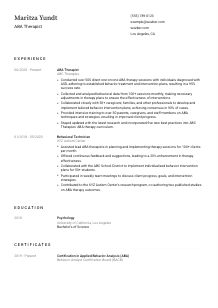
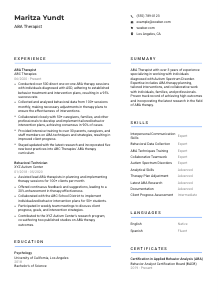
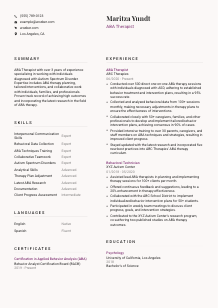
Molding young minds, but your resume doesn't quite fit the puzzle? Check out this ABA Therapist resume example, created with Wozber free resume builder. It shows how to connect your behavior-shaping skills to job needs, creating a career path that aligns perfectly with developmental milestones!
ABA therapy is hands-on work. Hiring teams want to see that you can run consistent one-on-one sessions, track behavior accurately, adjust interventions when data shifts, and communicate clearly with families and supervising clinicians. Resumes often miss that balance by leaning too far into compassion alone or listing duties without showing treatment progress, caregiver involvement, or the scale of client work.
A tailored resume helps your clinical judgment show up faster, especially when employers are sorting candidates with similar titles like ABA Therapist, Behavioral Technician, or RBT-level support experience. Using Wozber's free resume builder and ATS optimization tools makes it easier to match the language of behavior intervention plans, data collection, and caregiver training in an ATS-compliant resume, so the reader can quickly see where your experience supports direct ASD treatment.
For an ABA Therapist, the header does a practical job. It should confirm who you are, what role you perform, and whether you meet obvious screening requirements before the reader gets into session volume, behavioral data, or parent training.
Place your full name at the top in a clean, readable style. In clinical hiring, this is simple but important. Supervisors and coordinators often review many resumes quickly, and a clear header keeps your document easy to reference during interview scheduling and team review.
Add the exact title "ABA Therapist" beneath your name when that is the role you are pursuing. This helps frame your background immediately, especially if your past titles include related roles such as Behavioral Technician or therapist support positions. It also strengthens alignment with ATS searches tied to the posted title.
Include a phone number and a professional email address that you check regularly. ABA roles often move quickly once a clinic or provider identifies candidates with the right ASD experience, so accurate contact information matters more than people think. Check every digit and character before sending.
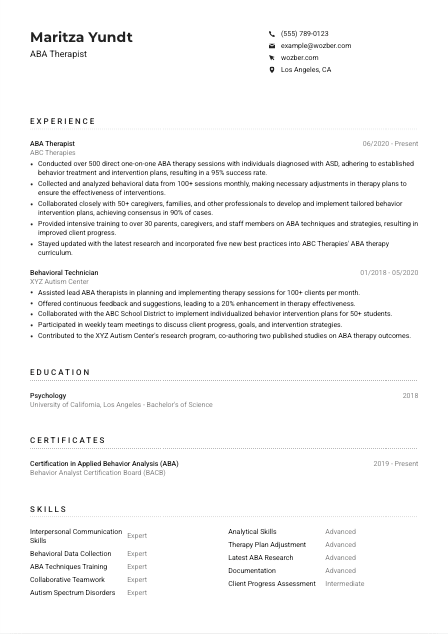
If a job specifies a location requirement, include your city and state clearly in the header. In this example, Los Angeles, CA is part of the stated criteria, so listing it removes an immediate screening question. Treat location this way when it is relevant to the specific opening, not as a universal rule for every ABA Therapist resume.
Include a LinkedIn profile or professional website only if it supports your application with matching experience, credentials, or clinical focus. For ABA work, that could mean a profile that reinforces your background with ASD populations, caregiver collaboration, or training history. If the content is outdated or inconsistent with the resume, leave it off.
Your personal details should answer the basic practical questions fast: who you are, what role you do, how to reach you, and whether you meet obvious screening points tied to the posting.




This is the section most hiring managers will study first. For ABA Therapist roles, they are looking for direct therapy work, behavioral data habits, intervention follow-through, collaboration with caregivers and clinicians, and signs that your sessions led to measurable client progress.
Read the responsibilities line by line and convert them into resume proof points. For ABA therapy, that usually means direct one-on-one sessions, data collection, treatment plan adjustments, behavior intervention plan support, caregiver training, and teamwork with other professionals. Once you know those priorities, write bullets that mirror them with real examples from your caseload.
Start with your most recent role and work backward. Include title, employer, and dates so the reader can track your progression from support roles into more independent ABA work. That progression matters when you are showing the move from assisting with sessions to leading them, documenting results, and contributing to treatment planning.
Focus each bullet on what you delivered, with whom, and what changed. Strong ABA bullets mention session volume, ASD population served, intervention execution, caregiver coordination, or treatment results. The sample resume does this well with details like 500+ direct sessions, 50+ caregiver collaborations, and parent training tied to improved client progress.
Quantify your work with measures that reflect the field. Useful examples include number of sessions delivered, clients supported per month, frequency of data collection, caregiver trainings completed, team meetings contributed to, or changes in program effectiveness. Metrics like analyzing data from 100+ sessions monthly are more convincing than broad claims about being effective or dedicated.
Prioritize experience that proves you can work with individuals with ASD, apply ABA strategies consistently, and collaborate around individualized plans. If you have unrelated work, keep it brief unless it strengthens a transferable area such as documentation, de-escalation, or family communication. The closer each bullet is to treatment delivery and behavior support, the stronger the section reads.
After reading your experience section, a clinic or school team should understand the kind of clients you supported, how you worked within behavior plans, how you used data, and what results followed from your interventions.
Most ABA Therapist postings set a straightforward academic floor, often a bachelor's degree in psychology, education, or a related field. Your education section should make that qualification easy to find and easy to verify without forcing the reader to hunt for it.
When the posting asks for a bachelor's degree in Psychology, Education, or a related field, list that credential clearly and high in the section. If your degree is closely aligned, say so plainly. A Bachelor of Science in Psychology, as shown in the example, directly supports the academic foundation many ABA employers expect.
Use a consistent structure with degree, field of study, school, and graduation year or date. Clean formatting helps both ATS parsing and human review, especially when recruiters are checking minimum qualifications before moving on to your therapy experience and certification history.
If your major or concentration connects to child development, behavioral science, special education, or psychology, keep that wording visible. Those details help explain why your academic background supports behavior intervention work, data interpretation, and collaboration with families and multidisciplinary teams.
You do not need to turn this section into a transcript, but one or two relevant additions can help early-career candidates. Courses in behavior analysis, developmental psychology, autism studies, or research methods can strengthen the section if your professional experience is still growing.
If you are pursuing additional coursework, supervised hours, or professional development related to ABA methods or autism support, include it when it strengthens your candidacy. This is especially helpful when the employer values current knowledge of best practices and evidence-based intervention approaches.
Your education section should confirm that you meet the degree requirement and that your academic background supports the clinical, developmental, and observational demands of ABA work.
Certification matters in ABA hiring because it shows formal preparation in the methods you are expected to apply with consistency. When a posting specifically asks for ABA certification, this section should make that credential impossible to miss.
If the role calls for certification in Applied Behavior Analysis from a recognized institution, list it prominently and use the full credential name. That immediately addresses one of the employer's non-negotiable requirements and helps separate you from candidates whose experience is adjacent but not formally certified.
Keep this section focused on certifications that support direct ABA practice, behavior intervention, autism services, or closely related therapeutic work. Relevance matters more than quantity here. A shorter list of field-specific credentials reads better than a long list of unrelated training completions.
Add the issue date, renewal range, or current status when applicable. In the example, showing "2019 - Present" helps communicate that the ABA certification is active and current. That kind of detail is useful in a field where employers may need confidence that credentials are up to date.
ABA practice changes with research, supervision standards, and program design approaches. If you have recent training in behavior reduction procedures, parent coaching, data collection methods, or autism-related interventions, include it when it strengthens your profile and reflects continued learning.
By the time a reviewer leaves your certifications section, they should be confident that your formal ABA preparation matches the level of practice the role requires.
The best ABA Therapist skills sections look like the work itself. They combine behavior-focused technical abilities with the communication and collaboration skills needed to carry treatment plans across sessions, homes, schools, and multidisciplinary teams.
Start with the language in the job description, then add the skills that are clearly built into the responsibilities. Here, that includes observational ability, analytical thinking, behavior intervention strategies, interpersonal communication, teamwork, and work with individuals with ASD. From the responsibilities, you can also infer behavioral data collection, caregiver training, and therapy plan adjustment.
Choose skills you can support elsewhere in the resume. If you list behavioral data collection, your experience bullets should show you tracked session data, analyzed patterns, or adjusted interventions. If you list caregiver training, there should be evidence that you coached parents, caregivers, or staff on ABA techniques.
Avoid padding the section with broad workplace traits that could belong to any profession. Skills such as Autism Spectrum Disorders, behavioral data collection, therapy plan adjustment, documentation, collaborative teamwork, and client progress assessment are much more useful because they map directly to how ABA teams work. The sample resume handles this well by balancing technical and interpersonal strengths.
This section should reinforce the core tools of your practice, from observation and data tracking to communication with families and clinicians, using the same language employers use when staffing ABA positions.
Language can matter in ABA settings because therapy often depends on clear instruction, caregiver coaching, and consistent communication across home, clinic, and school environments. Even when only one language is required, presenting proficiency accurately helps employers understand how you can function in daily treatment work.
If the posting says English proficiency is fundamental, list English clearly and indicate your actual level. For roles involving session delivery, documentation, and caregiver communication, this is a basic operational requirement, so do not leave it implied.
Order your languages by relevance to the role. Listing English first keeps the most important qualification visible, then any additional languages can follow as added value. This simple ordering helps the reader process what matters immediately.
Extra languages can be valuable in ABA work, especially when families, caregivers, or community settings are multilingual. Spanish, for example, may strengthen communication in some markets, but it should be presented as an added asset unless the posting specifically requires it.
Describe your level with straightforward terms such as native, fluent, conversational, or basic. Accuracy matters because language ability affects parent education, rapport, and sometimes documentation support. Overstating it can create problems quickly in interview or practice settings.
If you speak more than one language, think about how it strengthens ABA care. It may help you explain reinforcement strategies to caregivers, support rapport with clients, or communicate more smoothly with school staff and families. That practical value is what makes the section relevant.
List language skills in a way that helps employers understand how you will communicate in sessions, with families, and across the care team.
Your summary should tell the reader, in a few lines, what kind of ABA professional you are. For this role, that usually means your experience level, the population you support, the kind of intervention work you handle, and one or two concrete strengths that match the employer's priorities.
Review the posting before writing the summary so you can reflect the right mix of ABA experience, ASD population work, data-informed intervention, and team collaboration. A line such as "ABA Therapist with 3+ years of experience supporting individuals with Autism Spectrum Disorder" works because it immediately anchors your background in the employer's core need.
Open with your current professional label if it matches the target role. Stating "ABA Therapist" up front is especially useful when your background also includes related titles like Behavioral Technician, because it clarifies where you sit now in the field.
Choose strengths that match the daily work, such as delivering one-on-one ABA sessions, collecting and analyzing behavioral data, adjusting intervention plans, or training caregivers. The example summary succeeds because it stays close to ASD support, tailored interventions, and collaborative work rather than drifting into generic personality language.
Aim for a compact summary of a few sentences. The reader should quickly understand your experience level, clinical focus, and contribution style without wading through broad claims. If a detail does not help explain your ABA practice, remove it.
A focused summary gives the hiring team an immediate picture of your ABA background and makes the rest of the resume easier to read through that lens.
An effective ABA Therapist resume makes a practical case. It shows that you can work directly with individuals with ASD, document behavior accurately, adjust interventions based on data, and communicate clearly with caregivers and the wider care team.
Use each section to reinforce that pattern. Wozber's free resume builder, ATS-friendly resume templates, and ATS resume scanner can help you align your language with the posting, surface missing requirements, and organize your experience in an ATS-friendly resume format that stays easy to review.
When the resume is tailored well, the hiring team can quickly see whether you are ready to step into sessions, support treatment goals, and contribute to stronger client progress.




