



Use Wozber and land your dream job
Create Resume
No registration required
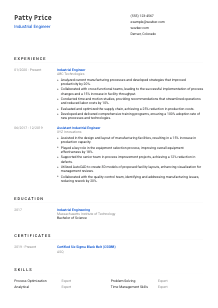
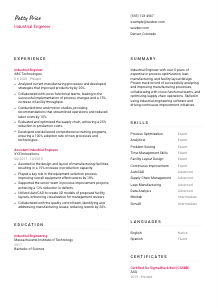
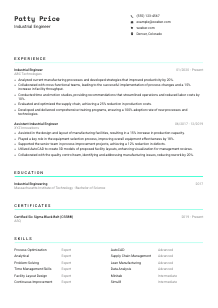
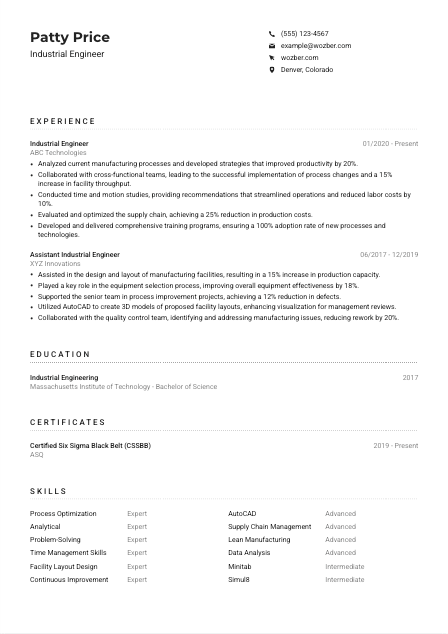
Optimizing processes, but feeling rusty about your resume? Check out this Industrial Engineer example, created with Wozber free resume builder. It shows how you can smoothly streamline your manufacturing mastery to match job specifics, shaping a career narrative as efficiently as your production lines!
Industrial engineering resumes are strongest when they show how you improve a real operation. Hiring teams want to see where you raised throughput, reduced waste, tightened labor standards, improved layout flow, or made a production environment safer and easier to run. If your resume stays abstract and only says you are analytical or improvement-focused, it misses the operational proof that matters in manufacturing, logistics, and continuous improvement work.
A tailored resume also helps separate hands-on process engineers from candidates whose work stayed closer to general operations support. Using Wozber's free resume builder and an ATS-compliant resume structure, you can mirror the language of the target role, surface tools such as AutoCAD, Minitab, or Simul8 where they genuinely apply, and make it easier for a hiring team to quickly recognize your scope in process optimization, facility layout, and implementation work.
This section is short, but it still affects how smoothly your application moves forward. For industrial engineering roles, clean contact details, a matching title, and any location relevance help remove basic friction before the reviewer gets to your process improvement work.
Use your full name as the most visible text on the page. Keep it easy to read and professional. In a field where resumes often include technical detail, plant metrics, and software references, a clean header helps the document feel organized from the first glance.
Place "Industrial Engineer" beneath your name if that is the role you are targeting. This immediately aligns your application with jobs focused on lean manufacturing, layout design, time studies, and production efficiency. If your recent title was slightly different, such as Manufacturing Engineer or Process Improvement Engineer, use the target title only when your experience genuinely supports it.
If the employer wants someone based in a specific area, include your city and state when you meet that requirement. Here, listing Denver, Colorado immediately answers a stated location preference. If you are relocating, make that clear in a way that removes uncertainty rather than leaving the employer to guess.
A LinkedIn profile or personal website can help if it supports your candidacy with project context, software work, plant optimization results, or engineering credentials. Keep it current. If the link adds no value beyond what the resume already shows, it is fine to leave it out.
Your header should confirm who you are, how to reach you, and whether any practical requirement such as title alignment or location is already covered. That lets the reader move straight to your improvement record.




This is where an industrial engineering resume earns attention. Employers are looking for evidence that you improved a process, influenced production flow, supported facility decisions, cut cost, or made implementation stick through cross-functional execution and training.
Read the posting for recurring responsibilities, not just isolated keywords. In this case, the recurring themes are process optimization, facility and equipment changes, time and motion analysis, supply chain efficiency, and training. Those themes should shape which projects and accomplishments you emphasize under each role.
List positions in reverse chronological order. For each one, include your title, employer, and dates first, then follow with bullet points that show what changed because of your work. Industrial engineering hiring often involves quick scanning for plant environment, production scope, improvement methods, and measurable outcomes, so the layout should make those easy to find.
Do not stop at task descriptions such as "analyzed processes" or "worked with cross-functional teams." Show the operational result. The sample resume does this well with bullets like improving productivity by 20 percent, increasing facility throughput by 15 percent, and reducing labor costs by 10 percent after time and motion studies. That kind of framing shows both the method and the business result.
Metrics matter in this field because productivity, scrap, cycle time, labor utilization, throughput, and cost reduction are common ways industrial engineering work is judged. Use percentages, volume changes, defect reductions, staffing impact, or capacity increases whenever they are accurate. Even one number in a bullet makes the contribution more concrete.
Choose accomplishments that support the role you want now. For an industrial engineering position, prioritize continuous improvement, manufacturing systems, layout work, labor analysis, simulation, supply chain optimization, and implementation support. A strong bullet about unrelated work is still noise if it pulls attention away from process performance and operational decision-making.
Your experience section should show where you changed a system, what tools or methods you used, and what the operation gained from it. When the bullets are specific, measurable, and tied to production performance, the fit for an industrial engineering role becomes much easier to see.
Education is usually straightforward for industrial engineering roles, but it still needs to line up cleanly with the posting. A degree match helps establish technical grounding for process analysis, systems thinking, manufacturing methods, and quantitative problem-solving.
If the job asks for a bachelor's degree in Industrial Engineering or a related field, make sure your degree is presented clearly and early in the section. That requirement is often a basic screen, so do not bury the field of study or make the reviewer interpret it.
List your degree, field, school, and graduation year in a consistent order. This keeps the section easy to scan and helps ATS parsing. The example, "Bachelor of Science" in "Industrial Engineering" from MIT, works because the degree and discipline are both immediately visible.
If your degree is specifically in Industrial Engineering, say so exactly. When your background is in a related field such as manufacturing engineering, mechanical engineering, or operations research, use the official title and let the rest of the resume reinforce the connection through relevant project and work experience.
Extra educational detail is most useful for early-career candidates or for roles with a strong methods focus. Coursework in ergonomics, operations research, simulation, production systems, quality engineering, or supply chain analysis can help if your experience section is still developing.
Honors, capstone projects, or engineering organizations are worth adding when they support your technical profile. Keep the emphasis on items that relate to manufacturing systems, process improvement, analytics, or design work rather than general student activity.
This section should confirm that you meet the academic baseline and, when useful, add a little more technical context. Clear degree information lets the hiring team move quickly to the part that matters most next, your engineering impact in practice.
Certifications are especially helpful in industrial engineering when they connect to the methods used on the job. Lean, Six Sigma, quality, and process improvement credentials can strengthen your profile when the role involves measurable operational change.
When a job prefers Six Sigma or Lean Manufacturing certification, move those credentials to the front of the section. That instantly supports your experience in waste reduction, process control, root cause analysis, and continuous improvement. The example resume does this by featuring both Six Sigma and Lean credentials.
List credentials that connect to industrial engineering work such as Lean, Six Sigma, quality systems, supply chain, safety, or manufacturing improvement methods. Skip certificates that do not add much to the kind of process, production, or systems role you are targeting.
Add the earned date and, if relevant, the active period. This helps the employer understand whether the certification is current and whether your training reflects recent methods or standards. It is especially useful for credentials tied to ongoing professional standing.
A current certification profile tells employers you keep building your toolkit, whether through formal Lean programs, advanced Six Sigma levels, or related operations training. In industrial engineering, that can support your credibility when leading kaizen work, process redesign, or implementation training.
Certifications matter most when they reinforce the kind of improvement work your experience already shows. When the section is relevant and current, it strengthens your case for roles centered on efficiency, quality, and operational change.
The skills section should read like the toolkit behind your accomplishments. For industrial engineers, that usually means a mix of process improvement methods, analysis capability, manufacturing knowledge, and the software used to model, measure, or redesign operations.
Look beyond the buzzwords and identify the working skills behind the posting. Here, that includes process optimization, facility layout design, lean manufacturing, analytical problem-solving, time management, and software such as AutoCAD, Minitab, and Simul8. Those are better anchors than generic terms alone.
Show a combination of technical and applied skills. A solid industrial engineering list might include process optimization, continuous improvement, time studies, supply chain analysis, labor standards, AutoCAD, Minitab, simulation tools, and stakeholder collaboration. The example resume balances broader capabilities like continuous improvement with named tools that matter for the job.
Do not crowd the section with every skill you have used once. Put the most relevant items first, especially those named in the job description or supported by your experience bullets. If the role is manufacturing-heavy, skills tied to throughput, layout, quality, and waste reduction should outrank generic office or administrative abilities.
This section should echo the methods, tools, and operating areas already shown in your experience. When the list is focused and role-specific, it helps the reviewer connect your results to the capabilities that produced them.
Language requirements are often simple, but they still matter. Industrial engineers regularly work across production, quality, maintenance, supply chain, and leadership teams, so communication has a direct effect on implementation, training, and day-to-day coordination.
If the posting names a required language, include it clearly with an honest proficiency level. In this case, English is a core requirement, so listing strong English ability is essential rather than optional.
When a job requires or strongly prefers a certain language, place it at the top of the section. Use straightforward labels such as Native, Fluent, or Intermediate so the employer can quickly understand your working level.
Extra languages can be valuable in plants, warehouses, supplier environments, or regional operations where teams and partners may communicate across languages. The sample resume includes Spanish, which can be useful in some manufacturing settings, though it is not a universal requirement for every industrial engineering role.
Do not overstate what you can do. If you can lead training, run meetings, or write process documentation in a language, your level should support that claim. If your ability is conversational only, label it accordingly.
Some industrial engineering roles stay heavily internal, while others involve supplier coordination, multi-site rollout, or frontline training. When language ability supports those responsibilities, it becomes more relevant and worth featuring more prominently.
Clear language information helps employers understand whether you can communicate effectively in the environments their operation requires. For this field, that can matter well beyond conversation, especially when training, documentation, and cross-functional coordination are part of the job.
Your summary should give the reader a fast, accurate picture of the kind of industrial engineer you are. Focus on your operating environment, your improvement strengths, and a few outcomes or methods that match the role you want.
Before writing, identify the two or three themes the job emphasizes most. For this posting, that would be process optimization, lean manufacturing, facility or equipment improvement, and operational efficiency. Use those themes to decide what belongs in the opening lines.
Start with a direct professional identity statement, such as an Industrial Engineer with 5+ years in manufacturing process improvement, layout design, or continuous improvement. This gives immediate context and helps the hiring team place your background quickly.
Mention the capabilities most relevant to the target role, such as time and motion studies, supply chain optimization, facility layout, lean initiatives, or cross-functional implementation. The sample summary works because it highlights process optimization, lean manufacturing, and collaboration without drifting into unrelated strengths.
Aim for a short paragraph that sounds grounded in actual work. Avoid vague claims about being results-driven or dynamic unless you immediately back them up with real context. A concise summary with the right methods, tools, and improvement focus does more than a longer paragraph full of broad adjectives.
A well-written summary helps the reader understand your lane before they reach the rest of the resume. For industrial engineering roles, that means making your improvement focus, technical foundation, and operational scope clear within a few lines.
An effective industrial engineer resume should make it easy to find the work that matters most: process analysis, implementation, layout or flow decisions, cost or throughput gains, and the tools or methods behind those results. When each section supports that story, the document reads like a practical record of operational improvement rather than a list of duties.
Use Wozber's free resume builder, ATS-friendly resume templates, and ATS resume scanner to tighten the language around the role you want, strengthen ATS optimization, and present your experience in a clean ATS-friendly resume format. The result should make one thing clear fast: you know how to improve systems, and you can show where you already have.




