




Use Wozber and land your dream job
Create Resume
No registration required
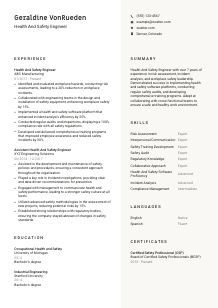
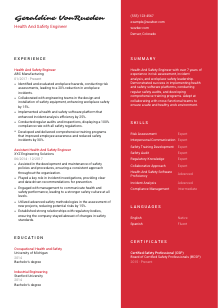
Preventing workplace mishaps, but your resume feels hazardous? Check out this Health And Safety Engineer resume example, created with Wozber free resume builder. Learn how to spotlight your risk-reducing expertise in line with job requirements, keeping your career path incident-free and thriving!
Health and Safety Engineers are trusted with problems that carry real operational weight. A resume for this field needs to show how you reduce incident exposure, improve compliance, and work with engineering, operations, and frontline teams to turn safety requirements into daily practice.
When the resume is tailored well, hiring teams can quickly separate broad EHS experience from engineering-focused safety work in settings like manufacturing and industrial operations. Wozber's free resume builder helps you shape that story into an ATS-compliant resume, so risk assessments, audit results, investigations, and training outcomes are easy to connect to the role you are targeting.
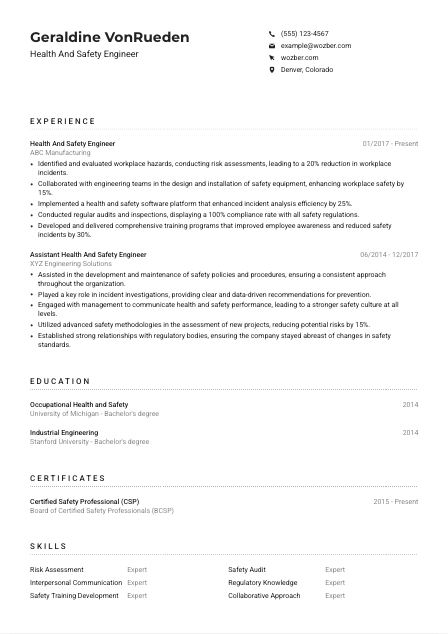
This section should be clean, practical, and easy to scan. For a Health and Safety Engineer, the basics matter because hiring teams often check role title, contact access, and location fit before they spend time on audit results, incident data, or compliance work.
Use your full name as the main heading in a clear professional font. Keep it more prominent than the rest of the contact block so the document feels organized from the first line, much like the structured reporting expected in safety documentation and incident records.
Place "Health And Safety Engineer" directly under your name when that is the role you are pursuing. This helps frame your background immediately, especially if your previous titles vary between safety engineer, EHS engineer, or health and safety specialist, and it supports ATS matching for the target opening.
Include a reliable phone number and a professional email address, ideally in a simple firstname.lastname format. If the employer has a location requirement, as this Denver-based example does, adding your city and state can remove an early question about availability or relocation.
A LinkedIn profile or professional website is useful when it reinforces your resume with the same career timeline, certifications, and safety focus. If it includes project work, audit leadership, or regulatory expertise, make sure those details are current and consistent with the resume.
Location is not always a deciding factor for every Health and Safety Engineer role, but when an employer specifies it, address it directly. In this example, listing Denver, Colorado aligns neatly with the requirement and makes the application easier to process.
Your contact section should answer simple hiring questions fast: who you are, what role you do, how to reach you, and whether location is already aligned. Then the resume can move quickly to your safety performance and engineering scope.




Experience carries the most weight in this profession because employers want to see how you handled hazards, compliance pressure, investigations, and corrective action in real operating environments. Focus less on generic duty lists and more on what you improved, prevented, implemented, or brought into compliance.
List each position in reverse chronological order with your title, employer, and dates. If the company context helps explain your scope, make that visible through the employer name or bullet content. A role at a manufacturing plant, engineering firm, or industrial site immediately gives more meaning to your safety work than a title alone.
Use accomplishment-driven bullets that show how your work changed safety results. Good examples include reducing recordable incidents, improving audit scores, shortening investigation turnaround, increasing training completion, or raising compliance rates. The sample resume does this well by linking risk assessments to a 20% reduction in incidents and training efforts to a 30% drop in safety events.
Numbers matter in safety roles because they show whether your programs worked in practice. Include percentages, compliance rates, incident reductions, audit frequencies, response times, or adoption rates for safety systems where you can support them. Metrics like 100% regulatory compliance or 25% faster incident analysis tell a hiring manager far more than "responsible for safety improvements."
Prioritize bullets that reflect the core work of the opening, such as hazard identification, risk assessment, incident investigation, corrective actions, safety system implementation, KPI reporting, and employee training. If the employer emphasizes cross-functional collaboration, show how you worked with engineering, operations, maintenance, or management to install controls or improve procedures.
Keep this section centered on work that proves you can operate as a Health and Safety Engineer. Side achievements that do not connect to compliance, hazard control, training, audits, reporting, or engineering support only dilute the message. Every bullet should help the reader understand your technical judgment, field presence, and effect on workplace safety.
The best experience sections make your contribution measurable. By the end of this section, a hiring team should be able to see the environments you worked in, the risks you managed, and the results you delivered.
Education matters here because many Health and Safety Engineer roles start with a degree requirement tied to technical judgment, regulatory knowledge, and risk analysis. Present it clearly so the employer can confirm the academic foundation behind your field and compliance work.
If the role asks for a bachelor's degree in Occupational Health and Safety, Environmental Engineering, Industrial Engineering, or a related field, make that qualification easy to find. In this example, the Occupational Health and Safety degree lines up directly with the posting and should appear prominently.
List degree, school, field of study, and graduation year. That is usually enough for an experienced Health and Safety Engineer. Clean formatting helps both ATS parsing and human review, especially when recruiters are quickly checking degree alignment against posting requirements.
Early-career candidates can include coursework, projects, or thesis topics if they connect to risk assessment, industrial systems, environmental controls, ergonomics, or regulatory compliance. For experienced candidates, this is less important unless a specific technical specialty supports the target role.
Membership in recognized safety or engineering organizations can reinforce your professional commitment, particularly if it relates to ongoing standards awareness, industry conferences, or technical practice. Keep it relevant and avoid filling space with unrelated associations.
Safety regulations, reporting tools, and industrial processes change over time. If you have recent coursework, seminars, or formal training in areas like OSHA updates, incident investigation methods, or safety management systems, include them when they support the role you are targeting.
Your education section does not need much space, but it should quickly confirm that your technical background matches the level of responsibility expected in health and safety engineering.
Certifications carry real weight in safety hiring because they show recognized technical standards, current knowledge, and professional commitment. When a posting mentions CSP or an equivalent credential, that should be easy to spot on the page.
If you hold a Certified Safety Professional credential or a close equivalent, list it clearly and early. In this job description, CSP is highly desired, so placing it in the certificates section gives the hiring team one of the strongest role-specific qualifiers right away.
Choose certifications that support your work in compliance, hazard analysis, investigations, training, or environmental health and safety systems. A shorter list of meaningful credentials is more convincing than a long list of certificates with little connection to the work.
For credentials that require renewal or show active standing, include the relevant dates. In safety work, current certification status matters because regulations, standards, and accepted practices evolve, and employers often want proof that your credential is active.
Recent certification activity can strengthen your candidacy, especially if it covers new compliance requirements, industrial hygiene topics, investigation methods, or safety management frameworks. It shows that your knowledge is being maintained in the same way you would maintain a robust safety program.
Relevant certifications help hiring managers place your knowledge level quickly. They are especially useful when the role involves regulatory interpretation, plant safety programs, and leadership with frontline teams.
A Health and Safety Engineer skills section should read like a practical operating profile, not a generic checklist. Focus on the technical, regulatory, analytical, and communication capabilities that support hazard reduction, compliance, and safer engineering decisions.
Review the posting for explicit and implied requirements. Here, the clearest ones include risk assessment, incident analysis, safety audits, regulatory knowledge, health and safety software, training delivery, and cross-functional communication. Those are the capabilities your skills section should emphasize.
Mirror the employer's wording naturally. If you have done the work, terms such as "Risk Assessment," "Incident Analysis," "Safety Audit," "Regulatory Knowledge," and "Health And Safety Software Proficiency" will align well with both ATS filters and hiring expectations. The sample resume uses this approach effectively.
List the most relevant hard and soft skills first. For this profession, that often means hazard identification, compliance management, investigation methods, training development, reporting, and collaboration with engineering and operations teams. Keep weaker or less relevant skills off the list so the section stays targeted.
If someone reads only this section, they should still recognize a candidate who can assess risk, interpret safety requirements, investigate incidents, and work across teams to improve site performance.
Language skills matter in safety roles because instructions, training, investigations, and corrective actions depend on clear communication. Include this section with the same practicality you would bring to a safety briefing or incident report.
When a posting specifically requires English proficiency, include it clearly and accurately. For a Health and Safety Engineer, this is especially important because audits, reports, training materials, and regulatory communication all depend on precise written and spoken English.
If you work with multilingual production teams, contractors, or regional operations, additional languages can be valuable. They can help with training delivery, hazard communication, and employee engagement on the floor, but they should follow the primary language required for the role.
Use standard labels such as Native, Fluent, Intermediate, or Basic so the employer can quickly understand your communication level. Avoid vague descriptions. In safety work, clarity matters because communication gaps can affect training quality and compliance execution.
A second language is worth including when it could help you reach more employees, support investigations, or improve clarity in diverse teams. For example, Spanish may be useful in many industrial settings, but only mention languages you can genuinely use in a professional context.
Do not overexpand this section unless languages are central to the role. If the posting only requires English, a concise listing is enough. The point is to show communication readiness, not to shift attention away from your safety engineering qualifications.
For this field, language ability is most valuable when it helps training land clearly, reports stay accurate, and safety expectations reach the people doing the work.
The summary should quickly establish your level, your safety domain, and the kind of results you deliver. For a Health and Safety Engineer, that usually means combining years of experience with a few specific strengths such as risk assessment, compliance leadership, investigations, training, or safety systems implementation.
Read the posting closely before writing the summary. If the role centers on manufacturing safety, compliance oversight, audits, and training, those points should shape your opening lines. This keeps the summary anchored in the actual work instead of sounding broad or interchangeable.
Begin with a direct statement that identifies you as a Health and Safety Engineer and states your level of experience. The sample summary's "over 7 years of experience" works because it immediately clears the posting's 5+ years requirement and frames the rest of the paragraph with credibility.
Follow with the capabilities most relevant to the opening, such as risk assessment, incident analysis, audit leadership, regulatory compliance, safety software implementation, or training development. Choose strengths you can support elsewhere in the resume, ideally with metrics or project examples.
Aim for three to five lines with concrete language. Avoid soft claims about passion or dedication unless they are backed by real work. A compact summary that mentions years of experience, key safety functions, and a few clear outcomes will do more than a paragraph full of generic praise.
By the time a hiring manager finishes these lines, they should already understand your experience level, your safety focus, and the kind of improvements you have delivered in the field.
When each section is tailored to the role, your resume starts to read like the profile of someone who can walk into a facility, assess risk, work with engineering and operations, and improve safety outcomes with discipline. That is the standard this kind of hiring looks for.
Wozber's free resume builder gives you a practical way to organize that content in an ATS-friendly resume format, and its ATS resume scanner can help you align key terms, requirements, and section-level match before you apply. The finished resume should make your compliance knowledge, field judgment, and operational impact easy to recognize.




