




Use Wozber and land your dream job
Create Resume
No registration required
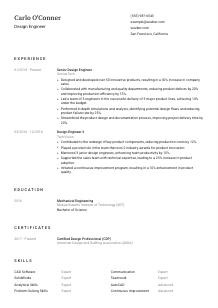
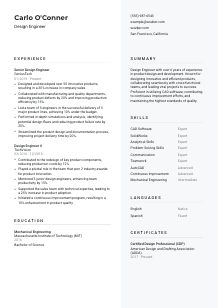
Sculpting product blueprints, but your resume lacks form? Explore this Design Engineer resume example, created with Wozber free resume builder. Learn how to blend your visionary drafts with job specs, so your career ascent is as elegant as your creations!
Design engineering work gets judged in the real world through products that function, hold up in testing, and move cleanly into manufacturing. A resume for this field needs to make that visible fast. Hiring teams want to see how you handled CAD-based design, design-for-manufacture tradeoffs, analysis, and documentation, not just that you were involved in development projects.
Resume tailoring changes how quickly your application reads as technically relevant instead of broadly mechanical. Using Wozber's free resume builder to align your wording with the posting and keep an ATS-compliant resume cleanly structured helps surface the right terms early, from CAD tools to testing and cross-functional collaboration. That makes it easier to recognize whether you can design parts and systems that meet performance, quality, and timeline expectations.
For engineering roles, the header does more than identify you. It confirms basic logistics, presents a professional point of contact, and removes friction before anyone reaches your technical experience.
Use your full name as the most prominent text on the page. Keep it simple and professional so the focus stays on your engineering background, project scope, and results rather than on styling choices.
Place the role title directly under your name when it matches the opening you are pursuing. If you are applying for a Design Engineer position, say "Design Engineer." That immediate alignment helps frame the rest of the resume around product design, CAD work, and development experience.
Include a reliable phone number and a professional email address. Design engineering hiring often moves from resume review to screening calls and then technical interviews, so your contact details need to look credible and be easy to use.
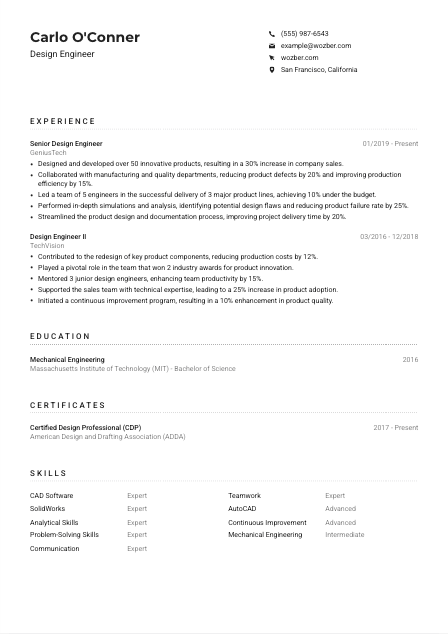
If the posting includes a location requirement, reflect it clearly in your header. Here, San Francisco, CA is part of the stated criteria, so listing that location addresses a practical filter right away. Treat this as tailoring to the opening, not as a rule for every Design Engineer resume.
Add a LinkedIn profile or portfolio site only if it reinforces your resume. For a Design Engineer, that could mean project pages, product visuals, design process examples, or engineering accomplishments that support your CAD, testing, and product development work. Make sure titles, dates, and achievements match your resume.
This section should answer the basics in seconds: who you are, what role you are targeting, how to reach you, and whether you meet any location requirement in the posting. Once that is clear, the reader can move straight to your engineering work.




This is the section where Design Engineers separate themselves from candidates who only list responsibilities. Hiring managers look for proof that you have designed real parts or products, worked through feasibility constraints, and improved performance, quality, cost, or delivery outcomes.
Start by marking the core requirements in the job description: product design and development, CAD proficiency, collaboration with manufacturing and quality, analysis and testing, continuous improvement, and documentation. Then shape your bullets around comparable work you have actually done. This gives your resume stronger ATS optimization and makes your experience read as directly relevant instead of generally mechanical.
List each role in reverse chronological order with job title, employer, and dates. That simple structure matters in engineering hiring because reviewers often compare progression in scope, such as moving from component design support to ownership of assemblies, systems, or product lines.
Focus each bullet on what you designed, what process you supported, and what changed because of your work. The sample resume does this well with points like designing more than 50 products and collaborating with manufacturing and quality to reduce defects. That is much stronger than writing "responsible for product design" because it shows output and operational impact.
Use numbers where they reflect real performance. In this profession, useful measures include defect reduction, failure-rate improvement, cost savings, cycle-time gains, production efficiency, budget performance, or number of products delivered. Results like a 20% drop in defects or a 12% reduction in production cost tell a hiring team far more than broad claims about innovation.
Prioritize experience tied to design engineering work: CAD modeling, redesigns, simulations, testing, documentation control, manufacturing collaboration, and product improvement. If an older role is less relevant, either shorten it or remove it. The section should read as a clear record of engineering contribution, not a full autobiography.
Your experience section should show how you move from concept to manufacturable result and what business or product outcome followed. With an ATS-friendly resume format and Wozber's ATS resume scanner, you can sharpen the match between your actual engineering work and the terms the employer is screening for.
For Design Engineer openings, education is often a baseline qualification rather than a differentiator. It still needs to be clear, accurate, and easy to verify, especially when the posting specifies a degree in Mechanical Engineering or a related field.
If the job asks for a Bachelor's degree in Mechanical Engineering or a related discipline, make that information unmistakable. A degree entry such as "Bachelor of Science, Mechanical Engineering" directly addresses a key requirement and removes guesswork during screening.
Present degree, field, school, and graduation year in a consistent format. Engineering resumes benefit from clean structure because hiring teams are already processing technical details elsewhere on the page.
When your degree aligns tightly with the role, keep that alignment visible. In the example, a Mechanical Engineering degree supports the product design and development focus of the opening. If your degree is in a related area, make sure the rest of the resume reinforces the engineering depth behind it.
Relevant coursework can help if you are early in your career or if the role leans on a specialized area such as materials, machine design, CAD, FEA, or manufacturing processes. For experienced candidates, coursework is usually less important than project and work history.
Honors, scholarships, senior design projects, or competition work belong here when they strengthen your case for product design, analysis, prototyping, or problem-solving. Keep them concise and relevant to engineering practice.
This section should confirm that you meet the educational baseline without forcing the reader to search for it. When the degree matches the role cleanly, your resume can move quickly to the design, analysis, and manufacturing work that carries more hiring weight.
Certifications are rarely the deciding factor for Design Engineer roles, but the right ones can reinforce specialized capability, ongoing development, or commitment to engineering standards and tools.
List certifications that support design engineering tasks, such as CAD proficiency, drafting standards, product development methods, quality systems, or specialized analysis tools. Generic certificates add little unless they connect directly to the role.
Choose certifications that strengthen your core profile rather than filling space. A credential like the Certified Design Professional shown in the example supports design-related credibility because it aligns with drafting and design practice.
Show the year earned and, if applicable, the active date range or renewal status. This is especially useful for certifications tied to current software proficiency, quality frameworks, or regulated engineering environments.
Design engineering changes with tooling, manufacturing methods, and simulation practices. Recent certifications or renewals can show that you are keeping current with the methods and systems used in modern product development.
A certificate can support your case, especially when it aligns with CAD, drafting, quality, or design process work. It should complement your hands-on engineering record and help the reviewer see extra depth where it matters.
A Design Engineer skills section should read like a compact map of how you work. It needs to cover the software, engineering judgment, and collaboration abilities that support product development from concept through validation and release.
Start with the language used in the job description and map it to your real strengths. Here that includes CAD software, analytical and problem-solving skills, communication, teamwork, and product design experience. Matching this language naturally improves ATS alignment while keeping the section grounded in actual capability.
Include hard skills such as SolidWorks, AutoCAD, CAD modeling, simulation, design documentation, or continuous improvement, then pair them with skills that matter in project execution like problem-solving, communication, and collaboration with manufacturing or quality teams. Design Engineers are hired for both technical output and cross-functional effectiveness.
Lead with the skills that are central to the opening rather than listing every tool you have touched. In the example, CAD software and SolidWorks deserve prominent placement because they connect directly to product design and development. Keep the list lean enough that every item supports the target role.
Every skill listed should help explain how you design, analyze, communicate, or improve products. A targeted skills section strengthens both ATS matching and the technical story your experience section is already telling.
Language requirements are usually straightforward in engineering roles, but they still matter. Communication affects design reviews, documentation, cross-functional coordination, and any situation where technical details need to be understood without confusion.
If the job posting calls out English, include it with an honest proficiency level. That matters because Design Engineers write documentation, explain design decisions, participate in review meetings, and coordinate with manufacturing and quality teams.
List the language required for the role at the top. This keeps the section aligned with the posting and prevents the reader from having to search for a stated requirement.
Additional languages can be useful when products are developed across regions, suppliers are international, or customer support has a technical component. They are secondary to core engineering qualifications, but still worth listing if they are real and usable.
Use levels you can defend in conversation or in a technical work setting. If you claim fluency, expect to handle meetings, documentation discussions, or problem-solving exchanges in that language.
Some Design Engineer roles involve global manufacturing partners, external vendors, or distributed engineering teams. In those cases, an additional language can support smoother collaboration, even if English remains the required working language.
List language ability the same way you present any other qualification: clearly, truthfully, and in proportion to the role. For engineering positions, the key question is whether you can communicate technical information accurately where the job requires it.
The summary sits at the top of the resume, so it needs to establish your design background without drifting into broad claims. For this profession, the best summaries combine years of experience, core technical focus, and one or two outcomes that point to product, process, or team impact.
Read the posting closely before writing the summary. Identify the central themes, such as product design and development, CAD proficiency, analysis, testing, cross-functional collaboration, and improvement work. Those themes should shape your opening lines.
Begin with a direct statement that covers your title and level of experience. The sample summary does this effectively with "Design Engineer with over 6 years of experience in product design and development," which immediately establishes role alignment.
Follow with specifics that connect to the target role, such as designing successful products, improving quality, reducing failure rates, or collaborating with manufacturing teams to improve feasibility and delivery. Choose points that reflect how Design Engineers are actually evaluated.
Aim for a short paragraph that can be read in a few seconds. Three to five lines is usually enough to cover your experience level, core design capabilities, and the type of outcomes you deliver. Save the detail for the experience section.
A well-written summary should make the reader expect solid design work, relevant CAD and analysis experience, and measurable product impact before they reach the first job entry. Wozber's AI resume builder and ATS resume scanner can help tighten that top section so it reflects the posting language and presents your experience with sharper alignment.
A Design Engineer resume works when it shows how your technical decisions translate into better products, cleaner manufacturing handoff, stronger quality results, or lower cost. Each section should support that story, from the degree that meets the baseline to the bullets that show design output, analysis, testing, and improvement work.
Use Wozber to organize that content into an ATS-friendly resume template, align your wording with the posting, and check where important requirements are still missing. The finished resume should make it easy to judge one thing quickly: whether you can step into the design process and deliver engineering work that performs in production.




