



Use Wozber and land your dream job
Create Resume
No registration required
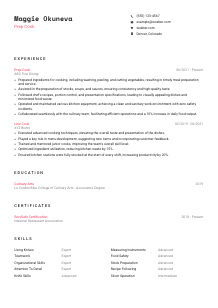
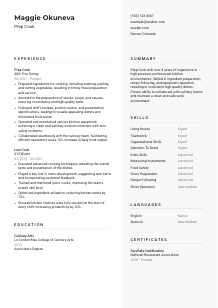
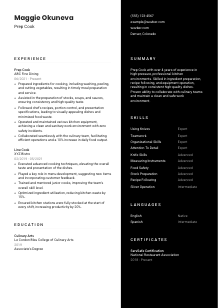
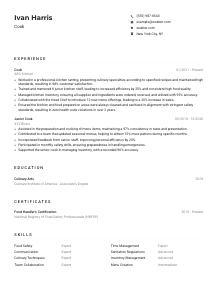
Mastering mise en place but feeling out of order with your resume? Check out this Prep Cook resume example, created with Wozber free resume builder. Learn how to arrange your culinary talents to match job requirements, serving up a career that's always perfectly seasoned!
Prep cook hiring moves quickly because kitchen leaders need people who can step onto the station, prep accurately, and keep service moving without creating waste, delays, or food safety issues. Your resume should make that operating standard visible right away through the kind of prep work you handle, the pace of kitchen you have worked in, and how reliably you follow recipes, portioning, and sanitation routines.
A tailored resume changes how your background is read in a kitchen hiring stack. When the language matches the posting, an ATS-compliant resume makes it easier to see whether your experience lines up with prep volume, equipment use, food safety training, and team communication. Wozber's free resume builder helps organize that match clearly, so both the ATS and the chef reviewing your application can quickly understand where you can contribute on day one.
Kitchen hiring starts with practical checks. Can they contact you quickly, are you applying for the right role, and do you meet any location requirement listed in the posting? Your Personal Details section should answer those points cleanly without taking space away from your kitchen experience.
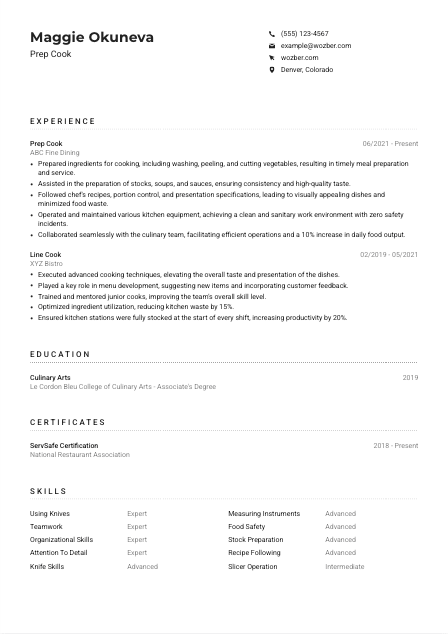
Use your full name as the main header, then place "Prep Cook" directly beneath it if that is the job you are pursuing. This keeps your resume aligned with the opening and avoids any confusion if your recent title was something adjacent, such as Line Cook or Cook. In the example resume, the title immediately tells the reader that the candidate is applying specifically for prep-focused kitchen work.
List a phone number you answer and a professional email address you check regularly. Kitchen interviews and trial shifts are often scheduled fast, so a missed call or typo can cost you the opportunity. Keep this section simple and accurate, with no extra labels or clutter that slow down a hiring manager scanning the top of the page.
If the employer asks for candidates in a specific city, show that clearly. Here, listing Denver, Colorado helps confirm that you meet the stated location requirement. When a posting does not mention location beyond standard contact details, city and state are usually enough. Save relocation explanations for the cover letter or interview if needed.
Include a website or profile only if it supports your application. For a prep cook, that might be a simple portfolio, culinary profile, or professional page showing kitchen experience, certifications, or training. If the link is outdated or unrelated to food service work, leave it off. The goal is to reinforce your kitchen background, not send the reader elsewhere without a clear reason.
Do not add age, marital status, photo, or other personal details that do not help a chef or kitchen manager evaluate your ability to prep, maintain sanitation, or work with the team. Keep attention on the details that matter in food service hiring: role, availability to contact, and any stated location requirement.
This section should confirm that you are reachable, role-specific, and logistically aligned with the opening. Then the rest of the resume can stay focused on kitchen execution.




This is where hiring managers look for proof that you can work cleanly, quickly, and consistently in a professional kitchen. They want to see the prep tasks you owned, the kitchen standards you followed, and the operational results you helped produce, whether that meant smoother service, lower waste, or better output during busy shifts.
Read the posting the way you would read a prep list before service. Mark the tasks, tools, and standards that appear repeatedly. In this role, that includes ingredient prep, stocks and sauces, recipe adherence, portion control, equipment use, sanitation, and teamwork. Those are the themes your bullet points should reflect, because they describe how prep cook performance is actually measured in the kitchen.
Start with your most recent kitchen job and work backward. For each role, include your title, the restaurant or employer, and dates. This makes it easy to track how long you have worked in professional kitchens and whether you meet experience expectations such as the 2 years requested here. If your background includes both prep and line work, keep both when they show transferable station discipline and production skills.
Do not stop at generic duties like "prepared ingredients" or "helped in the kitchen." Show the actual prep work, standards, and outcomes. Strong bullets mention tasks such as washing and cutting vegetables, measuring ingredients, preparing stocks or sauces, maintaining station cleanliness, and coordinating with cooks during service. The sample does this well by tying prep tasks to timely meal preparation, consistency, and smoother daily output.
Numbers help when they reflect kitchen performance. Good examples include reduced waste, increased output, zero safety incidents, faster prep completion, or productivity gains across the shift. The sample resume includes a 10% increase in daily food output and a 15% reduction in waste, which gives the hiring team a clearer picture of operational impact. If you do not have exact numbers, use scope details such as volume, shift pace, or number of stations supported.
Prioritize experience that supports prep cook hiring decisions. If an older role involved customer service or unrelated work, trim it unless it adds something useful such as food handling, speed, or team coordination. For this kind of opening, the most persuasive material shows production prep, consistency under chef direction, safe equipment handling, and clean execution in a professional kitchen environment.
After reading your experience, a chef should be able to picture you on prep. Show the station work, the standards, and the kitchen results that back up your claim.
Prep cook roles are usually hired on practical kitchen ability first, but education still adds useful context. Culinary school, food service training, and relevant coursework can show formal technique, kitchen discipline, and exposure to sanitation standards that support your hands-on experience.
Start by looking for any degree, diploma, or training requirement in the posting. This particular opening does not require a culinary degree, so education plays a supporting role rather than a deciding one. Still, listing culinary training can strengthen your profile by showing structured instruction in knife work, kitchen fundamentals, and food preparation methods.
List the school, degree or credential, field of study, and graduation year. For example, an Associate's Degree in Culinary Arts clearly supports a prep cook application because it connects directly to kitchen technique and food production. Use straightforward formatting so the reader can absorb it in seconds.
If you studied Culinary Arts, Food Service Management, or a related field, make that easy to spot. It is especially helpful when the job asks for recipe discipline, equipment handling, or sanitation knowledge. Even when a posting focuses mainly on experience, relevant education can support your case by showing formal training behind your kitchen habits.
Short courses and workshops can belong here if they strengthen your fit for the kitchen you are targeting. Food safety, allergen awareness, knife skills, or sauce and stock technique are all useful examples for prep cook work. Include them when they add substance, not just extra lines.
Academic distinctions can stay if they are genuinely relevant and recent, especially early in your kitchen career. If you are already several years into professional food service, employers will usually care more about your station work, prep speed, and sanitation habits than classroom recognition. Keep this section proportional to your experience level.
Education should reinforce the kitchen foundation behind your work. Keep it concise and relevant, then let your prep experience carry the most weight.
Certifications carry real weight in kitchen hiring when they relate directly to food handling, sanitation, or compliance. For prep cook roles, a current food safety credential can move your resume higher because it tells the employer you already understand core sanitation standards and safe kitchen practice.
When a job description calls out a certification, include it exactly and place it where it is easy to find. Here, ServSafe certification is directly relevant because the role involves ingredient handling, equipment sanitation, and maintaining a clean work environment. Matching that requirement clearly helps your resume line up with both ATS filters and kitchen expectations.
List the certifications that support your work in a professional kitchen first. Food safety, sanitation, allergen handling, or local food handler credentials belong ahead of unrelated training. Employers hiring for prep need to know you can work safely around ingredients, surfaces, and equipment from the start of the shift.
Many food safety certifications expire or require renewal, so include the date earned and, if relevant, indicate that it is current. The sample resume shows ServSafe as active from 2018 to present, which is useful because it answers the obvious follow-up question before anyone has to ask. Clarity matters here.
If you are applying regularly, check expiration dates before sending your resume. An expired certification can weaken an otherwise solid prep background, especially in kitchens with strict compliance standards. Ongoing certification also shows you stay current with sanitation rules, which matters in any operation handling volume and shared workstations.
For prep cook hiring, the right certification supports trust around food safety and kitchen discipline. Keep the section current, visible, and tied to the actual work.
A prep cook skills section should read like a practical kitchen toolkit, not a list of vague strengths. Hiring managers want to see whether you can handle prep tasks, equipment, sanitation, and team coordination at the pace their operation requires.
Start with the posting and extract both technical and operational skills. In this opening, that means knife handling, slicer use, measuring ingredients, food safety, organization, attention to detail, and communication with kitchen staff. Those are not filler keywords. They point to how the shift actually runs and what can go wrong if the wrong person is hired.
Choose skills that support ingredient prep, consistency, and safe station work. Good examples include knife skills, portioning, recipe following, stock preparation, sauce prep, sanitation procedures, equipment operation, teamwork, and shift organization. The example resume balances hard skills like measuring instruments and food safety with workplace skills like teamwork and attention to detail, which is the right mix for this kind of role.
Avoid padding the section with broad claims that do not tell the kitchen anything. A shorter list of relevant skills is stronger than a long list of generic traits. If you use skill levels, make sure they are believable and consistent with your experience. Every skill listed should connect back to work you can discuss from an actual prep station.
Your skills section should quickly confirm that you know the tools, standards, and pace of prep work. Make every line support that picture.
In kitchen work, language matters because prep instructions, safety procedures, recipe details, and shift communication all depend on being understood quickly. If a posting names a required language, treat it as an operational requirement, not a minor detail.
This job asks for strong proficiency in English, so English should be listed clearly with an honest proficiency level. That requirement matters because prep cooks need to follow chef instructions, read recipes, understand food safety guidance, and communicate during production without confusion.
Lead with the language most relevant to the role and note your level as Native, Fluent, Advanced, or another accurate label. In the sample resume, English appears first, which fits the posting and removes doubt about day-to-day kitchen communication. Keep the wording direct and standard.
Additional languages can strengthen your application, especially in diverse kitchen teams where bilingual communication helps with speed and coordination. Spanish, for example, can be useful in many food service settings, but it should be presented as an added strength rather than a substitute for the required English proficiency.
Do not overstate your fluency. If you can handle basic kitchen communication but not detailed instruction, mark that honestly. Accurate language levels help avoid mismatches and show professional judgment. The same principle applies throughout a prep resume: clear, factual information builds trust.
Only expand this section if language skills genuinely support the role. For most prep cook resumes, one or two entries are enough. The section matters when it clarifies kitchen communication, recipe comprehension, or coordination with the culinary team, not because multilingual ability is automatically required in every kitchen.
List the languages that support safe, efficient kitchen communication, and state your level clearly. For this role, English proficiency should be impossible to miss.
Your summary sits at the top of the resume, so it needs to establish your kitchen background fast. A prep cook summary works best when it names your experience level, the type of kitchen work you handle, and two or three strengths that match the opening, all in language that sounds grounded in actual food service work.
Before writing the summary, pull out the few requirements that matter most. Here, those are professional kitchen experience, ingredient preparation, food safety, equipment use, and team collaboration. Build your opening around that mix instead of writing a broad statement that could apply to any back-of-house role.
Start with your title and years of experience, then add a short description of the environment you know. The sample summary does this well by stating more than 4 years of experience in high-pressure professional kitchens. That immediately gives hiring managers a useful frame for the rest of the resume.
Follow with a few targeted strengths such as ingredient prep, recipe adherence, equipment operation, stock or sauce preparation, sanitation, or team coordination. If possible, connect them to outcomes like consistent quality, efficient service, or safe kitchen operations. This makes the summary feel earned rather than generic.
Aim for 3 to 5 lines. A chef or kitchen manager should be able to read it between other applications and quickly understand whether you belong in the interview pile. Cut any soft, generic language that does not help explain how you perform in prep work.
If your summary is specific, concise, and aligned with the posting, it will frame the rest of your resume in the right way. Wozber's free resume builder can help tighten that wording, keep the structure ATS-friendly, and use ATS resume scanner insights to align your resume with the requirements that matter most in prep cook hiring.
A prep cook resume should make one thing clear fast: you can support service through accurate prep, safe food handling, and dependable teamwork in a professional kitchen. When each section points back to those standards, your application feels focused and credible.
Keep refining your resume as your kitchen experience grows, especially when you add stronger production results, new certifications, or broader station knowledge. Wozber's free resume builder and ATS optimization tools can help you tailor that experience into an ATS-friendly resume format that shows chefs and hiring teams exactly where you are ready to contribute.




