



Use Wozber and land your dream job
Create Resume
No registration required
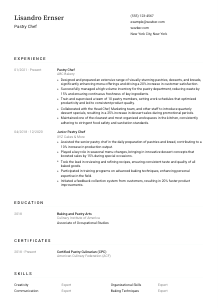
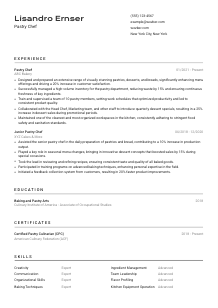
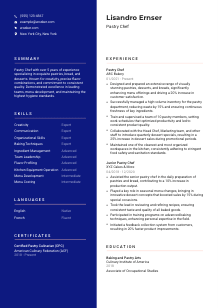
Crafting delectable treats, but your resume doesn't make the best rise? Check out this Pastry Chef resume example, made with Wozber free resume builder. Learn how to layer your baking brilliance to match job requirements, so your career rises as beautifully as your soufflés!
Pastry Chef hiring turns quickly on whether your resume shows disciplined production as clearly as creativity. Beautiful plated desserts matter, but so do batch consistency, recipe execution, sanitation, prep flow, and the ability to keep a pastry section running smoothly during service, events, or seasonal menu changes. Your resume should make that operational range visible from the start.
When pastry resumes are tailored well, the hiring team can immediately see whether you cover the right mix of production, menu contribution, and team oversight instead of reading you as a line cook with some dessert exposure. Wozber's free resume builder helps shape that into an ATS-compliant resume by aligning your wording with the posting's kitchen language, so your experience reads clearly for both screening systems and chefs reviewing who can actually lead the pastry station.
In a kitchen, details matter because mistakes compound fast. The top of your resume should be just as controlled. Keep this section clean, accurate, and aligned with the posting so the employer can place you quickly and move on to your pastry background.
Use your full name as the header's focal point in a clear, readable font. For a Pastry Chef, that top line should feel polished and professional, much like the finish on a plated dessert or display case item. Skip decorative styling that distracts from the rest of the page.
Place "Pastry Chef" directly under your name when that is the role you are pursuing. This keeps your positioning clear and helps both ATS screening and kitchen leadership immediately connect your background to the opening rather than guessing whether you are applying from a broader baker or pastry cook track.
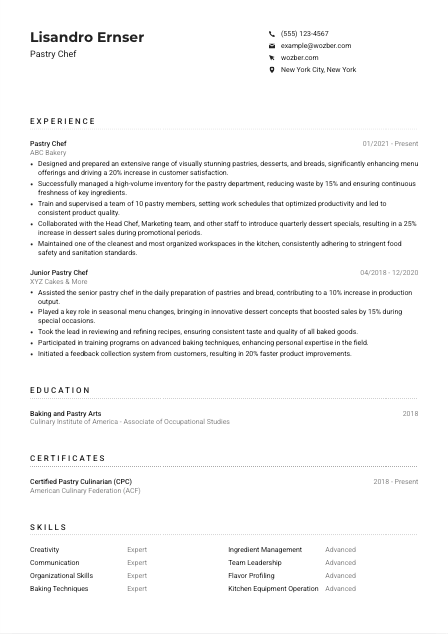
List a working phone number, a professional email address, and your current city and state. If the job has a location requirement, include it when accurate. In the provided example, "New York City, New York" supports a posting that specifically asks for a local candidate, which removes an unnecessary question before anyone reads your experience.
If you maintain a website, Instagram portfolio, or LinkedIn profile that shows plated desserts, viennoiserie, celebration cakes, bread work, or seasonal menu items at a professional standard, include it. Make sure the content reflects the kind of pastry production you want to be hired for, not casual home baking or unrelated food photos.
Do not crowd this area with birth date, photo, marital status, or other personal information unless local norms require it. Save the space for sections that prove recipe range, team leadership, production volume, and food safety discipline.
This section only needs to answer basic logistics and role identity. When it is clean and accurate, the reader gets straight to what matters in pastry hiring: what you make, how well you run the station, and whether you can step into the kitchen without friction.




Pastry kitchens hire from proof, not promise. Your experience section should show what you produced, how consistently you executed, what standards you maintained, and how your work affected sales, waste, service quality, or team performance.
Before writing bullets, mark the responsibilities that define the opening. For pastry roles, that usually includes product range, recipe execution, presentation standards, inventory control, waste reduction, menu development, sanitation, and team supervision. Use those points to decide which achievements belong on the page and which can stay out.
List positions in reverse chronological order with employer, title, and dates. This helps the reader track your progression from assistant or junior pastry work into ownership of production, scheduling, ordering, and menu contribution. Clear chronology matters in hospitality because seniority often maps directly to station responsibility.
Each role should include bullets that show what you actually delivered. Mention the types of goods you produced, the standards you worked to, and the results you helped create. The sample resume does this well by pairing broad pastry output with business outcomes such as higher customer satisfaction, stronger dessert sales, and smoother seasonal rollouts.
Quantify where the numbers are meaningful: dessert sales, waste reduction, customer satisfaction, team size, production output, menu launches, or service improvements. Metrics like a 15% reduction in waste or supervising 10 pastry team members tell a Head Chef far more than vague claims about "high impact" work.
Keep bullets focused on pastry production, bread, plated desserts, recipe refinement, quality control, inventory, staff training, and collaboration with the wider kitchen. If an older role does not support your case for leading or contributing meaningfully in a professional pastry kitchen, trim it down so the stronger experience gets the space.
A strong experience section should leave no doubt about your output, your standards, and your contribution to kitchen performance. The more clearly you connect pastry work to consistency, sales, waste control, and team execution, the easier it is for an employer to picture you running the section.
Formal pastry training still carries weight because it points to technical foundation. For a role built around breads, desserts, presentation, and ingredient knowledge, your education section should confirm that you learned the craft in a structured culinary environment or through recognized pastry training.
If the employer asks for a degree or certification in Baking and Pastry Arts, place that qualification where it is easy to find. In the example, the Associate of Occupational Studies in Baking and Pastry Arts directly answers that requirement and strengthens the resume before the reader reaches the rest of the details.
List school, degree or certificate, field of study, and graduation year or date. Keep the formatting simple. Culinary hiring teams are scanning for training relevance, not a long academic narrative.
Use the actual discipline names that connect to pastry hiring, such as Baking and Pastry Arts, Culinary Arts with pastry focus, or professional baking certification. Precise wording improves ATS alignment and makes it easier to distinguish your background from general food service training.
Relevant workshops or coursework can help if they point to useful kitchen capability, such as artisan bread, chocolate work, plated desserts, sugar techniques, or menu costing. Add them when they support the kind of production the role calls for, especially if your main credential is older or broad.
Scholarships, competition placements, dean's list recognition, or pastry-focused extracurricular work can be worth adding when they point to technical excellence or commitment to the craft. Keep this selective so the section stays focused on training that matters in a professional pastry kitchen.
This section does not need much space, but it should quickly confirm that your pastry background is built on real instruction. For openings that ask for formal baking education, that clarity matters.
Certifications are especially useful when they reinforce kitchen standards, specialty knowledge, or continued professional development. In pastry hiring, they can strengthen the case that your technique and discipline are recognized beyond day-to-day work experience.
Read the posting closely first. Some employers ask for a degree or certification, while others treat credentials as a plus. Even when not mandatory, pastry certifications can support your profile by showing recognized training, standards knowledge, or commitment to the craft.
Choose credentials that connect directly to baking, pastry production, or culinary standards. The example's "Certified Pastry Culinarian (CPC)" works because it reinforces professional pastry expertise rather than adding a generic food credential with little bearing on dessert production.
Show when the certificate was earned and, if relevant, whether it remains active. This is particularly helpful for credentials tied to current practice, professional membership, or ongoing standing within culinary organizations.
Pastry trends and techniques keep moving, from fermentation and viennoiserie refinement to plated dessert presentation and seasonal menu design. Updated certificates or continuing education can show that you are still investing in technique, standards, and kitchen leadership.
Certificates should add something specific to your candidacy, whether that is pastry credibility, up-to-date training, or recognized professional standing. If a credential does not strengthen your pastry profile, leave it out.
A pastry skills section should read like the profile of someone who can execute recipes, manage production, and contribute to the kitchen's standards every day. Focus on skills that reflect how pastry work is actually done, from technique and flavor development to organization and team coordination.
Look beyond obvious baking terms. A Pastry Chef posting often combines hard skills like dough work, dessert preparation, ingredient handling, and flavor pairing with operational needs such as supervision, communication, scheduling, and organization. Your list should reflect that real mix.
If the posting names baking techniques, presentation standards, inventory management, or team leadership, use those phrases naturally in your skills section and across your experience bullets. This helps ATS optimization while keeping the resume grounded in real kitchen work instead of generic buzzwords.
Choose the skills that best support the role you want. The sample resume balances craft and operations well with items like Baking Techniques, Ingredient Management, Flavor Profiling, Team Leadership, and Menu Costing. That kind of list tells the employer you can create quality products and also run the pastry side of service with control.
The right skills section should sound like the toolkit of a working Pastry Chef, not a broad personality list. Prioritize the techniques, controls, and leadership traits that shape product quality and daily execution.
Language skills matter in kitchens because miscommunication affects timing, prep, safety, and service. If a posting specifies English proficiency, address it directly and present your language levels clearly.
When a role calls for strong English, make that clear in this section. Use an honest proficiency label such as Native, Fluent, or Advanced. In the provided example, listing English as Native directly supports a stated hiring requirement.
List the language most important to the role first, then add others that may help in team communication, training, or guest-facing environments. This keeps the section practical instead of decorative.
Extra languages can be useful in diverse brigade environments, multilingual teams, or concepts with international clientele. They are not a substitute for pastry skill, but they can support smoother collaboration across service and production.
Avoid vague labels. Standard descriptors such as Native, Fluent, Intermediate, and Basic give a clearer sense of how well you can communicate instructions, training, and day-to-day kitchen needs.
If another language supports the type of establishment you are targeting, it is worth including. For example, French can complement pastry training or communication in certain bakery and patisserie settings, though it should remain an added strength rather than the centerpiece of your resume.
This section works best when it answers a practical question: can you communicate clearly in the kitchen and, where relevant, with guests or cross-functional teams. Present it simply and let it support the rest of your pastry profile.
Your summary should quickly establish your level, product range, and the kind of pastry operation you can support. In a few lines, show whether you are strongest in production, menu creativity, team leadership, quality control, or a combination that fits the opening.
Start with a direct introduction such as how many years you have worked in professional pastry kitchens and what kind of work defines you, whether that is breads, plated desserts, viennoiserie, cake production, or broad pastry leadership. This gives the reader immediate context.
Include one or two measurable outcomes that fit pastry work, such as reducing ingredient waste, improving customer satisfaction, increasing dessert sales, or leading a productive team. The example summary works because it stays rooted in pastry output, quality, and leadership rather than making broad personal claims.
Call out abilities that matter in pastry hiring, such as flavor development, visual presentation, consistency, menu development, sanitation standards, or team supervision. Choose strengths that are backed up elsewhere in the resume so the summary feels credible.
Aim for 3 to 5 lines. This section should read like a concise kitchen profile, not a personal statement. Every phrase should support your case for the target Pastry Chef job.
A good summary helps the employer understand your level before they scan the rest of the page. When it combines years of experience, product expertise, and a few concrete outcomes, it sets up the entire resume more effectively.
A Pastry Chef resume works best when it shows both artistry and control: the desserts you create, the standards you maintain, the inventory you manage, and the team you can guide through prep and service. That combination is what turns a visually appealing resume into one that feels credible in a professional kitchen.
Use Wozber's free resume builder to organize those details into an ATS-compliant resume that matches the language of the posting and keeps your strongest pastry work easy to find. The finished document should make one thing clear right away: you can deliver quality products, run the pastry section well, and contribute to the menu from day one.




