



Use Wozber and land your dream job
Create Resume
No registration required
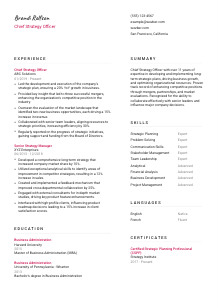
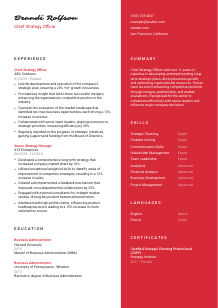
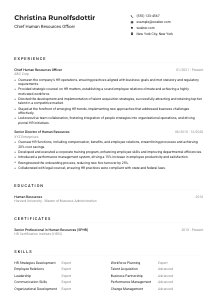
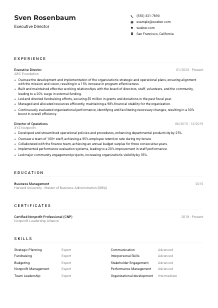
Masterminding business moves, but your resume's lacking a strategic blueprint? Check out this Chief Strategy Officer resume example, created with Wozber free resume builder. Learn how to align your visionary prowess with job requirements, charting a career trajectory as astute as your long-term plans!
A Chief Strategy Officer is expected to connect long-range direction with real operating choices. Boards and CEOs look for someone who can turn market shifts, competitive threats, capital priorities, and growth bets into a strategic plan that the business can actually execute. Your resume needs to show that you have led that kind of work, not just participated in planning discussions.
When this resume is tailored well, the first read becomes much clearer: hiring teams can quickly see whether your background centers on enterprise strategy, growth, and executive influence rather than adjacent leadership work. Wozber's free resume builder helps shape that story in an ATS-compliant resume, so strategic planning, M&A input, market analysis, and board-facing reporting are easy to surface where they matter most.
At the executive level, this section does not need flair. It needs clean identification, credible contact details, and any practical information that removes friction for a search committee or recruiter reviewing Chief Strategy Officer candidates.
Use your full name as the most prominent text on the page. For senior leadership hiring, your name functions as your professional header, so keep it simple, polished, and easy to scan.
Place "Chief Strategy Officer" beneath your name when that is the role you are pursuing. This immediately frames your experience around enterprise strategy, executive alignment, and long-term growth leadership instead of broader operations or business development work.
Include a reliable phone number and a professional email address. At this level, small errors suggest carelessness, so check every character before you send the resume.
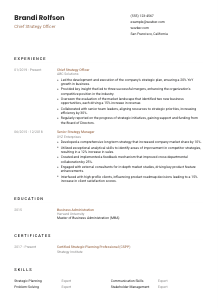
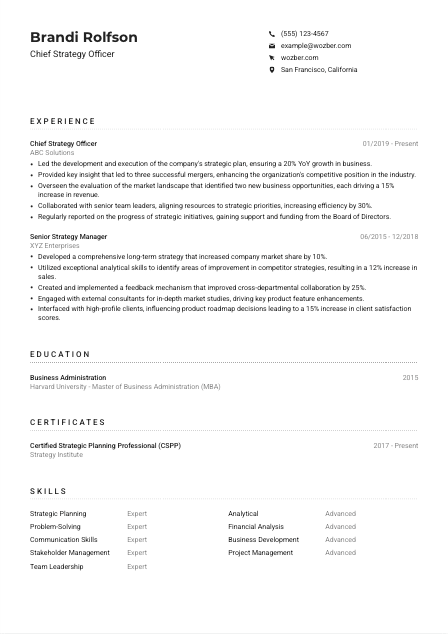
If the role requires a specific city or relocation readiness, reflect that clearly. In the example, listing "San Francisco, California" directly supports the employer's stated requirement and removes an avoidable question early in the process.
A current LinkedIn profile or personal website can strengthen your candidacy, especially if it reinforces board interaction, growth strategy work, transactions, or major business outcomes. Make sure the leadership narrative matches the resume instead of introducing different titles or timelines.
Keep this part concise and exact. For a Chief Strategy Officer, personal details should confirm executive professionalism and remove practical concerns before the reader reaches your strategy track record.




This section carries the most weight for a Chief Strategy Officer. Hiring teams want to see where you shaped company direction, how you influenced growth decisions, and what results followed from your strategic planning, market analysis, or partnership and acquisition work.
Start by marking the core themes in the job description. Here, the emphasis falls on long-term strategy, business growth, profitability, market evaluation, M&A and partnerships, resource alignment, and reporting to the CEO and Board. Those themes should guide which achievements you choose and how you phrase them.
List roles in reverse chronological order with company name, title, and dates. For strategy leadership roles, progression matters. A move from Senior Strategy Manager to Chief Strategy Officer, as shown in the example, tells a stronger story when the bullets also show increasing enterprise scope, influence, and ownership.
Each bullet should show what strategic problem you addressed, what action you led, and what business result followed. Good CSO bullets often cover strategic plan execution, competitive positioning, new market entry, portfolio decisions, transaction support, or cross-functional capital allocation. The sample bullet about leading a strategic plan that drove 20% YoY growth works because it connects executive ownership to a measurable business outcome.
Numbers matter here, but they should reflect how strategy is judged. Revenue growth, market share gains, profitability improvement, successful acquisitions, efficiency gains from resource alignment, and new opportunity identification are all strong proof points. The example uses growth, revenue lift, deal count, and efficiency improvement well because those are familiar performance measures in senior strategy roles.
Prioritize experience that supports enterprise planning, high-level analysis, stakeholder influence, and execution across functions. If a bullet reads more like mid-level project coordination than strategic leadership, rewrite it or remove it. Every line should reinforce that you can guide company direction and translate strategy into operating results.
Your experience section should read like a record of business decisions shaped and results delivered. By the end of it, a CEO or board member should be able to see your range across growth strategy, market insight, executive collaboration, and measurable outcomes.
Education matters in Chief Strategy Officer hiring, especially when a posting signals preference for an MBA, finance background, or another business-focused graduate degree. This section should confirm that you have the formal foundation to support high-level strategic and financial decision-making.
If you hold a master's degree in Business Administration, Finance, or a related field, list it first. In this case, an MBA aligns closely with the employer's preference and supports the strategic, financial, and organizational scope expected in the role.
List degree, field, school, and graduation year in a clean structure. Executive resumes benefit from clarity here. The reader should be able to confirm qualifications in seconds without sorting through extra detail.
Use the formal degree name when it matches your background. "Master of Business Administration (MBA)" is more effective than a shortened version because it reflects the language many postings use and supports ATS alignment without forcing keywords unnaturally.
Coursework is usually unnecessary for senior candidates, but a specialization in finance, strategy, corporate development, or market analysis can be worth noting if it strengthens your positioning for a particular CSO search.
Honors, leadership roles, or notable academic projects can stay if they add something relevant, such as early evidence of analytical rigor or business leadership. At this level, they should support the executive narrative, not compete with your career results.
For this role, education should confirm business credibility quickly. If your degrees align with strategy, finance, or executive management, let that support the broader case built by your experience.
Certifications are usually secondary for Chief Strategy Officer roles, but the right one can reinforce expertise in planning, corporate strategy, financial analysis, or executive leadership. Include them when they add substance, not simply to fill space.
Focus on credentials that relate to strategic planning, corporate development, finance, business analysis, or executive leadership. The example certification, "Certified Strategic Planning Professional (CSPP)," works because it reinforces the candidate's core positioning rather than introducing an unrelated specialty.
One well-chosen certification is stronger than a long list of marginal ones. For CSO hiring, the credential should support strategic judgment, market analysis, portfolio thinking, or leadership scope.
Show the year earned and, if relevant, active status. That helps indicate whether the certification reflects current professional development or a credential from much earlier in your career.
Update this section as your development evolves. If you pursue newer training in M&A, corporate finance, governance, or strategy execution, add it when it genuinely sharpens your positioning for senior strategy roles.
The best certifications section adds one more layer of credibility to your strategic profile. Keep it tightly aligned with the kind of enterprise-level decision-making the role demands.
A Chief Strategy Officer skills section should reflect how strategy leaders operate across analysis, growth planning, executive communication, and cross-functional influence. Keep it focused on capabilities that support enterprise decisions, not a broad catalog of generic strengths.
Identify the capabilities the employer repeats or emphasizes. In this description, strategic planning, analytical thinking, problem-solving, communication, collaboration, and execution all matter. Using that language where it matches your background improves ATS optimization and keeps the section aligned with the role.
Place high-priority skills first. For a CSO, that usually means strategic planning, market analysis, business growth strategy, stakeholder management, financial analysis, and executive communication before more general leadership terms.
A useful list should show range across hard and leadership capabilities. The example combines strategic planning and financial analysis with stakeholder management and communication, which fits the role well because strategy work depends on both insight and organizational influence.
This section should quickly confirm the capabilities behind your experience. If the skills read like the toolkit of someone who can shape direction, influence executives, and drive growth decisions, you are on the right track.
Language requirements are often simple in strategy roles, but they still matter. If the position requires English, state your proficiency clearly. Additional languages can help when the business operates across regions, partnerships, or international markets.
If English proficiency is required, list it clearly and use an accurate level such as "Native" or "Fluent." That addresses a stated requirement without leaving the reviewer to infer it from the rest of the resume.
Place the primary business language first, then any others that add value. This keeps the section aligned with how executive communication is actually handled in board meetings, investor discussions, and cross-functional planning.
A second language is especially helpful if your strategy work has involved international expansion, multinational teams, or cross-border partnerships. In the example, French adds breadth, though it is an added asset rather than a universal CSO requirement.
Choose standard terms such as "Native," "Fluent," "Advanced," or "Conversational." Vague descriptions make it harder for employers to judge whether you can actually operate in high-stakes meetings or negotiations.
For senior strategy roles, language skills matter most when they support market evaluation, partnership development, stakeholder management, or global expansion. Present them as a practical business asset, not a decorative detail.
State what you can genuinely use in professional settings. When language skills support broader market reach or executive communication, they strengthen the strategic profile you are presenting.
For a Chief Strategy Officer, the summary should establish your level, strategic scope, and business impact in a few lines. It needs to position you as someone who has shaped growth strategy, guided executive decisions, and translated analysis into action.
Start with the core of your background: years of experience, seniority level, and the kind of strategy work you lead. If your strength is long-term planning, growth strategy, M&A support, or market expansion, bring that into the first sentence.
Introduce yourself as a senior strategy leader with substantial executive experience. For this posting, mentioning 10+ years in strategic planning and execution is especially relevant because it answers one of the clearest screening requirements immediately.
Use one or two outcomes that reflect how your strategy work performs in practice. The sample summary does this well by mentioning business growth, competitive positioning, mergers, partnerships, and resource optimization without turning into a bullet list.
Aim for a summary that sounds like executive communication: direct, specific, and grounded in results. Skip broad claims about being visionary unless the rest of the sentence proves it through strategy execution, profitability, growth, or organizational influence.
A well-written summary tells the reader, from the opening lines, that your background belongs in a Chief Strategy Officer search. It should make your strategic leadership, growth impact, and executive credibility clear before the first job entry begins.
A Chief Strategy Officer resume should make one point unmistakable: you can shape long-term direction and move the business toward measurable growth. When your sections align around strategic planning, market insight, executive influence, M&A or partnership work, and board-level reporting, the document starts to read like an executive case for hire rather than a list of past responsibilities.
Wozber's free resume builder helps turn that case into a polished ATS-friendly resume format, and its ATS resume scanner can help you align your language with the priorities in a specific posting. Use that structure to surface the experience, metrics, and executive scope that matter most. The final result should make it easy to judge your readiness to lead strategy at the company level.