



Use Wozber and land your dream job
Create Resume
No registration required
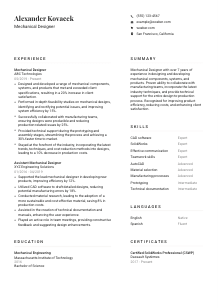
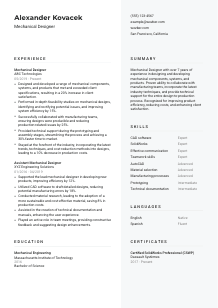
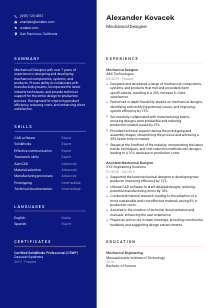
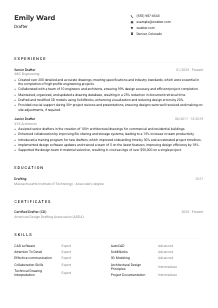
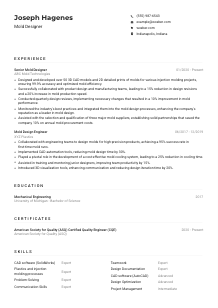
Crafting intricate assemblies, but your resume seems disassembled? Gear up your credentials with this Mechanical Designer resume example, created with Wozber free resume builder. Learn how to align your mechanical genius with job specifications, ensuring your career blueprint is as robust as your designs!
Mechanical design work is judged in the real world by what happens after the model leaves CAD. A hiring team wants to see whether your designs hold up through feasibility review, prototyping, manufacturing handoff, and production troubleshooting. Your resume should make that progression visible, not stop at software proficiency or a list of parts you've drawn.
For Mechanical Designer roles, early screening often comes down to whether your resume clearly connects design work to manufacturable outcomes. Wozber's free resume builder helps you shape an ATS-compliant resume that matches the language of the posting while keeping project results, production collaboration, and engineering scope easy to read. That makes it much easier for employers to recognize where you can contribute from concept through release.
Mechanical Designer hiring starts with a few practical checks before anyone studies your project work. If your contact details, title, and location do not line up with the posting, you can be screened out before your CAD experience or manufacturing knowledge gets reviewed. Keep this section clean, accurate, and directly aligned with the role.
Use your full name as the header anchor of the resume. Keep it larger than the body text and easy to scan, much like a clear title block on a drawing. You want the hiring team to identify you instantly without decorative formatting getting in the way.
Place "Mechanical Designer" directly under your name when that matches the role you are pursuing. This helps position your background immediately, especially when recruiters are sorting applicants across adjacent profiles such as Mechanical Engineer, Product Designer, or CAD Drafter. If your recent work fits the target role, make that connection explicit.
List a working phone number and a professional email address with no typos. Small errors here create unnecessary friction in a process that already moves quickly. If you include a website or portfolio, make sure it leads to relevant project samples, drawings, assemblies, or product work rather than a generic landing page.
Some openings include a location requirement for on-site design reviews, lab access, prototype builds, or manufacturing coordination. In the example here, San Francisco, California is stated directly, so showing that city and state in the personal section removes an immediate question about availability. Treat location as a tailoring point, not a line to repeat throughout the resume.
A LinkedIn profile, portfolio, or project site can strengthen your application when it shows the kind of mechanical design work the role involves. Prioritize links that support your resume with CAD-based projects, product development examples, technical documentation, or prototype outcomes. For this profession, a useful link should extend the engineering story, not just add another profile.
Your personal details should answer the first operational questions fast: who you are, what role you do, how to reach you, and whether you match any stated location requirement. When this section is accurate and direct, the hiring team can move quickly to the engineering substance of your resume.




This is the section where Mechanical Designers separate themselves from candidates who only describe drafting tasks. Hiring teams want to see how you handled component design, feasibility analysis, manufacturing constraints, prototyping support, and measurable product or process improvement. Write your experience so each role shows technical scope and what changed because of your work.
Read the posting for clues about how the design function is organized. Here, the employer is asking for CAD proficiency, materials knowledge, manufacturing awareness, cost reduction, feasibility studies, and cross-functional collaboration. Those points tell you what to emphasize in your bullets, especially if your past roles included design reviews, production support, or product development work that maps directly to those needs.
List positions in reverse chronological order with company name, job title, and dates. That structure matters in engineering hiring because it shows how your responsibility grew over time, from supporting design work to owning assemblies, systems, or product changes. Clear dates also help employers confirm that you meet experience thresholds such as the 5+ years requested in this posting.
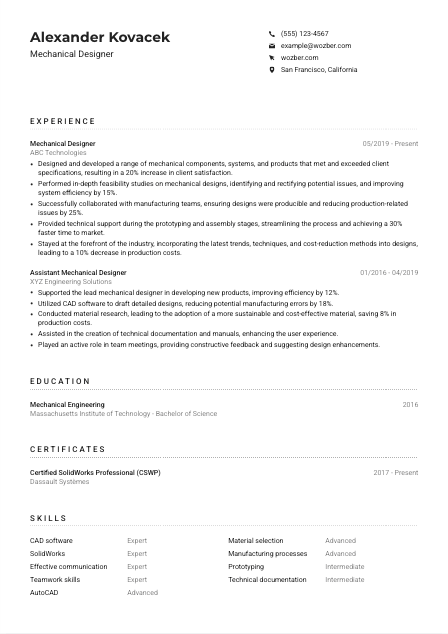
Each bullet should show what you designed, what engineering challenge you addressed, and what result followed. Good Mechanical Designer bullets often include phrases tied to feasibility, tolerancing, producibility, test support, or manufacturing issue resolution. The example resume does this well by connecting design work to client satisfaction, system efficiency, fewer production issues, and faster time to market.
Quantify improvements where the numbers are credible and relevant. Mechanical design work is often measured through cost reduction, cycle time, yield improvement, defect reduction, prototype speed, product performance, or fewer manufacturing issues. A bullet showing a 25% drop in production-related issues or a 10% reduction in production costs gives a hiring manager a much clearer picture than a general claim about improving processes.
Focus your space on work that reflects mechanical design judgment. Prioritize CAD-driven design, materials selection, DFM input, prototyping support, assembly troubleshooting, technical documentation, and cross-functional collaboration with manufacturing or product teams. If an older bullet does not support those themes, trim or rewrite it so the section stays tightly aligned with the position you want.
Your experience section should show that you can move from design intent to manufacturable execution. When the bullets connect CAD work to feasibility, production support, and measurable engineering results, your background reads like someone who can contribute on day one.
For Mechanical Designer roles, education is usually a quick qualification check, but it still matters. Employers often need confirmation that you have the engineering fundamentals behind your design decisions, especially when the work involves materials, mechanics, manufacturing processes, and product development. Keep the section simple, accurate, and aligned with the degree level the posting requests.
If the role asks for a Bachelor's degree in Mechanical Engineering or a related field, list that qualification clearly and without extra wording getting in the way. In the example resume, the Bachelor of Science in Mechanical Engineering answers that requirement directly. Put the most relevant degree first so the employer can confirm the baseline quickly.
Include degree, field of study, school, and graduation year. This is enough for most mid-level Mechanical Designer applications, where the emphasis is on your project and production experience rather than a long academic profile. Straightforward formatting also supports ATS parsing and makes the section easy to verify at a glance.
When the posting uses specific wording and your background genuinely matches it, mirror that language. If you hold a Bachelor of Science in Mechanical Engineering, say that exactly instead of shortening it to something vague. Precision matters in engineering resumes because it shows both qualification and attention to detail.
Relevant coursework can help if you are early in your career or pivoting into a more specialized design environment. Focus on subjects that support mechanical design work, such as machine design, materials science, manufacturing processes, CAD, finite element analysis, or thermodynamics. If you already have several years of product development experience, keep coursework brief or leave it out.
Academic distinctions can support your profile when they connect to the field. Honors, engineering society memberships, research work, or design competition recognition can add value if they reinforce your technical foundation. Keep these additions selective so the section stays useful rather than crowded.
Your education section should quickly confirm that you have the formal engineering base to support your design decisions. Once that requirement is clear, the rest of the resume can focus on how you have applied that knowledge in design, testing, and manufacturing settings.
Certifications are not required for every Mechanical Designer role, but the right one can sharpen your profile when it connects directly to the tools or standards the employer uses. CAD credentials, process training, or specialized technical certifications work best when they reinforce the actual design work shown elsewhere on the resume.
Start with the job description. Some employers do not ask for certifications at all, while others prefer platform-specific credentials or industry training. In this example, no certificate is mandatory, but a credential like Certified SolidWorks Professional supports the stated need for CAD proficiency and helps confirm depth beyond a basic software mention.
Choose certifications tied to the role's real demands, not every course or badge you have earned. For Mechanical Designers, that usually means CAD software, product development methods, manufacturing, quality, or related technical specialties. A focused list reads as deliberate and relevant.
If the credential is current, renewable, or tied to ongoing professional standing, include the date or date range. That gives employers a quick sense of how recent the qualification is. The example certification shows an active timeline, which works well for a tool-based credential that still supports current design work.
Mechanical design evolves with software updates, manufacturing methods, materials, and product development practices. Adding newer certifications can signal that you stay current with the tools and methods shaping the field. Keep them relevant to the jobs you want, especially when they strengthen your case for prototyping, DFM collaboration, or advanced CAD work.
A well-chosen certification should reinforce a real strength already visible in your resume, such as CAD depth or manufacturing awareness. Used selectively, it adds technical credibility without distracting from your core design experience.
Mechanical Designer skills need to do more than fill a keyword section. They should quickly tell an employer what tools you use, what engineering knowledge you apply, and how you work across design and production teams. Build this section around role-relevant capabilities, not a generic mix of software and soft skills.
Use the job description as your reference point for what belongs here. This posting points to CAD software, SolidWorks or AutoCAD, materials knowledge, manufacturing processes, cost-reduction techniques, communication, and teamwork. That mix tells you the employer wants both design execution and practical collaboration with manufacturing and internal stakeholders.
If the employer names specific tools or capabilities you have used, reflect them in your skills list and reinforce them in experience bullets. The example resume does this by listing SolidWorks, AutoCAD, material selection, manufacturing processes, and technical documentation. That alignment works best when the same terms also appear in your work history with real project context.
Group or order skills so the most relevant ones appear first. For a Mechanical Designer, that often means CAD platforms, design and development capabilities, manufacturing and materials knowledge, then collaboration or communication skills. A tighter list makes the section more useful for both ATS optimization and human review.
Your skills section should give a fast, accurate picture of the tools and engineering capabilities you bring to product design work. When the list matches the posting and is backed up by your experience, it strengthens both ATS alignment and hiring confidence.
Language proficiency matters more in engineering roles than many candidates realize. Mechanical Designers often need to explain design intent, document changes, support prototype reviews, and work across manufacturing, product, and client-facing teams. If the posting names a language requirement, treat it as a core qualification rather than an extra detail.
When a job description explicitly calls for strong English proficiency, list English prominently with an accurate level. For a Mechanical Designer, that matters because design reviews, technical documentation, specification interpretation, and production communication all depend on clear written and verbal English.
Include additional languages when they are real working strengths, especially if they help in multinational teams, supplier communication, or client support. The example resume adds Spanish after English, which broadens the profile without distracting from the required language.
Choose simple, recognizable labels such as Native, Fluent, Intermediate, or Basic. Avoid inflated descriptions. If you may need to discuss design changes, tolerances, assembly issues, or test observations in that language, your stated level should hold up in an interview or on the job.
A language section should reflect communication ability you can actually use in meetings, documentation, or cross-functional work. Overstating fluency can create real problems in technical environments where precision matters. Be specific enough that the employer knows what to expect.
Some Mechanical Designer roles involve global suppliers, distributed engineering teams, or international clients. In those cases, language capability can become a meaningful differentiator alongside CAD and manufacturing knowledge. If that applies to your target role, make sure the section supports that broader working context.
This section earns its place when it supports how you communicate in technical settings, from documentation to team coordination. For roles that require strong English or involve global collaboration, accurate language details can remove uncertainty early.
The summary is your chance to frame your background before the reader gets into the details. For a Mechanical Designer, the best summaries quickly establish years of experience, core design strengths, and the kinds of outcomes you have delivered across development, prototyping, and manufacturing support. Keep it short, specific, and anchored in the work.
Before writing, identify the few priorities the employer is most likely to look for first. In this posting, those include mechanical design experience, CAD proficiency, materials and manufacturing understanding, teamwork, and support across feasibility, prototyping, and production. Your summary should reflect that mix without turning into a keyword list.
A strong first line usually includes your title and years of experience. "Mechanical Designer with 7+ years of experience" works because it gives immediate context and helps establish that you meet the seniority level of the role. From there, add one or two areas of real strength, such as product development, CAD-driven design, or manufacturing collaboration.
Use the next sentence or two to show how your background maps to the role. Mention the parts of your experience that matter most, such as designing mechanical components and systems, improving manufacturability, supporting prototypes, or reducing cost through better materials and process choices. The sample summary works because it ties design work to efficiency, cost reduction, and collaboration across the design-to-production cycle.
Aim for a compact paragraph of 3 to 5 lines. Include one or two concrete results if they strengthen the summary, but do not overload it with numbers. The section should read like a concise engineering profile, not a compressed version of your entire experience section.
By the end of the summary, an employer should understand your level, your core mechanical design strengths, and the kind of product or process impact you tend to deliver. That framing sets up the rest of the resume to confirm the details.
A Mechanical Designer resume should show more than CAD familiarity. It should connect design work to feasibility, manufacturability, prototype support, cost awareness, and measurable product outcomes.
Use Wozber's free resume builder to organize that experience into an ATS-friendly resume format, align your wording with the job description, and strengthen ATS optimization without sacrificing technical clarity.
When the final version makes your design judgment, production collaboration, and engineering results easy to see, you are ready to apply with confidence.