



Use Wozber and land your dream job
Create Resume
No registration required
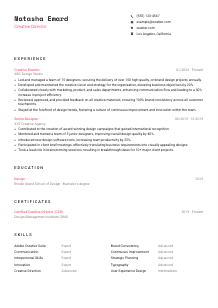
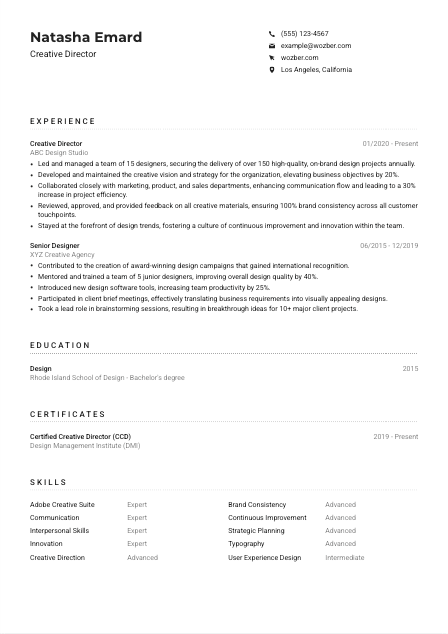
Orchestrating campaigns, but your resume feels like a solo act? Direct your attention to this Creative Director resume example, created with Wozber free resume builder. It shows how to showcase your innovative vision and brand leadership to match job criteria with as much flair as your best ad spots!
Creative Director hiring usually turns on a simple question: can you lead the work, not just produce it? A resume for this level needs to show how you shaped brand direction, guided designers through review cycles, and translated business goals into campaigns, product visuals, or multi-channel creative systems that held together under pressure.
When that story is tailored well, hiring teams can quickly separate hands-on senior designers from true creative leaders who set vision, give useful feedback, and keep output on-brand across teams. Wozber's free resume builder helps you align that story in an ATS-friendly resume format, so core signals like team leadership, creative strategy, and cross-functional collaboration are easy to spot early.
For a Creative Director, the header should do two things fast: establish professional identity and remove avoidable friction. Keep it clean, credible, and easy to scan so the reader can move straight to your leadership track, portfolio, and brand work.
Your name should be the most visible text on the page. Use a clean, professional format that fits a senior creative leader, not a stylized treatment that competes with the content below. The role already asks you to manage quality and consistency, so your resume layout should reflect the same judgment.
Place "Creative Director" directly under your name when that is the role you are pursuing. This immediately frames your background around creative leadership, brand direction, and team oversight rather than pure execution. If your recent title differs slightly, use a version that stays accurate while still aligning with the position.
List a current phone number, a professional email address, and your city and state. For this example, "Los Angeles, California" matters because the posting specifies that location. When a role includes a geographic requirement, showing it in the header can prevent an otherwise qualified application from being screened out early.
Creative Director resumes benefit from a direct path to portfolio work, case studies, or a personal site. At this level, employers often want to see how you handle brand systems, campaign thinking, art direction, and the polish of final execution. A simple website link in the header gives them that access without cluttering the page.
Skip details like age, marital status, or a photo unless local market norms specifically require them. Creative leadership hiring decisions are built around vision, critique ability, team management, and brand results, not personal background details that do not support the role.
This section should confirm who you are, where you are, and how your work can be reviewed. Once those basics are in place, the rest of the resume can focus on the part that matters most for a Creative Director: the quality and scope of your leadership.




This is the section where Creative Director resumes either hold up or fall apart. Hiring teams look past attractive wording very quickly. They want to see who you led, what kind of creative output you owned, how you worked with marketing or product partners, and what business results followed from your direction.
Start by marking the responsibilities and requirements that define the position. Here, that includes leading designers, setting creative vision, maintaining brand consistency, collaborating across departments, and using design tools fluently. Those points should shape your bullet selection and wording so your experience section mirrors the operating reality of the job rather than listing generic design tasks.
List your most recent role first and make the title, company, and dates easy to scan. For Creative Director candidates, progression matters. A move from senior design work into team leadership, feedback ownership, and strategic direction tells a stronger story than a flat list of design responsibilities. In the example, the transition from Senior Designer to Creative Director supports that progression well.
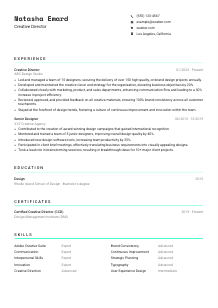
Each role should show what you directed and what improved because of your decisions. Good Creative Director bullets often cover team size, campaign or project volume, brand stewardship, stakeholder collaboration, review and approval responsibility, and creative strategy. A bullet like leading 15 designers or overseeing 150 on-brand projects annually works because it pairs leadership scope with delivery volume.
Quantification matters when it reflects how creative teams are actually measured. Use metrics such as number of designers managed, campaign output, turnaround improvements, productivity gains, brand consistency targets, engagement lift, conversion support, or business growth influenced by creative strategy. In the sample, a 30% project-efficiency gain and 20% improvement tied to business objectives give the work commercial weight.
By the time you are applying for Creative Director roles, every bullet should reinforce senior creative judgment. Remove older details that focus only on production tasks unless they show concept development, client-facing work, mentoring, or the foundation of your leadership path. A tighter set of role-relevant achievements will do more than a long history of undifferentiated design work.
The experience section should leave no doubt that you can guide a creative team, protect brand standards, and turn business goals into strong design output. Wozber's ATS resume scanner can help you check that the language in your bullets stays aligned with the posting while remaining natural and specific.
Education rarely carries a Creative Director resume on its own, but it still matters when the posting calls for a specific academic foundation. Present it clearly, especially when the role asks for a degree in design, fine arts, or a related field.
If the job asks for a bachelor's degree in Design, Fine Arts, or a related discipline, make sure that credential is easy to find. In the example, a Bachelor's degree in Design directly supports the requirement and helps remove any doubt about baseline qualifications.
List the degree, field of study, school, and graduation year. That is usually enough for a senior creative candidate. A compact format keeps attention on your leadership record while still showing the formal training behind your visual and conceptual foundation.
Use the exact field where possible rather than broad shorthand. "Design" or "Fine Arts" connects more directly to the role than a vague label. Matching the employer's language can also help with ATS optimization when a degree requirement is part of the initial screen.
If you are early in your career, relevant coursework in branding, typography, visual communication, or user experience can strengthen the section. For experienced Creative Directors, these details usually matter less unless a standout thesis, capstone, or specialized program clearly supports the target work.
Academic distinctions, design awards, or meaningful extracurricular work can stay if they reinforce your creative development. Keep them only if they add something the rest of the resume does not already prove, such as early recognition in art direction, publication design, or interdisciplinary creative work.
For most Creative Director applications, education is a supporting credential rather than the headline. Make the required degree easy to confirm, then let your leadership experience and portfolio do the heavier lifting.
Certifications are usually secondary for Creative Director roles, but they can still strengthen your profile when they reflect leadership, brand management, design systems, or continued development in the creative field. Use this section to show professional growth, not to pad the page.
Even when certifications are not required, they can help if they point to relevant expertise. A credential such as "Certified Creative Director" supports the leadership dimension of the role and shows continued investment in creative management rather than only software execution.
Choose certifications that support the work you want next. For a Creative Director, that usually means design leadership, brand strategy, creative operations, UX, or advanced platform skills that matter in your niche. Leave out old or unrelated certificates that do not deepen the hiring picture.
If a certification is current, ongoing, or recently earned, include the date range. That helps show recency in a field where tools, workflows, and creative standards change quickly. In the example, the active date on the CCD credential gives it more credibility than a title alone would.
Creative Directors are expected to stay current on design tools, emerging formats, and evolving brand expectations. Relevant certifications can support that point, especially if your work spans digital campaigns, product experiences, or multi-channel content ecosystems. Use them to show active development, not passive collection.
A well-chosen certification can add depth to your profile, especially when it backs up leadership, strategy, or a specialized creative capability. Wozber's free resume builder makes it easy to place these credentials in a clean, ATS-compliant format without letting them distract from your main story.
Creative Director skills should read like the toolkit of someone who sets direction, critiques work, and keeps brand output aligned across teams. A random mix of generic soft skills and design terms will not do much. The list needs to reflect how senior creative work actually gets done.
Pull the required skills from the job description first. In this case, Adobe Creative Suite, conceptual thinking, clear creative direction, feedback, communication, and cross-functional collaboration all deserve attention. Building your list from the posting helps your resume match both the role's priorities and ATS keyword patterns.
Lead with the capabilities that matter most in day-to-day Creative Director work. That usually means creative direction, brand consistency, strategic planning, team leadership, art direction, campaign development, and design software fluency. In the example, skills like Adobe Creative Suite, Creative Direction, Brand Consistency, and Strategic Planning support the target role much better than a broad list of general traits.
Group or order skills so a hiring manager can scan them quickly. Aim for a mix of leadership skills, creative judgment, and technical fluency rather than a long, unranked inventory. If you use ratings, keep them honest and reserve top levels for strengths you can clearly support in your experience section or portfolio.
Your skills should reinforce that you can direct the work, guide the team, and maintain brand quality across channels. With Wozber, you can organize those terms in an ATS-friendly resume template so the keywords match the job without reading like a keyword dump.
Creative Directors spend a large part of the job giving feedback, presenting concepts, and aligning stakeholders around a creative direction. If a posting specifies language ability, treat it as a practical requirement, not a minor detail.
When the role explicitly requires strong English communication, list English clearly with an accurate proficiency level. That matters in a position where presentations, critique sessions, client conversations, and cross-functional reviews all depend on precise language.
Order languages by business relevance, not personal preference. For this position, English should appear first because it is named directly in the requirements. The example handles this well by listing English as "Native," which answers the requirement immediately.
Extra languages can strengthen your profile if you work with international brands, global teams, diverse audiences, or multilingual markets. A second language such as French may not be required here, but it can still suggest broader communication range depending on the organization and client base.
Stick to simple, recognizable terms such as Native, Fluent, Advanced, Intermediate, or Basic. Creative leadership already involves enough interpretation in concept work and feedback. Your language section should be one of the most straightforward parts of the resume.
Some Creative Director roles include global campaigns, localization oversight, or collaboration with international partners. When that is part of your background, language skills can help support the scale of your experience. If they are not relevant, keep the section brief and factual.
This section should confirm that you can communicate at the level the role requires and, where relevant, operate across broader teams or markets. For a Creative Director, clarity here supports the larger picture of how you lead and present ideas.
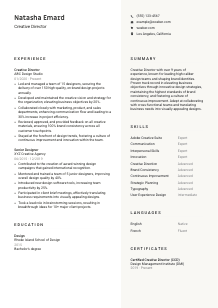
A Creative Director summary should read like the opening frame of a pitch: concise, assured, and grounded in real leadership. It needs to establish your level quickly, then point toward the kind of creative scope and business contribution the rest of the resume will prove.
Before writing, identify the two or three themes that define the target position. For this posting, the important threads are creative vision, team leadership, brand consistency, and cross-functional collaboration. Those ideas should shape the summary more than generic claims about passion or innovation.
Start with a direct introduction that positions you at the right level, such as "Creative Director with over 9 years of experience." That gives immediate context and helps distinguish you from candidates who have strong portfolios but less leadership depth.
Use the next sentence to connect your creative leadership to outcomes. In the example, leading high-caliber design teams, shaping brand identities, and supporting business objectives gives the summary range beyond pure aesthetics. That combination matters because Creative Directors are expected to influence both creative quality and commercial direction.
Aim for a short paragraph that someone can read in a few seconds. Focus on leadership scope, creative direction, and collaboration with functions like marketing or product. A compact summary with role-specific language will carry more weight than a longer statement full of broad adjectives.
Your summary should quickly establish that you can lead teams, sharpen brand output, and align creative work with business goals. Wozber helps you shape that opening into an ATS-compliant resume summary that immediately frames you as a Creative Director, not simply a senior designer with a new title in mind.
A Creative Director resume needs to make three things easy to see: the scale of your leadership, the quality of your creative judgment, and the business impact of the work you directed. When those points are clear in the summary, experience, skills, and portfolio link, the application reads with much more authority.
Use Wozber's AI resume builder, ATS-friendly resume templates, and ATS resume scanner to tighten the language, align your wording with the job description, and present your experience in a format that is easy to parse. The final result should make it easy for a hiring team to picture you leading the brand, the team, and the standard of the work.




