



Use Wozber and land your dream job
Create Resume
No registration required
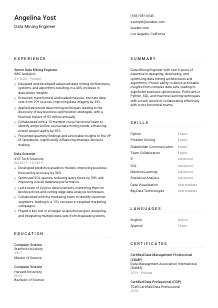
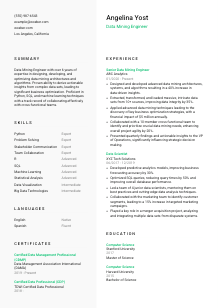
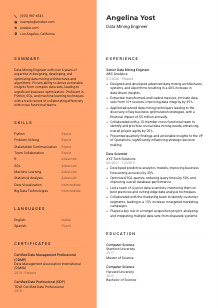
Drilling through datasets, but your resume feels buried? Unearth this Data Mining Engineer resume example, created with Wozber free resume builder. Learn how to shape your algorithm prowess to match job demands, presenting your data mining skills to shine as brilliantly as a precious gem discovered deep within the bytes!
Data Mining Engineers are hired to turn messy, high-volume data into patterns the business can actually use. A resume for this work needs to show more than comfort with datasets. It should make clear that you can build mining workflows, work across ETL pipelines, choose the right analytical methods, and translate findings into decisions that affect revenue, operations, or product strategy.
Screening often narrows quickly when a resume stays vague about tools, scale, or business outcomes. Wozber's free resume builder helps you shape an ATS-compliant resume around the language of the posting, so Python, SQL, machine learning, stakeholder communication, and similar requirements are easy to surface in the right sections. That makes it much easier for hiring teams to see where your data mining work produced usable insight, not just analysis activity.
For a Data Mining Engineer, the top of the resume should establish role alignment fast. Hiring teams do not need biography here. They need a clean header that confirms who you are, how to reach you, and whether basic requirements such as title and location are already in place.
Use your full name as the most visible text on the page. Keep it easy to scan and consistent with your LinkedIn profile, publication credits, or GitHub presence if those support your data work. In technical hiring, consistency across profiles matters because recruiters often cross-check project history and tool exposure quickly.
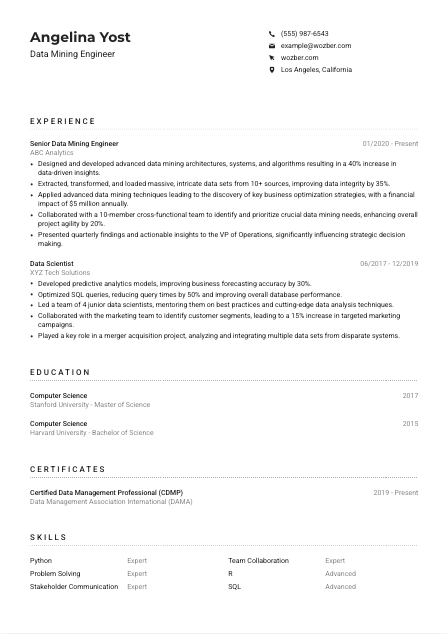
Place "Data Mining Engineer" directly under your name when that is the role you are pursuing. This helps position your background correctly, especially if your recent titles include nearby roles such as Data Scientist, Analytics Engineer, or Machine Learning Engineer. In the example resume, the target title removes any doubt about which side of the data function the candidate is aiming for.
Add a reliable phone number and a professional email address. Avoid casual handles and double-check for typos. If a hiring manager wants to discuss your work on mining architectures, predictive models, or large-source ETL pipelines, your contact information should never be the reason that conversation stalls.
If the employer specifies a location requirement, reflect it clearly in this section. Here, Los Angeles, California matters because it is stated in the posting. Include city and state exactly and do not bury that detail elsewhere. When location is a filter, this small line can prevent unnecessary rejection before anyone reads your project impact.
Include LinkedIn, GitHub, portfolio, or personal site links when they reinforce your resume. For Data Mining Engineers, a repository with SQL work, Python notebooks, model experimentation, or data pipeline projects can strengthen credibility. Only link profiles that are current and aligned with the experience described on the page.
This header should answer the first practical questions right away: who you are, how to contact you, whether you match the target role, and whether you meet any location requirement. Keep it clean so the rest of the resume can focus on your data work.




This is the section that carries the most weight for a Data Mining Engineer. Hiring teams look for proof that you have worked with large datasets, built or improved data mining methods, and delivered findings that changed a business decision, model, or process. Broad statements about analysis are rarely enough.
Before editing bullets, mark the work the employer actually needs done. In this posting, that includes designing data mining architectures, handling ETL across complex sources, applying mining techniques to uncover trends, partnering with cross-functional teams, and presenting insights to senior management. Those are the themes your experience bullets should echo with your own projects, tools, and outcomes.
List positions in reverse chronological order and make the role history easy to follow. If your background includes adjacent titles, frame them through relevant responsibilities. A prior Data Scientist role, for example, still supports a Data Mining Engineer application when the bullets show model development, SQL optimization, source integration, or business segmentation work tied to real outcomes.
Each bullet should capture what you built or analyzed, how you approached it, and what changed because of it. Strong verbs matter, but specifics matter more. The example resume does this well with bullets such as designing data mining architectures that increased insights by 40% and applying advanced techniques that led to $5 million in annual business impact. That combination of technical work and business result is what makes experience persuasive in this field.
Use numbers that fit data mining work naturally. Good examples include number of sources integrated, query-time reduction, model accuracy lift, data quality improvement, revenue impact, or reporting cadence to leadership. Metrics like 10+ data sources, 35% better data integrity, or 50% faster SQL queries tell the reader far more than general claims about optimization.
Keep older or less relevant experience brief unless it contributes directly to the role you want now. Prioritize work that shows data extraction, transformation, algorithm design, pattern discovery, experimentation, stakeholder communication, or business optimization. Every bullet should support the case that you can move from raw data to actionable insight in a production setting.
By the end of this section, the reader should understand the scale of data you handled, the methods you applied, and the business decisions your work influenced. That is the core of Data Mining Engineer experience.
Education matters here because the role sits at the intersection of computer science, statistics, and applied business analysis. Most employers want to see a solid technical degree first, then any added depth that supports work in data systems, modeling, or algorithm design.
If the posting asks for a Bachelor's degree in Computer Science, Information Systems, or a related technical field, make that easy to find. The example resume meets this cleanly with a Bachelor of Science in Computer Science and then adds a Master's degree on top. If you hold a higher degree, list it first, but keep the required baseline visible.
For each entry, include degree, field of study, school, and graduation year or date. That is usually all a technical hiring team needs unless you are early in your career. Straightforward formatting helps both ATS parsing and quick manual review.
Degrees in Computer Science, Information Systems, Data Science, Statistics, Applied Mathematics, or similar fields all help when they connect naturally to the work. If your degree title is less direct, use the field description to clarify the technical foundation behind your data mining experience.
Detailed coursework is most useful for recent graduates or candidates shifting into data mining from a nearby discipline. Include courses such as machine learning, database systems, data structures, statistics, or data warehousing only if they strengthen the story your experience section cannot yet tell on its own.
Honors, research projects, thesis work, or technical competitions can help when they relate to mining large datasets, statistical analysis, or model development. Keep them concise and relevant. If you are already several years into industry work, practical results usually deserve more space than campus activities.
This section should confirm the technical education the role asks for and support the depth of your analytical background. Once that is clear, let your project and work results do the heavier lifting.
Certifications are rarely the main reason a Data Mining Engineer gets hired, but they can add weight when they reinforce data management, analytics, machine learning, or platform-specific expertise. Use them to strengthen the profile, not to compensate for weak experience.
Choose certificates that support tasks common to data mining roles, such as data management, machine learning, analytics engineering, cloud data platforms, or database work. In the example, CDMP and CDP fit because they reinforce data governance and professional depth around handling complex information assets.
Order certifications by relevance to the target role, not by personal preference. If a posting mentions machine learning familiarity, a current ML-related certification may deserve higher placement than a general technology credential. Prioritization shows that you understand which qualifications matter for the specific application.
Include issue dates and, where applicable, active or renewal status. Data tools, platforms, and methods change quickly, so current credentials carry more weight than expired ones. Clear dates also help recruiters judge whether the certification reflects your present skill set.
Data mining work evolves with new modeling approaches, cloud ecosystems, and data processing frameworks. If you are actively building expertise in areas like machine learning operations, advanced SQL, distributed processing, or data engineering, updated certifications can show that your skills are moving with the field.
Well-chosen certificates can round out a technical profile and show continued investment in the field. Keep them relevant to the kind of mining, modeling, and data infrastructure work the job actually calls for.
For Data Mining Engineers, the skills section should read like a believable operating toolkit. That means core languages, analytical methods, and collaboration skills that connect directly to the work in your experience section. Random software lists weaken credibility fast.
Start with the obvious requirements such as Python, R, SQL, problem-solving, and communication. Then add the implied capabilities behind the responsibilities, including ETL, data modeling, machine learning techniques, pattern analysis, stakeholder presentation, and cross-functional collaboration. These are often the terms that help your resume align with ATS screening and hiring expectations.
Only feature skills you can back up with actual work. If you list SQL, the experience section should show query optimization, source integration, or reporting workflows. If you list machine learning, show where you built predictive models or applied classification, clustering, or forecasting techniques. The example resume handles this well by pairing Python, SQL, machine learning, and stakeholder communication with matching accomplishments.
Group the most relevant skills near the top and avoid padding the section with every tool you have ever touched. A shorter list built around languages, methods, and delivery skills is usually stronger than a long inventory. For this kind of role, that often means Python, SQL, R, machine learning, statistical analysis, data visualization, big data technologies, and communication with technical and non-technical teams.
The reader should be able to scan these skills and then find proof of them in your projects and achievements. When the list matches your experience, your technical profile becomes much more convincing.
Language ability is not a filler section for this profession. Data Mining Engineers often explain technical findings to product, operations, marketing, or executive audiences, so written and spoken clarity can matter, especially when the posting calls it out directly.
This posting explicitly requires the ability to write effectively in English, so English should appear clearly in the languages section if you include one. When a role involves presenting findings to senior management, written clarity in reports, summaries, and recommendations is part of the job, not an extra detail.
List English at the top and describe your proficiency accurately, such as Native or Fluent. This quickly addresses a stated requirement and supports your ability to document analyses, explain model outputs, and communicate recommendations across technical and non-technical groups.
Additional languages can be useful in multinational teams, customer analytics environments, or organizations working across regions. They are usually secondary for a Data Mining Engineer, but they can still add value when they support collaboration or reporting in a broader business context.
Use clear labels such as Native, Fluent, Intermediate, or Basic. Avoid exaggeration. If you claim advanced proficiency, be prepared to write emails, explain analytical findings, or participate in meetings in that language.
Unless the job depends heavily on multilingual communication, keep the languages section brief. For most Data Mining Engineer positions, language supports the bigger story of analysis, insight delivery, and stakeholder communication rather than replacing it.
When the posting asks for strong English writing, reflect that requirement clearly and move on. This section works best when it supports your ability to communicate data-backed recommendations with precision.
The summary should quickly tell the reader what kind of Data Mining Engineer you are. It works best when it combines years of experience, technical strengths, and the type of business outcomes your work influences, all in a few lines that sound specific rather than inflated.
Start with the recurring themes in the posting. Here, those are data mining architecture, large-scale data handling, analytical problem-solving, machine learning familiarity, and communication with mixed audiences. Your summary should reflect that combination, not just announce that you are "results-driven" or "passionate about data."
Lead with your title and years of relevant experience, such as "Data Mining Engineer with 6+ years of experience." That framing helps recruiters immediately place your seniority. The example summary does this effectively, then moves into designing and optimizing mining architectures and algorithms.
Choose two or three strengths that are central to the job and support them with real context. Good options include building data mining systems, extracting insight from complex datasets, improving business optimization, or working with Python, SQL, and machine learning. Keep the emphasis on work you have actually done and the value it created.
Aim for three to five lines with no filler. Every sentence should carry information about your technical scope, analytical focus, or business contribution. A concise summary that mentions complex datasets, actionable insight, and cross-functional collaboration will land better than a broad paragraph full of generic professional traits.
A solid summary should leave no confusion about your level, your core data mining strengths, and the kind of decisions your work can support. If that is clear, the rest of the resume has the right setup.
A Data Mining Engineer resume should make three things easy to see: the technical stack you use, the scale of data problems you have handled, and the business outcomes your analysis influenced. When those points are clear across your summary, experience, and skills, the application reads as focused and credible.
Use Wozber's free resume builder to organize that story in an ATS-friendly resume format, then refine the language with role-specific terms drawn from the posting. The final version should make it easy to judge your ability to build data mining solutions that move decisions forward.




