



Use Wozber and land your dream job
Create Resume
No registration required
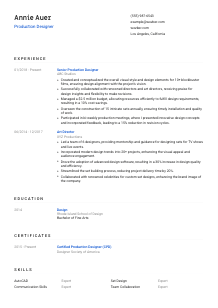
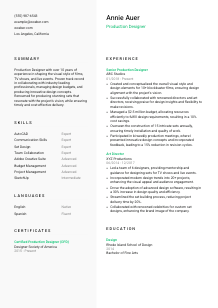
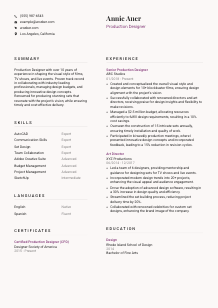
Reviving sets, but your resume feels like a prop? Check out this Production Designer resume example, created with Wozber free resume builder. Learn how to match your aesthetic acumen with job cues, presenting a career narrative as visually striking as the sets you create!
Production design is judged in the work long before anyone sees the finished frame. Hiring teams want to know whether you can turn a director's vision into a buildable environment, make decisions that hold up through revisions, and keep the visual world consistent from concept sketches to strike. Your resume needs to show that range clearly, with credits and outcomes that connect creative direction to execution.
When that story is tailored well, the first scan quickly separates a candidate who only has visual taste from one who can lead set design, manage resources, and work inside production realities. Wozber's free resume builder helps shape that into an ATS-compliant resume by aligning your language with the posting and keeping the structure easy to parse, so your production meetings, design tools, and set delivery results are easy to spot.
In production design, logistics matter as much as taste. Your header should make it easy to identify you, confirm the role you do, and check practical details such as location and portfolio access without forcing the reader to hunt for them.
Use your full name as the most prominent text on the page. Keep it straightforward and readable, the way a credit should appear on a call sheet or presentation deck. Decorative styling only distracts from quick recognition.
Place "Production Designer" directly under your name when that is the job you are pursuing. Matching the title in the posting helps hiring teams and ATS filters connect your resume to the opening immediately, especially when they are reviewing candidates with nearby titles such as Art Director or Set Designer.
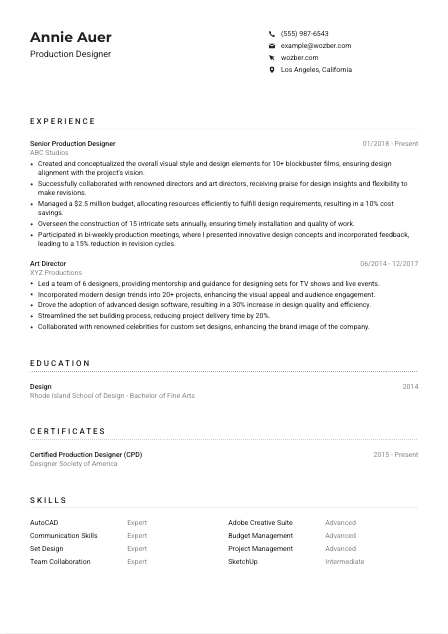
Include a reliable phone number and a professional email address. If the posting includes a location requirement, address that directly in this section. Here, listing Los Angeles, California is useful because the job asks for a local candidate, but treat location matching as a tailoring move, not a rule for every production design resume.
If you have a website or portfolio, include it. Production design hiring often moves beyond the resume quickly into visual review, so give direct access to set concepts, finished builds, mood boards, drafting samples, or selected credits. A link is far more useful than asking the reader to search for your work.
Leave out personal data that does not influence your ability to do the job. Focus this section on professional identity, contact access, and practical requirements. That keeps attention on your credits, software fluency, and production experience rather than irrelevant background information.
This top section should answer basic production questions fast: who you are, what role you do, how to reach you, where you are based when relevant, and where your visual work can be reviewed.




For a Production Designer, experience is where the hiring decision usually sharpens. Credits matter, but so does what happened inside them: the scale of the sets, the budget you controlled, the pace of revisions, and how well you worked with directors, art departments, and construction teams.
Start by identifying the capabilities the production actually needs. In this posting, that includes concepting overall visual style, collaborating with the director and art director, managing budget and resources, overseeing set construction, and using tools such as AutoCAD, Adobe Creative Suite, and SketchUp. Those are the themes your bullets should cover if they reflect your real work.
List your jobs in reverse chronological order and make sure the most relevant production design work gets the most space. If you moved from Art Director to Senior Production Designer, that progression helps show creative growth, leadership, and a wider decision-making remit across film, television, or live events.
Each bullet should show what you shaped, led, solved, or delivered. Replace generic duties with concrete production actions such as developing the visual language for a feature, presenting revised set concepts after director feedback, coordinating build schedules with construction crews, or balancing design ambition against budget limits.
Quantify your scope whenever possible. Useful metrics in this field include number of productions, set count, budget size, delivery timelines, revision reductions, cost savings, team size, or install volume. The sample resume does this well with details such as a $2.5 million budget, 15 intricate sets annually, and a 15% reduction in revision cycles.
Trim achievements that do not support the type of production design role you want next. Prioritize bullets that show visual concept development, set building knowledge, collaboration with creative leads, software use, and production delivery. Even impressive work should be cut if it pulls attention away from film, TV, or live-event design responsibilities.
Your experience section should make it easy to picture you inside a production workflow, shaping the look of the project while keeping builds, budgets, revisions, and team coordination under control.
Education matters most here as proof of formal design training and field relevance. Once you have several major credits, this section becomes shorter, but it still needs to confirm the foundation behind your visual and technical decisions.
If the posting asks for a bachelor's degree in Design, Film, or a related field, make that easy to find. You do not need to overexplain it. A directly relevant degree already supports your candidacy, especially for roles that combine visual design with practical production planning.
List the degree, field of study, school, and graduation year. That is usually enough. Production hiring rarely needs a dense academic section when your professional work is established, so keep the presentation simple and easy to scan.
When your degree closely connects to the role, make sure that link is visible. A Bachelor of Fine Arts in Design, like the one in the example, speaks directly to the requirement without needing extra framing. If your degree is adjacent, a clear field label helps show relevance.
Early-career candidates can include classes or major projects related to scenic design, drafting, materials, model making, or film production. For someone with 5+ years in the field, that detail is usually optional unless it adds something the experience section does not cover.
Awards, honors, or leadership in design organizations can be useful if they relate to visual storytelling, production work, or creative leadership. Keep them brief. This section should support your professional profile, not compete with it.
Education should confirm that your design background is relevant and established, with enough detail to support the role without taking space away from your production credits.
Certifications are rarely the first thing that lands a Production Designer interview, but they can strengthen your profile when they point to recognized expertise, current practice, or specialized knowledge that supports set design and production work.
Start with the job description. Many production design roles do not require certifications, so this section should be driven by relevance rather than volume. If a credential is not requested, list it only if it adds real value to your design or production profile.
Choose credentials that reinforce production design, drafting, design systems, construction knowledge, or related creative leadership. A credential such as "Certified Production Designer (CPD)" works because it supports the core identity of the role instead of feeling generic.
If a certification is active, renewed, or time-bound, include the date or validity range. That helps show the credential is current. In fields where software practices and production workflows evolve, recency can matter more than a long list.
If you are actively building toward larger productions or more technical environments, pursue certifications that support that direction. Training in drafting platforms, live-event systems, or construction-related workflows can complement your portfolio when it matches the jobs you target.
Certifications should reinforce your professional credibility, not pad the page. List the ones that deepen your production design profile and leave out the rest.
A Production Designer skill section should read like the toolkit behind the work, not a random keyword list. Hiring teams want to see the mix of design software, production knowledge, and collaboration skills that lets you move from concept approval to physical build.
Start with the posting's direct requirements, then add the adjacent skills your experience proves. Here, the obvious technical terms are AutoCAD, Adobe Creative Suite, SketchUp, and knowledge of set building techniques and materials. Just as important are communication and collaboration, because production design happens through constant review with directors, art directors, construction teams, and producers.
If you have the skill, use the wording the employer uses. That improves ATS optimization and keeps your resume easy to match against the role. For example, if the posting says "AutoCAD" rather than "CAD drafting," list AutoCAD explicitly. The same goes for "budget management" or "team collaboration" when those are part of your actual work.
Group or order skills by importance, and do not overload the section with every tool you have touched once. A focused list is stronger. The example resume works because it balances software, production skills, and teamwork rather than treating the section as software-only.
Someone reading your skills list should quickly understand both how you design and how you deliver, from software fluency to on-set coordination and budget-aware execution.
Production design is collaborative, fast-moving work. Language skills matter when they affect meetings, revisions, vendor coordination, or communication across departments, so list them with the same accuracy you would use for any technical qualification.
If the posting specifies language ability, put that first. This role requires effective English, so English should appear prominently with an honest proficiency level. That matters because design presentations, production meetings, and revision notes depend on clear communication.
Lead with the language most tied to the role and location, then add others in descending relevance. If you are applying in an English-speaking production environment, English should stay at the top even if you speak several languages well.
Extra languages can help on multinational shoots, vendor coordination, or live events with broader stakeholder groups. They are not mandatory unless requested, but they can widen the kinds of teams and productions you can work with.
Describe your level with standard terms such as "Native," "Fluent," or "Intermediate." Avoid vague descriptions. Production teams need to know whether you can lead a design conversation, review materials, or handle real-time collaboration in that language.
Feature the languages that support the productions you pursue. If your work often crosses regions or talent teams, a second language can be worth highlighting. If not, keep the section concise and focused.
Language skills should tell the reader how confidently you can communicate in production settings, especially in meetings, presentations, and collaborative revision cycles.
Your summary should quickly establish what kind of Production Designer you are, how long you have been doing the work, and what scale of productions you handle. This is not the place for broad creative claims. It should point to the environments, responsibilities, and results that define your work.
Before writing the summary, identify the two or three priorities the job emphasizes most. For this posting, that includes overall visual concepting, collaboration with the production team, and oversight of budget and set execution. Those are stronger anchors than generic statements about passion or creativity.
Your first sentence should establish your professional identity directly. Mention "Production Designer," your years of experience, and the production spaces you know best, such as film, television, or live events. That immediately frames your level and context.
Use the next sentence to highlight capabilities that match the job, such as shaping a project's visual style, leading cross-functional collaboration, managing multimillion-dollar design budgets, or delivering complex sets on schedule. The sample summary is strongest where it connects visual work with cost-effective delivery rather than relying only on praise-heavy wording.
Aim for a compact paragraph that earns every line. Three to five focused sentences are enough. If a point already appears in your experience bullets, summarize it rather than repeating it in full. The summary should create a clear first read, then send the reader into the details below.
By the end of this section, a hiring team should already understand your level, your production environment, and the kind of visual and operational responsibility you can take on.
A production design resume works when it shows more than taste. It needs to connect visual concepting, collaboration with directors and art departments, command of tools like AutoCAD or Adobe Creative Suite, and the practical side of budgets, builds, installs, and revisions.
Use Wozber's free resume builder to shape that experience into an ATS-compliant resume with clean structure, targeted wording, and fast role-specific revisions. Features such as the ATS resume scanner and ATS-friendly resume templates can help you align your resume with the posting while keeping your credits, software, and production outcomes easy to read.
When those details are in place, your resume makes one thing clear: you can carry a design vision from concept through construction and deliver it inside real production constraints.