



Use Wozber and land your dream job
Create Resume
No registration required
Strutting on catwalks, but your model resume isn't coming into focus? Strike a pose with this Model resume example, created with Wozber free resume builder. Learn how to align your modeling talents with job expectations effortlessly, ensuring your career trajectory is always picture-perfect!
Modeling resumes get screened for more than appearance. Casting teams and brand partners want to see whether you can deliver a specific visual direction, stay composed through long shoot days, and work smoothly with photographers, stylists, directors, and clients. Your resume needs to make that professional range visible fast, especially when your work spans editorial, commercial, events, and castings.
When the resume is tailored to the assignment, it becomes much easier to separate a model with broad on-set value from someone listing generic gigs. Wozber's free resume builder helps you shape that story into an ATS-compliant resume by aligning your wording with the brief and keeping structure clean, so the hiring team can quickly see your experience, versatility, and professionalism in front of the camera.
In modeling, the top of the resume should read like a clean comp card header. It needs to identify you quickly, confirm you are reachable, and remove any friction before a portfolio link or experience section does the heavier lifting.
Use your full name in the largest, clearest text on the page. Agencies, casting coordinators, and production teams often scan resumes quickly between portfolios and booking notes, so readability matters more than decorative styling. Keep it polished and simple so your name is easy to remember and easy to find again.
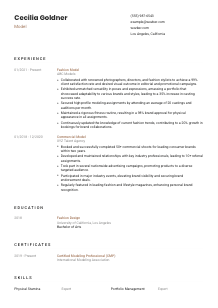
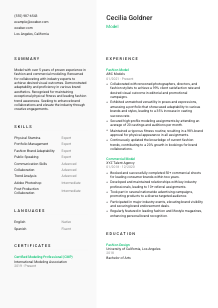
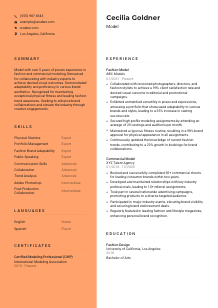
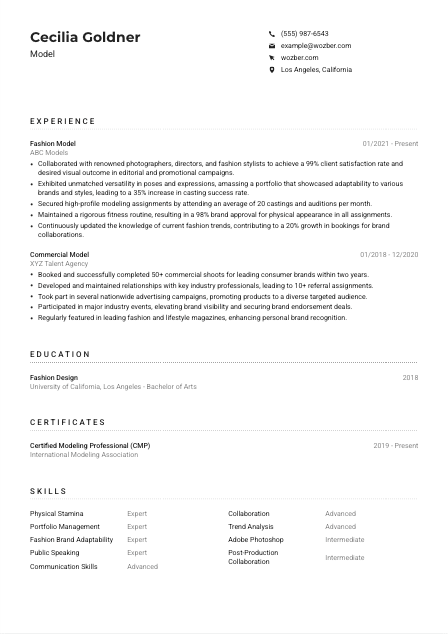
Place "Model" directly under your name, or use a close variant only if it reflects the jobs you are actively pursuing, such as Fashion Model or Commercial Model. This helps frame your profile before anyone reads your credits. In the sample resume, the title stays direct, which works well because the role spans both fashion and commercial assignments.
Include a reliable phone number and a professional email address. Production schedules move quickly, and missed calls or an unprofessional email handle can create unnecessary doubt. If you maintain a personal website or digital portfolio, add it here so a casting team can move from your resume to your book without searching for you.
If a job requires local availability, include your city and state exactly. Here, Los Angeles, California matters because the employer asked for a candidate already based there. For other model roles, location is only worth emphasizing when it affects castings, fittings, travel logistics, or same-day availability.
Your portfolio link should lead to current, role-relevant work. For modeling, that means different poses, expressions, brand aesthetics, and campaign formats rather than dozens of similar images. Since this job asks for versatility across brands and styles, your linked work should reinforce that point immediately.
Personal details should answer the practical questions first: who you are, what kind of modeling work you do, how to reach you, and whether you are available where the work happens. When this section is clean, the reader can move straight to your portfolio and booking history.




For a model, experience is not just a list of shoots. It is the record of how often you book, what kinds of teams trust you, how adaptable you are across brand aesthetics, and how reliably you perform under production pressure.
Put fashion, commercial, editorial, runway, catalog, or promotional work ahead of unrelated jobs. This posting asks for at least 2 years of fashion or commercial modeling experience, so your first entries should make that requirement easy to confirm. Include agency names, freelance work, or long-term client relationships that show continuity in the industry.
Recognizable brands can strengthen credibility, but context matters even more. Mention whether the work was for editorial shoots, ad campaigns, e-commerce, product launches, or fashion shows so the reader understands the type of performance expected. If confidentiality limits brand names, describe the campaign scale or audience instead.
Each bullet should show what you helped deliver, not just that you appeared in a shoot. Useful details include booking frequency, repeat clients, campaign reach, casting conversion, client satisfaction, or how well you adapted to a brand's visual direction. The sample resume does this well by connecting collaboration with photographers and stylists to a 99% client satisfaction rate.
Metrics give shape to your career. You might cite the number of commercial shoots completed, castings attended per month, repeat bookings, campaign conversions, social reach for promotional events, or portfolio growth tied to booking success. In the example, figures such as 50+ commercial shoots and a 35% increase in casting success make the work feel real and measurable.
Cut details that do not support your modeling profile. Prioritize versatility, poise, trend awareness, event participation, fitness discipline, and collaboration with creative teams because those are directly connected to how models are selected and retained. Even when you have adjacent experience, keep the emphasis on what makes you dependable in front of the camera and useful to a brand team.
This section should show that you have worked consistently, adapted to different creative directions, and delivered results that matter in modeling, from bookings and repeat work to client confidence and campaign execution. If those points are clear, your experience is doing its job.
Education is rarely the deciding factor in modeling, but it can still strengthen your profile when it supports brand knowledge, creative collaboration, or the business side of the industry. Use it to add useful context, not filler.
If you have a degree or coursework in fashion, design, media, communications, marketing, or performance, include it clearly. The sample resume lists a Bachelor of Arts in Fashion Design, which adds useful context because it suggests familiarity with garment construction, styling, and visual presentation. That kind of background can help when working with fashion teams and understanding brand aesthetics.
List the institution, degree, field of study, and graduation year or date range. Casting staff and recruiters do not need a long academic narrative. Clean formatting keeps the focus on the credential itself and prevents the section from distracting from your portfolio and experience.
Add short details if they connect to the role. For example, training in fashion styling, photography, media production, English writing, or digital imaging can reinforce parts of this job description, especially where post-production collaboration or written English matters. Keep these additions selective and practical.
Short programs in posing, runway technique, movement, personal branding, skincare for camera work, or public speaking can be worth listing when they improve how you perform in castings or campaigns. These details help if you are earlier in your career or want to show active development beyond booked work.
Modeling careers are often shaped through agency coaching, mentorship, test shoots, backstage training, and repeated production experience. If those experiences are substantial and more relevant than older academic details, include them in a concise way so the section reflects how you actually built your craft.
Education should support your modeling profile by showing industry awareness, creative literacy, or useful adjacent skills. Keep it brief, relevant, and clearly connected to the kind of assignments you want next.
Certificates are optional in modeling, but the right ones can help when they point to formal training, professional standards, or skills that strengthen your value on set and in front of clients.
Choose credentials tied to modeling, image presentation, fashion, communication, wellness, or production-related collaboration. A certificate like Certified Modeling Professional can work well because it supports your professional positioning without taking attention away from your portfolio and booked work.
Look for certificates in runway coaching, posing, brand presentation, personal styling, media training, or other areas that improve performance during shoots, events, and castings. If a credential helps you adapt to direction, present yourself professionally, or contribute to campaign execution, it is worth considering.
Add the year earned or validity period. That gives the reader a sense of how recently you invested in your development and whether the credential is active. In fast-moving visual industries, current training can matter more than a long list of older certificates.
Update certificates when you complete new workshops or retire older items that no longer support your target work. A short, relevant list is stronger than a crowded one. Keep the focus on training that adds credibility to your present modeling direction.
Certificates should add useful professional context, not compete with your portfolio or experience. When chosen well, they show that you take the craft seriously and keep building skills that matter on shoots, at events, and in client-facing work.
A model's skills section should translate your day-to-day value into clear terms. It needs to show how you perform under direction, how you support a brand image, and what practical abilities you bring to castings, shoots, events, and post-production collaboration.
Start with the abilities the employer actually asked for, then add closely related strengths you can back up with experience. In this description, that includes physical stamina, communication, professionalism, versatility, and familiarity with Adobe Photoshop for post-production collaboration. Mirror that language when it truthfully matches your background.
Modeling jobs often require more than presence in front of the camera. Mix role-specific strengths such as posing versatility, runway presentation, brand adaptability, and trend awareness with practical capabilities like collaboration, public speaking, schedule reliability, and comfort with production workflows. That mix reflects how the work really happens.
Place the most important and job-matched skills first. If the role centers on fashion and commercial assignments, lead with stamina, portfolio versatility, communication, and brand adaptability before adding secondary tools. The sample resume handles this well by putting core modeling abilities ahead of software knowledge, while still acknowledging Photoshop and post-production collaboration.
The right skills section should read like a practical summary of how you work with brands and creative teams. Keep it focused on abilities that influence casting decisions, on-set performance, and campaign outcomes.
Language skills matter in modeling when they affect communication on set, written professionalism, client interaction, or access to specific markets. List them with the same clarity you would bring to any casting profile.
When a posting asks for written or spoken ability in a specific language, lead with that language and your level. This role requires effective writing in English, so English should be easy to find on the resume. Make sure the proficiency level matches what you can actually handle in emails, briefs, release forms, and professional communication.
Additional languages can help with international brands, multicultural campaigns, travel assignments, and client-facing events. If you speak Spanish, French, Italian, or another commonly used market language, include it when it reflects real ability. In the sample resume, Spanish adds range without distracting from the core requirement in English.
Do not list a language just because you know a few phrases. Add it when you can use it in castings, fittings, backstage coordination, interviews, or promotional appearances. This keeps the section credible and useful for employers planning real-world production needs.
Use clear labels such as Native, Fluent, Advanced, Intermediate, or Basic. Vague claims can create problems if you are expected to communicate directly with clients or teams during fast-paced shoots. Accurate levels help everyone understand where you can contribute confidently.
If you are targeting campaigns in specific regions or with global consumer brands, your language list can reinforce that direction. Keep the section aligned with the markets, clients, and production environments you are most likely to enter next, rather than turning it into a generic list.
For modeling roles, languages can support castings, travel work, brand events, and day-to-day professionalism. List the ones you can truly use, and make the required language impossible to miss.
Your summary should tell a casting director, agency recruiter, or brand team what kind of model you are and where you have already delivered results. Keep it tight, specific, and grounded in the kind of assignments you want more of.
Start with your years of experience and the areas you work in, such as fashion, commercial, editorial, runway, or promotional modeling. That gives immediate context and helps the reader place you within the market. For this job, a summary that clearly mentions both fashion and commercial work would align well with the brief.
Choose two or three points that define your professional value. Good options include versatility across brand aesthetics, strong on-set collaboration, poise under pressure, booking consistency, or a track record of repeat assignments. The example summary works because it highlights collaboration, adaptability, and physical discipline rather than relying on generic confidence statements.
Review the posting and borrow the terms that accurately describe your background. If the role emphasizes visual outcome, professionalism, trend awareness, and collaboration with photographers or stylists, echo those priorities in natural language. That improves alignment for both human readers and ATS screening.
Aim for three to five lines with concrete wording. Avoid broad claims that could fit any performer or creative professional. A concise summary with years of experience, modeling specializations, and one or two clear strengths will carry more weight than a paragraph full of general ambition.
A well-written summary should make the reader expect exactly the kind of experience they will find below: relevant modeling work, strong creative collaboration, and proof that you can represent a brand professionally across different assignments.
A model resume works best when it pairs visual credibility with practical booking information. Before you apply, check that your experience shows the types of campaigns you can handle, your skills match the brief, and your portfolio link supports the story your resume tells.
Use Wozber to turn that into a polished, ATS-friendly resume with clean structure, targeted phrasing, and faster ATS optimization. The finished resume should make one thing clear right away: you can step into the brand's visual world and perform professionally from casting through final campaign delivery.