



Use Wozber and land your dream job
Create Resume
No registration required
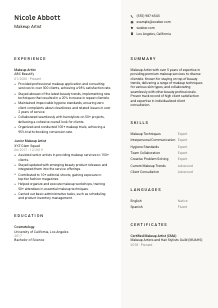
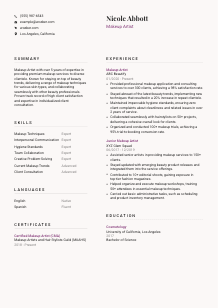
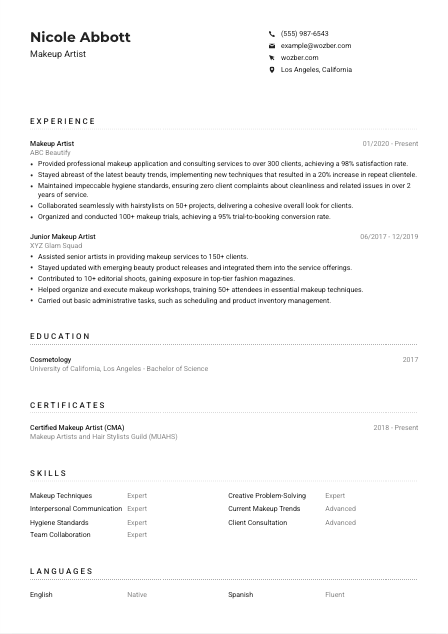
Painting faces, but your resume looks bare? Brush up your skills with this Makeup Artist resume example, created with Wozber free resume builder. Learn how to layer your artistic talents to match job demands, making sure your career looks as flawless as your clients do!
Makeup artistry is judged in the chair and behind the scenes. Hiring teams want to see how you work with different skin tones, adapt looks for weddings or editorial shoots, keep hygiene standards tight, and help clients feel confident in the final result. Your resume should make that range visible quickly, not bury it under generic beauty language.
A tailored resume changes how your experience is read for this kind of role. When the language matches the posting, an ATS-compliant resume makes it easier to recognize client consultation work, trial bookings, trend knowledge, and collaboration with hairstylists or photographers. Wozber's free resume builder helps organize that wording cleanly so the first pass already shows whether you can deliver polished, client-ready makeup services.
In beauty services, small practical details affect hiring more than many candidates realize. A clean header tells the employer who you are, what role you do, how to contact you, and whether basic requirements such as location are already covered. Keep this section simple, polished, and directly usable.
Use your full name in a larger, readable font so it is easy to find at a glance. For a Makeup Artist, that name often travels with your portfolio, social profile, referrals, and client list, so consistency matters. If your website, Instagram portfolio, or booking profile uses a professional version of your name, match it here.
Use the title "Makeup Artist" directly under your name when that is the role you are targeting. This keeps the resume aligned with the posting and avoids confusion with adjacent titles such as Beauty Advisor, Esthetician, or Hair and Makeup Artist. Exact title matching also helps ATS sorting when employers are screening multiple beauty applicants.
List a current phone number and a professional email address that you check regularly. Beauty roles often move fast, especially for event work, bridal bookings, and shoot scheduling, so missed calls and messy contact info create avoidable friction. If you use a portfolio site, include it only if it is current and shows finished looks that support the kind of work you want.
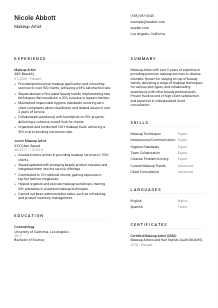
If the employer wants someone based in a specific market, add your city and state. In the example here, Los Angeles, California matters because the job specifically requires local availability. Treat that as a tailoring move for this opening, not a universal rule for every Makeup Artist resume.
For Makeup Artists, a portfolio link can carry real weight because it backs up your claims with visual work. Include a website or professional social profile that shows different skin tones, event styles, clean beauty looks, full-glam applications, or on-camera work, depending on the jobs you want. Keep the gallery edited and relevant rather than posting every look you have ever done.
This section does not need personality copy or extra decoration. It should confirm that you are a Makeup Artist, easy to contact, and positioned for the assignment the employer needs to fill.




This section carries the most weight because it shows how your artistry performs in real settings. Employers are looking past the title alone. They want proof that you have handled clients, delivered consistent results, worked across skin types and occasions, and stayed reliable in professional environments where timing, hygiene, and collaboration matter.
Before you write bullets, identify the parts of the role that repeat or carry the most responsibility. For this Makeup Artist opening, that includes client consultations, makeup application for events and shoots, trend awareness, hygiene standards, teamwork with hairstylists, and organizing trials. Those are the themes your experience bullets should echo in natural, job-relevant language.
Start with your most recent position and include employer, title, and dates in a format that is easy to scan. If you have freelance work, bridal contracts, retail artistry, studio work, or production experience, present it in a way that shows continuity rather than a scattered timeline. Makeup hiring often values active client work more than formal title prestige, so clarity around where and when you worked matters.
Generic bullets like "did makeup for clients" do not tell enough. Show scope, service quality, and business results. The sample resume does this well with details such as serving 300+ clients, reaching a 98% satisfaction rate, and converting 95% of trials into bookings. Metrics like repeat clientele, booking volume, project count, retail add-ons, or zero hygiene complaints make your work easier to trust.
Choose accomplishments that relate to the kind of makeup work the employer needs. Special events, weddings, photoshoots, collaborative beauty work, and one-on-one consultations are more useful here than unrelated salon tasks. If you also have skincare, retail, or training experience, include it only when it strengthens your profile, such as improving product recommendations or client education.
Each bullet should show what you did and what changed because of it. Good examples for a Makeup Artist include improving repeat bookings after introducing new techniques, maintaining spotless sanitation practices, or coordinating with hairstylists to deliver a unified bridal or editorial look. That reads much stronger than listing routine duties without context.
Your experience section should leave no doubt that you can handle real clients, real timelines, and real standards. When your bullets show technique, professionalism, and outcomes together, the hiring team can picture you on the booking calendar.
Education is rarely the first thing reviewed for a Makeup Artist, but it still helps frame your training. Formal study in cosmetology, esthetics, beauty, theater makeup, or related fields can strengthen your credibility, especially when the role mentions certification, skin knowledge, or work across varied client needs.
List your most relevant education first, especially if it connects directly to beauty services, skin, cosmetics, or client care. A degree is not always required for makeup roles, but relevant schooling can reinforce that your technique is built on more than trend familiarity. In the example, a Bachelor of Science in Cosmetology adds useful professional grounding.
Include school name, degree or program, field of study, and graduation year or date range. This section should be quick to scan and easy to verify. Beauty employers are not looking for elaborate academic storytelling here. They want to see credible training without having to hunt for the basics.
If your program included bridal makeup, color theory, corrective makeup, sanitation, skincare, or work with diverse skin tones, mention that only when it helps explain your professional focus. This is especially useful early in your career or when your experience section is still growing. Keep it concise and connected to actual job requirements.
Makeup trends, product formulations, and application techniques change quickly, so continuing education is worth noting. Masterclasses, brand certifications, editorial workshops, or airbrush training can show that your skills are current. Add these when they support the kind of work you are targeting rather than listing every short course you have taken.
If you have strong professional experience, your education section does not need extra filler. Honors, student clubs, or unrelated coursework should stay off the page unless they connect directly to beauty work, client service, or artistic performance. Keep the emphasis on training that supports your credibility as a working artist.
This section works best when it quietly confirms that your makeup skills rest on real study, not just enthusiasm. Relevant education adds structure to the profile without distracting from your client-facing work.
Certificates matter more in makeup artistry when they tie directly to client trust, technical training, or licensing expectations. If a posting asks for recognized certification or an esthetician license, this section becomes a practical checkpoint rather than a bonus item.
Start with certifications or licenses that directly support the role. Here, the employer asks for certification from a recognized makeup artistry program or an esthetician license if applicable, so those should appear before less relevant beauty credentials. The example's Certified Makeup Artist credential works because it directly supports the employer's requirement.
For each credential, list the certificate name, issuing organization, and the date earned or validity period. This helps employers understand whether the training is current and whether it comes from a recognizable source. In regulated or hygiene-sensitive environments, clear credential details build confidence quickly.
If a certification is active, renewable, or recently completed, make that obvious. Recency matters in beauty because products, skin-prep practices, and application methods keep evolving. Older training can still stay on the resume if it is respected and relevant, but current credentials should lead.
Use this section to reflect ongoing investment in your craft. Advanced complexion work, bridal specialization, sanitation training, special effects makeup, or brand education can all help when they match the services you want to offer. Choose the certificates that support your market, not every badge you have collected.
A focused certificates section tells the employer that your training is recognized, current, and relevant to the services you provide. That is especially useful when the role involves direct client trust and high standards of hygiene.
For Makeup Artists, the skills section should reflect how the job is actually done. That means a mix of technical application skills, client-facing communication, hygiene discipline, and collaborative working style. Keep it specific enough that an employer can immediately connect your skill set to booked services and professional standards.
Review the posting and capture the exact skills that match your real experience. In this case, terms like makeup techniques, knowledge of different skin types and tones, current makeup trends, interpersonal communication, and hygiene standards belong on the page because they describe core day-to-day work. Direct alignment also supports ATS optimization without making the section feel forced.
Do not list only creative abilities. Makeup hiring also depends on consultation skills, listening, time management, client comfort, and collaboration with hairstylists, photographers, or bridal teams. The sample resume balances this well by pairing technical areas like Makeup Techniques with service-oriented strengths such as Client Consultation and Team Collaboration.
Put the most job-critical skills first and trim anything too vague or unrelated. For a role centered on events, shoots, and weddings, skills like shade matching, sanitation, trend adaptation, complexion work, and client consultation usually matter more than broad terms such as "creative" or "hardworking." This section should feel curated, like a well-packed kit.
When the right skills appear in the right order, employers can quickly see whether your toolkit fits their service model. Aim for a list that reflects how you actually work with clients, products, and collaborators.
Language ability matters in beauty because consultations depend on nuance. A client needs to understand what look is possible, how long it will take, what products are being used, and how the final result will photograph or wear through an event. If a job specifies language requirements, address that clearly.
If English is essential for the role, list it first with an honest proficiency level. That immediately answers a direct job requirement and shows you can handle consultations, scheduling, product discussions, and service instructions in the language expected by the employer. For this posting, English should not be buried lower in the section.
Additional languages can be a real advantage in client-facing beauty work, especially in diverse markets and event services. They can help during consultations, bridal parties, repeat bookings, and referrals. In the example, Spanish adds useful range because it supports communication with a broader client base.
Stick to straightforward terms such as Native, Fluent, Conversational, or Basic. Overstating fluency creates problems quickly in a service setting where misunderstanding a client's preferences can affect the final look. Honest labels set accurate expectations and make the section more credible.
If you speak multiple languages, the value is not only linguistic. It often improves rapport, helps clients explain skin concerns or style preferences, and makes trials run more smoothly. That matters in makeup work because trust and clear consultation directly affect satisfaction and repeat business.
List only languages you can use with confidence in a professional setting. The section should support your ability to consult, coordinate, and deliver services, not read like a broad personal profile. A short, accurate list is stronger than an inflated one.
Handled well, this section shows that you can communicate clearly with the people in your chair. For a Makeup Artist, that directly supports consultation quality, comfort, and client satisfaction.
The summary needs to do one thing well. It should tell the reader what kind of Makeup Artist you are, how much experience you bring, and which strengths are most relevant to the booking mix or team environment. Keep it short, specific, and grounded in real services and results.
Read the posting closely, then reflect its core needs in your opening lines. For this role, that means experience level, makeup expertise across skin types and tones, trend awareness, client consultation, and collaboration. The sample summary handles this well by combining years of experience with premium service, beauty trend knowledge, and individualized consultation.
Start with a direct statement such as your title and years of experience. "Makeup Artist with 5+ years of professional experience" is clear and useful because it immediately addresses the employer's minimum experience threshold. Save the more detailed nuance for the next sentence.
Choose highlights that speak to this kind of hiring decision. Good options include high client satisfaction, experience with weddings or photoshoots, strong knowledge of diverse skin tones, or repeat-booking results. Keep the focus on the strengths that shape client outcomes, not on broad personality claims.
Aim for a short paragraph that can be read in seconds. Remove filler phrases about passion, dreams, or loving makeup unless they are supported by something concrete. A concise summary with real service context does far more for a Makeup Artist than a dramatic personal statement.
A well-written summary helps the reader understand your lane before they reach the experience section. It should quickly establish whether you are the kind of artist they want handling clients, events, or production work.
A Makeup Artist resume works when it shows more than taste or enthusiasm. It should surface the parts of your work that employers actually hire for: client consultation, technical range across skin tones and event types, hygiene discipline, teamwork, and results that lead to satisfied clients and repeat bookings.
Use each section to make those strengths easier to read and easier to match to the posting. Wozber's AI resume builder can help you tailor your language, tighten each section, and build an ATS-friendly resume format that reflects the services you actually deliver. The finished resume should make one thing clear fast: you are ready to step in and create polished, dependable makeup work for real clients.