



Use Wozber and land your dream job
Create Resume
No registration required
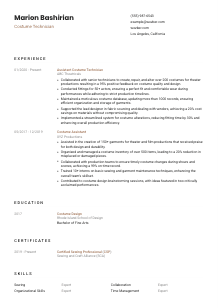
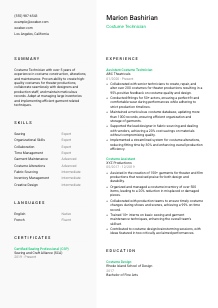
Stitching spotlights, but your resume is in the dressing room's shadows? Check out this Costume Technician resume example, created with Wozber free resume builder. It shows how to weave your wardrobe wizardry to match the job description, so your career stays dressed to impress!
Costume technicians are hired on trust. Productions need someone who can build, alter, and maintain garments under deadline, keep performers moving comfortably, and stay organized when fittings, quick changes, repairs, and storage all compete for attention. Your resume should make that hands-on reliability visible from the first few lines.
Screeners often look for clear proof that you can handle the full costume workflow, not just sketch concepts or assist loosely backstage. Using Wozber's free resume builder helps you shape an ATS-compliant resume around the language of construction, fittings, alterations, inventory, and garment care so hiring teams can quickly see where your experience matches the production floor.
This section is simple, but it still carries practical information for a Costume Technician opening. Production teams need to know who you are, how to reach you quickly, and whether basic logistics line up before they spend time reviewing your sewing, fitting, and maintenance experience.
Use your full name in a larger font so it is easy to find at a glance. In costume departments, presentation matters, and a cluttered header can make the rest of the resume feel less controlled than the work itself.
Place "Costume Technician" directly under your name when that is the role you are pursuing. This helps position you correctly, especially if your past titles include related variations such as Costume Assistant or Assistant Costume Technician.
Include a reliable phone number and a professional email address, then verify both carefully. A missed digit or typo can cost you an interview, particularly when production hiring moves fast between fittings, prep days, and rehearsal schedules.
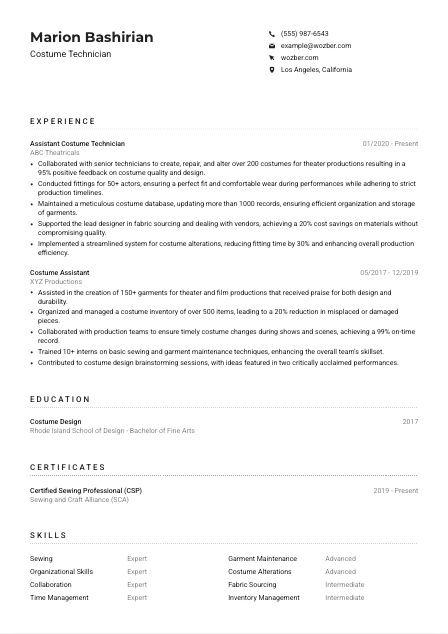
Some roles have a hard location requirement, and this one specifically asks for Los Angeles, California. If you are already based there, list "Los Angeles, California" clearly in your header, as the sample resume does. If a future posting does not require location, keep the detail lighter.
If you have a website or profile that shows costume builds, alterations, period work, specialty stitching, or wardrobe support credits, include it. Make sure the content reflects production-ready work rather than general fashion material, and confirm the link is active before sending the resume.
Your personal details do not need flair. They need to show that you are reachable, professionally presented, and logistically aligned with the production's needs.




Experience is where hiring teams decide whether you can actually keep costumes performance-ready. They look for proof of garment construction, alterations, fittings, repairs, organization, and collaboration with designers or production staff, preferably with enough detail to show scale and pace.
Before editing your bullets, mark the recurring work in the posting: costume creation, alteration, repair, fittings, records, inventory, collaboration, and garment care. Those are the operational priorities. Your experience section should mirror that language when it honestly reflects your background, so your resume speaks to the work being hired for.
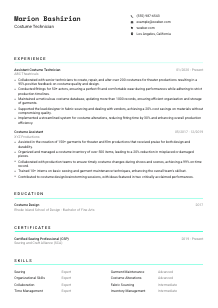
Start with your most recent job and include title, employer, and dates for each position. Titles matter here. "Assistant Costume Technician" and "Costume Assistant" already place the sample candidate inside a costume department, which makes the progression easy to follow.
Each bullet should show what you made, altered, maintained, or coordinated, and what changed because of your work. The sample resume does this well by naming tasks such as conducting fittings for 50+ actors, updating more than 1000 costume records, and supporting fabric sourcing. Those details tell a hiring manager how you function inside an active production workflow.
Metrics carry weight when they reflect costume operations. Good examples include number of garments built or repaired, actors fitted, inventory size, turnaround time, material savings, on-time changeovers, or reduction in fitting time. A bullet like "reduced fitting time by 30%" is stronger than a vague claim about efficiency because it ties your work to rehearsal and show readiness.
If you have unrelated theater, film, retail, or design experience, focus only on the parts that support this kind of role. Pull forward duties tied to sewing, tailoring, maintenance, garment organization, quick changes, and collaboration with designers or stage teams. Leave out extra detail that does not help a reader picture you working in a costume shop or on set.
A Costume Technician resume earns attention when the experience section makes your contribution tangible. Hiring teams should be able to see the garments, the fittings, the records, and the production pressure you handled.
For many Costume Technician openings, education helps establish your training in garment construction, costume history, textiles, pattern work, and design process. It will not replace hands-on production experience, but it can quickly confirm that you have the formal foundation the posting asks for.
This posting asks for a bachelor's degree in Costume Design or a related field, so make sure the matching degree is easy to spot. The sample resume handles this directly with a Bachelor of Fine Arts in Costume Design, which immediately checks an important box.
List your degree, field of study, school, and graduation year or date in a clean order. Keep it easy to scan. Costume hiring teams are usually moving quickly through resumes, and they do not need decorative formatting to understand your training.
If your degree is specifically in Costume Design, Theatre Design, Fashion Design, or a related field with strong garment-construction training, state that clearly. A role like this benefits from seeing discipline-specific study rather than a broad arts label with no context.
You can include select coursework, productions, or academic distinctions if they strengthen your case, especially early in your career. Focus on classes and projects tied to draping, patternmaking, costume construction, textile selection, or wardrobe maintenance, not generic academic achievements.
Student productions, costume shop assistant work, wardrobe crew assignments, and design labs can all help if your professional experience is still growing. Keep these additions relevant and concise so they support your technical profile rather than distract from it.
Education should confirm your technical grounding and support the rest of your resume. For this profession, the most helpful entries are the ones that connect clearly to garment work and production practice.
Certifications are usually secondary for Costume Technician roles, but they can still strengthen your resume when they point to real garment skills, safety knowledge, specialty techniques, or ongoing professional development. The key is relevance, not volume.
This job description does not require a certification, so do not treat one as mandatory. Still, a credential tied to sewing, construction, textiles, or wardrobe operations can add useful depth, especially when it supports the exact hands-on work listed in the posting.
Prioritize credentials that reinforce your ability to construct, alter, repair, or maintain costumes. The sample resume's "Certified Sewing Professional" works because it aligns directly with one of the role's core technical requirements.
List the issue date and, if relevant, the active period. That helps employers understand whether the training is current. For technical and craft-based credentials, recency can matter when tools, materials, or methods are part of the certification's value.
If you pursue additional training, look for courses or certifications in advanced tailoring, textile care, dye techniques, corsetry, millinery, costume crafts, or wardrobe supervision. Choose learning that improves what you can actually deliver during fittings, prep, and performance support.
A certificate helps when it adds another credible layer to your sewing and garment-handling profile. If it does not connect to costume production, leave it off.
A Costume Technician skills section should read like a practical toolkit. Hiring teams want to see the craft skills, coordination strengths, and workflow habits that keep garments accurate, wearable, and ready on schedule.
Read the job description closely and note the abilities it names directly: sewing, tailoring, organization, time management, teamwork, and English communication. Then add adjacent skills you genuinely use, such as fittings, alterations, garment maintenance, inventory tracking, fabric sourcing, or costume repair.
Do not list only technical sewing abilities. Costume departments also rely on people who can stay organized, document changes, communicate with designers and performers, and keep pace with deadlines. The sample skills list works because it combines sewing and costume alterations with collaboration, time management, and inventory management.
Keep the section focused on abilities that matter in the role you are targeting. If a posting leans toward wardrobe maintenance and fittings, lead with those. If it is more build-heavy, emphasize construction, tailoring, pattern adjustments, and fabric handling. A shorter, more role-specific list usually reads better than a long catalog of mixed abilities.
Your skills section should make a production team think, "Yes, this person can step into fittings, alterations, maintenance, and daily costume department coordination right away."
Language ability matters in costume work because fittings, adjustments, backstage coordination, and care instructions all depend on clear communication. This section is usually brief, but it can still help reinforce a practical requirement in the posting.
This job specifically requires strong English communication, so list English first and state your proficiency clearly. That is the language hiring teams need to see immediately because it affects fittings, collaboration, and day-to-day production communication.
Additional languages are worth listing if you speak them well enough to use them in real work settings. In multilingual casts or production crews, that can help during fittings, performer communication, and coordination with broader teams.
Use clear levels such as Native, Fluent, Advanced, Intermediate, or Basic. Avoid inflated labels. If you can discuss garment adjustments or backstage instructions in a language, your level should reflect that accurately.
Extra languages are a bonus, not the centerpiece, unless the production environment makes them especially useful. For most Costume Technician resumes, English should remain the primary language signal because it is directly tied to shop communication and performer support.
Language skills matter when they help you work more effectively with casts, designers, wardrobe staff, or vendors. If a second language has been useful in your past work, list it. If not, do not force the section beyond what is true.
For this role, language information should confirm that you can communicate clearly in fittings, on prep days, and during production. Anything beyond that is a useful extra.
The summary is your quickest chance to frame the kind of Costume Technician you are. It should tell a hiring manager whether your background leans toward construction, alterations, wardrobe maintenance, fittings, inventory control, or a mix of those areas, and it should do so in a few efficient lines.
Read the posting before you write the summary, then choose the two or three strengths that most closely match it. For this opening, that means costume construction and maintenance, fittings and adjustments, organization, and collaboration with production staff.
Lead with a direct line that states who you are and how long you have worked in the field. The sample resume's opening, "Costume Technician with over 5 years of experience in costume construction, alterations, and maintenance," works because it immediately establishes craft area and experience level.
Follow the opener with specific capabilities that matter to the employer. Good options include conducting performer fittings, maintaining detailed costume records, managing inventory, supporting designers, or improving turnaround on alterations. Keep these points grounded in real shop or production work.
Aim for a compact paragraph, usually three to five lines. Save detailed metrics for the experience section. The summary should quickly position you as someone who can support the production's costume needs without drifting into broad statements about passion or creativity.
When this section is working, a reader should immediately understand your level, your core costume strengths, and the kind of production support you bring. That clarity sets up the rest of the resume well.
A tailored Costume Technician resume should make your value easy to read in production terms: garments built or repaired, fittings handled, records maintained, inventory organized, and collaboration that kept costumes ready for rehearsal, shooting, or performance.
Use Wozber's free resume builder to shape that experience into an ATS-friendly resume format, refine wording with its AI resume builder, and check alignment with an ATS resume scanner. The result should show, clearly and quickly, that you can step into a costume department and keep the work moving.