



Use Wozber and land your dream job
Create Resume
No registration required
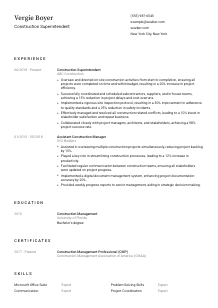
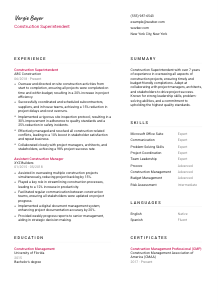
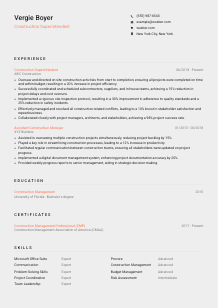
Building job sites, but your resume feels under construction? Check out this Construction Superintendent resume example, built with Wozber free resume builder. Learn how to blueprint your on-site expertise and leadership to match job specs, creating a career narrative as solid as the structures you oversee!
A Construction Superintendent resume has to show control of the jobsite, not just time spent in the field. Hiring teams look for people who can keep trades moving, hold schedule pressure without losing quality, manage daily site issues before they become delays, and maintain safe, code-compliant execution from mobilization through closeout. Your resume should make that operating range visible in plain terms.
The first pass often comes down to whether your project scope, site coordination experience, and construction tools are easy to match to the opening. Wozber's free resume builder helps you shape that experience into an ATS-compliant resume by aligning your wording with the posting and keeping the structure clean, so the reader can quickly see whether you can run the site, coordinate subcontractors, and deliver milestones without constant escalation.
Construction Superintendents work in environments where clear communication and local availability can matter immediately. Your personal details section should confirm who you are, how to reach you, and, when relevant to the posting, whether you already meet location expectations for site-based work.
Use your full name as the header and place the role title directly beneath it. If you are applying for a superintendent opening, use "Construction Superintendent" rather than a broad label like "Construction Professional" or an outdated title from a prior role. This gives hiring teams and ATS software an immediate role match before they read the rest of your project history.
List a working phone number and a professional email address you check regularly. Site leadership roles move fast, and interview scheduling often follows quickly when a resume matches active projects. Keep this section error-free and simple. A missed digit or unprofessional email can undercut an otherwise credible profile built on safety oversight, schedule management, and subcontractor coordination.
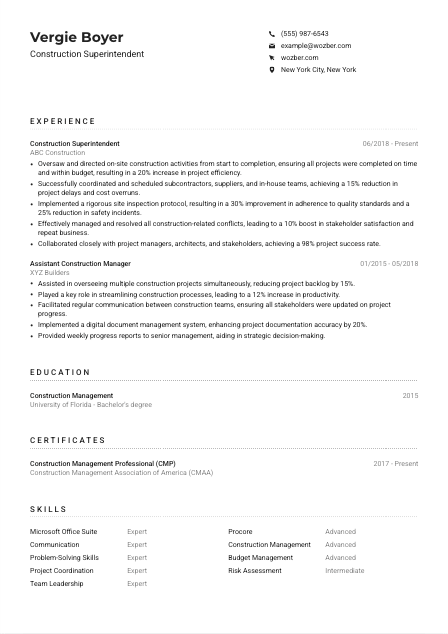
For site-based roles, employers may need someone already positioned for local codes, commuting reality, and on-site presence. If the posting specifies a location, reflect it clearly. In the example, listing "New York City, New York" directly answers a stated requirement. That does not make location essential for every superintendent resume, but when a posting names it, include it plainly.
Add LinkedIn or a professional website only if it strengthens your candidacy. For a Construction Superintendent, that might include project portfolio material, certifications, career progression, or recommendations tied to field supervision, scheduling, safety, or coordination with architects and project managers. Make sure those details match your resume in titles, dates, and project scope.
Do not include age, marital status, photo, or other non-job-related details. Keep the focus on information that supports site leadership hiring decisions: your title, contact details, and, if relevant to the opening, your location. This keeps the top of the resume clean and professional.
This section should confirm that you are reachable, professionally presented, and positioned for the role. For a Construction Superintendent, that means removing distractions and making the basics easy to verify before the reader moves into project delivery and field leadership.




Experience is where a superintendent resume either earns attention or blends into the pile. Hiring managers want to see how you handled live projects: keeping crews productive, coordinating trades, protecting schedule and budget, resolving field issues, and maintaining safety and code compliance under real jobsite pressure.
Before rewriting your bullets, identify the operating priorities in the job description. For this opening, the central themes are on-site supervision, subcontractor scheduling, site inspections, conflict resolution, and coordination with project managers and architects. Those priorities should shape which achievements you highlight and which older bullets you cut or rewrite.
List positions in reverse chronological order and emphasize titles that show growing responsibility on active projects. Construction Superintendent, Assistant Construction Manager, General Superintendent, or similar site leadership roles should be easy to spot. Include employer, title, and dates so the reader can follow your progression from support responsibilities into full site oversight.
Each bullet should show what you owned and what improved because of your work. Superintendent resumes are stronger when they connect actions such as coordinating subcontractors, running inspections, or resolving conflicts to outcomes like fewer delays, better safety performance, cleaner closeouts, or stronger schedule adherence. The example does this well by tying site coordination to a 15% reduction in delays and cost overruns, and inspections to better quality and fewer safety incidents.
Choose numbers that reflect how field performance is actually judged. Useful measures include schedule performance, change in project delays, cost control, safety incident reduction, inspection compliance, productivity gains, rework reduction, stakeholder satisfaction, or project completion rates. A line such as "completed projects on time and within budget" is stronger when paired with scope or results, as shown in the sample's 20% gain in project efficiency and 98% project success rate.
Keep the section centered on work that shows command of the site. Bullets about unrelated administrative tasks or generic team participation dilute the message unless they tie back to construction delivery. Even when your background includes broader project support, frame it around field operations, reporting cadence, document control, trade coordination, safety, or issue resolution that matters to a superintendent role.
Your experience section should leave no doubt that you can direct site operations, coordinate trades, and keep work moving under schedule, budget, and safety pressure. When the reader finishes this section, they should already have a clear picture of how you operate on a jobsite.
Education usually sits behind experience for a superintendent hire, but it still matters, especially when a posting asks for a specific degree. Present it clearly so employers can confirm the academic foundation behind your construction knowledge without having to search for it.
If the posting asks for a bachelor's degree in Construction Management or a related field, make that match obvious. Lead with your degree, field of study, and school. In the example, "Bachelor's degree, Construction Management" lines up cleanly with the employer's requirement and removes any guesswork during screening.
List degree, field, institution, and graduation year in a clean sequence. Construction hiring teams usually review this section quickly because they are mainly confirming qualifications rather than studying coursework in depth. A clear structure helps them move from education to the more decision-driving parts of the resume, such as project experience and software familiarity.
If you are early in your career, you can include coursework, capstone projects, or honors tied to estimating, scheduling, construction methods, safety, or project management. If you already have several years of site leadership experience, keep the section lean unless a specialization directly supports the role you are targeting.
Additional academic programs, trade-related coursework, or supervisory training can support your degree if they strengthen your fit for field leadership. This is especially useful when the role involves complex delivery methods, strict safety environments, or collaboration with architects and project managers across multiple phases.
A superintendent with 5+ years of relevant experience does not need a long education section. Let the degree confirm qualification, then give the space back to project results. For newer candidates, education can carry more weight, particularly when it includes construction-specific study that bridges into field supervision.
Your education section should quickly support the requirements of the role without competing with your project record. For a Construction Superintendent, that usually means a clean degree listing that backs up the field judgment shown in your experience section.
Certifications can strengthen a superintendent resume when they point to current professional standards, safety awareness, or construction management credibility. They are especially useful when they add something concrete beyond your degree and work history.
Review the posting for required or preferred credentials, then prioritize those first. This opening does not mandate a certification, but a relevant credential can still reinforce your profile. The sample's Construction Management Professional credential works because it supports the candidate's leadership background in construction delivery rather than feeling unrelated or decorative.
Focus on credentials that support the work of a superintendent, such as construction management, safety, scheduling, quality control, or software used in project administration. If you have training connected to Procore, OSHA standards, site safety, or project controls, those can be more valuable than generic professional development courses.
List the certification name, issuing organization, and date earned, plus renewal or active status when relevant. This matters most for credentials with expiration periods or continuing education requirements. Clear dates help employers see that your qualifications are current and maintained.
As your projects become larger or more complex, your certifications should reflect that progression. Updating this section with current safety, management, or technology credentials can support moves into larger commercial builds, multi-site oversight, or more demanding stakeholder environments.
The best certifications on a superintendent resume support how you run work in the field. They should add confidence in your construction knowledge, safety discipline, and management range, not simply fill space.
A Construction Superintendent needs a mix of field knowledge, coordination ability, and software fluency. Your skills section should read like the operating toolkit behind successful site execution, not a generic list of traits anyone could claim.
Read the job description closely and note both technical and supervisory requirements. Here, that includes Procore, Microsoft Office Suite, construction processes and methods, leadership, communication, and problem-solving. These are the exact skill areas the employer is likely to scan for first, both in ATS and during manual review.
A superintendent role is not purely technical and not purely managerial. Show both sides. Include construction management software, scheduling awareness, budget oversight, risk assessment, inspections, and understanding of means and methods alongside leadership, subcontractor coordination, communication, and conflict resolution. The sample skill set works best where it combines software and operational skills with team leadership and project coordination.
Choose skills that directly support superintendent work rather than listing every capability from your career. A shorter list built around field execution is stronger than a long inventory of vague strengths. If a skill would not help you run site operations, manage trades, maintain safety, or coordinate with project stakeholders, it probably does not belong here.
When this section is tailored well, it quickly confirms that you understand how projects move from plan to execution. The right mix of software, construction knowledge, and crew leadership makes your resume easier to match to superintendent openings.
Construction runs on constant communication between crews, subcontractors, project managers, inspectors, and clients. If a posting names language ability, your resume should state it clearly. Additional languages can also help when you work with diverse field teams or client groups.
When the job description calls for strong English competence, show your English level clearly in the languages section. Use an honest label such as "Native" or "Fluent." For this opening, that requirement is explicit, so English should not be buried or implied elsewhere.
If you speak additional languages, include them when they are relevant to the labor force, vendors, or client environment you commonly work with. In some markets and crews, bilingual communication can improve clarity during daily coordination, safety talks, and issue resolution. The example's Spanish entry supports that kind of practical value without overstating its necessity for every job.
Use clear levels such as Native, Fluent, Intermediate, or Basic. Overstating language ability can create problems quickly in a superintendent role, where misunderstandings around safety instructions, sequencing, or inspections carry real consequences. Keep the labels precise and defensible.
Not every superintendent role needs multilingual ability, but some do benefit from it. If your projects involve multilingual crews, public-facing stakeholders, or coordination across regions, language skills can be worth surfacing because they support smoother communication in the field.
Only include languages you can actually use in a work setting. On a construction resume, language skills matter when they help with crew direction, conflict de-escalation, stakeholder updates, or day-to-day coordination. That practical context is what makes the section useful.
For superintendent roles, language ability matters most when it helps you lead clearly and reduce friction on the jobsite. Keep the section honest and focused on communication that supports project execution.
The summary should quickly tell the reader what kind of Construction Superintendent you are. At this level, a generic introduction is wasted space. Use these lines to establish your years of experience, project leadership strengths, and the outcomes you are known for delivering in the field.
Start by identifying the few points the employer cares about most. In this job description, those are site oversight, schedule and budget control, subcontractor coordination, inspections, code and safety compliance, and stakeholder collaboration. Your summary should echo those priorities in natural language rather than trying to mention every skill you have.
Lead with a direct statement of identity and tenure, such as "Construction Superintendent with 7+ years of experience." This immediately frames your level. The sample does this well, and it works because it establishes experience before moving into execution strengths like timely, budget-conscious project delivery.
After the opener, name the areas where you consistently perform well. For a superintendent, that might be coordinating subcontractors, maintaining quality and safety standards, resolving site issues, or keeping projects on schedule. Choose strengths that connect to how projects are actually delivered, not broad traits without context.
A summary should be brief, but it still needs specifics. Mention outcomes such as on-time completion, budget control, safety discipline, or strong coordination with project managers and architects. Avoid generic claims like "results-driven professional" when you can state the result itself. Four to five lines is usually enough to establish your profile and lead the reader into the experience section.
A well-written summary makes your value clear before the first bullet point. Once you have it in place, use Wozber's AI resume builder and ATS-friendly resume template to keep the wording aligned with the posting and the format easy to scan. The result should make one thing clear quickly: you can take responsibility for site execution and keep a construction project moving.
A Construction Superintendent resume should show more than tenure. It should make your command of schedule, subcontractor coordination, inspections, safety standards, and stakeholder communication easy to recognize in a fast review.
Use the job description to guide what you emphasize, then refine the wording with Wozber's free resume builder, ATS resume scanner, and ATS-friendly resume format so your experience aligns cleanly with the opening. When the tailoring is done well, hiring teams can quickly see whether you are ready to lead the site from kickoff to closeout.




